

Japan uneasy despite Nikkei's record high…"Truss shock may occur"
Summary
- Although Japan's Nikkei 225 index reached a record high, it reported that expectations for the next prime minister's fiscal expansion policy and concerns over a surge in government bond yields are being highlighted simultaneously.
- It said that if former minister of economic security Sanae Takaichi comes to power, according to 'Sanaenomics' inheriting Abenomics, defense and real estate stocks have been strong while finance and bank stocks have been weak.
- It reported that with rising government bond yields, the burden of national debt, and persistent inflation, there is a possibility of market turmoil similar to the UK's Truss government.
Prime minister election on the 4th of next month…high inflation and other problems pile up
Expectations of fiscal expansion push up the stock market
Takaichi ahead in next prime minister support ratings
Expectations for 'a second Abenomics' revival
Burden of inflation and sharp rise in government bond yields
10-year yields soar to an annual 1.6%
Next year's government bond interest alone 13 trillion yen 'pressure'
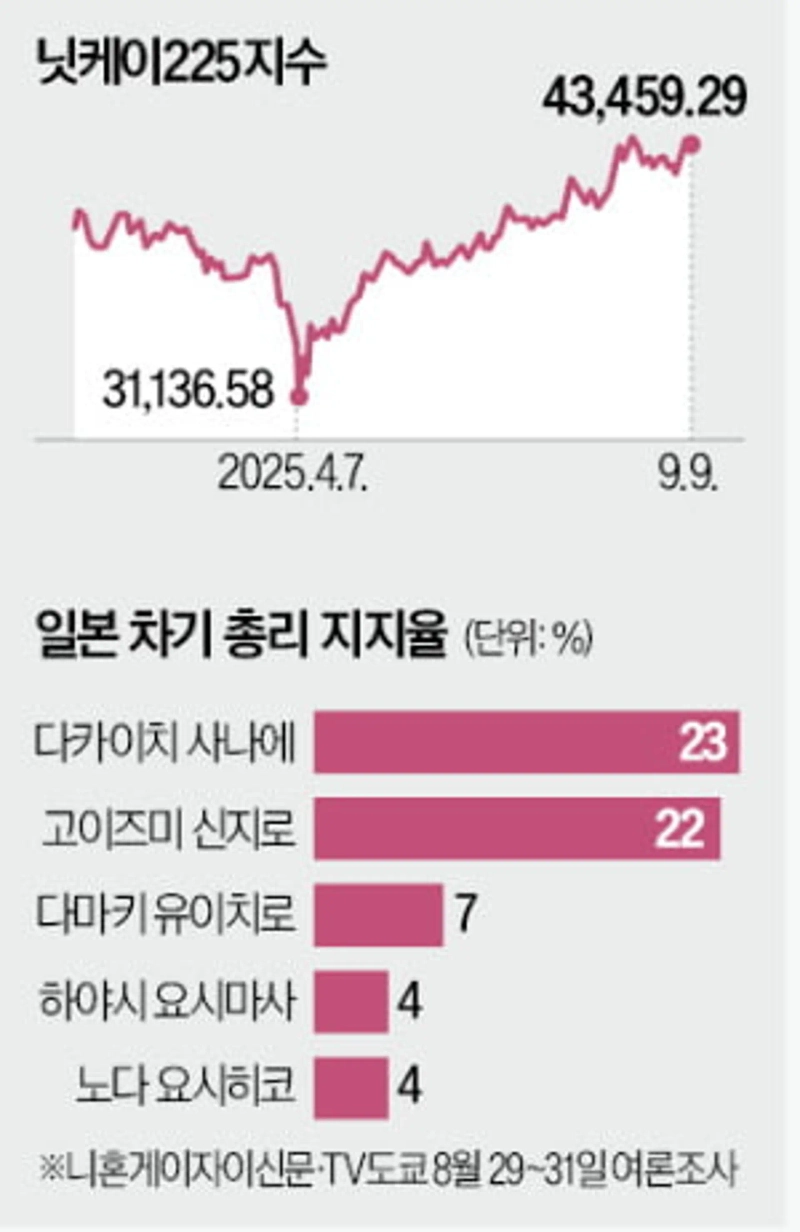
Japan's Nikkei 225 index surpassed the 44,000 mark during trading on the 9th and hit a record high. Expectations that the next government will implement bold fiscal expansion policies after Prime Minister Shigeru Ishiba's resignation acted as a positive factor. In the bond market, concerns have also emerged that a 'Truss shock'—in which government bond yields surge and the yen plunges, as during Liz Truss's government in the UK—could occur.
◇ Expectations for 'Sanaenomics' grow
On the day, the Nikkei index at one point in the morning rose to 44,185, setting a record high. From the afternoon, profit-taking increased and the index closed down 0.42% at 43,459. The rise over the past four trading days is 3.6%. Japan's stock market price-earnings ratio (PER) exceeded 18 times for the first time.
It is analyzed that buying of stock index futures intensified after Prime Minister Ishiba announced his intention to resign on the 7th. "Macro hedge fund money is flowing in on a large scale on the change of government," said Masatoshi Kikuchi, chief strategist at Mizuho Securities.
In securities circles, there are expectations that if Sanae Takaichi, the former minister of economic security who is being strongly mentioned as the next prime minister, takes power, she will reenact Abenomics through an aggressive economic stimulus policy. Takaichi is seen as the figure who most clearly inherits former Prime Minister Shinzo Abe's political philosophy, and she is promoting 'Sanaenomics', which develops Abenomics. Her stance is cautious about raising the policy rate, and she aims to rebuild a "strong Japan" through bold monetary easing and full-scale investment in defense and advanced technology sectors. Following her policy stance, on the Tokyo market that day defense and real estate stocks were strong while finance and bank stocks fell, producing a 'Takaichi trade' phenomenon.
Shinjiro Koizumi, minister of agriculture, forestry and fisheries, who is competing with Takaichi in opinion polls, is also pursuing a growth-oriented line through reforms such as labor market reform. Japan's economic situation is not favorable enough for the next prime minister to pursue aggressive fiscal expansion. The national debt situation is so serious that next year alone it must pay 13 trillion yen (about 123 trillion won) in government bond interest. Japan's 10-year government bond yield has surged from an annual 0.9% when Prime Minister Ishiba took office last October to the current annual 1.6% range.
Continuing inflation is also a burden. Rice prices briefly eased due to the release of government stockpiles but have started rising again, and the consumer price index's rate of increase has exceeded 3% for eight consecutive months. Sayuri Kawamura, senior researcher at the Japan Research Institute, pointed out, "If the next administration pursues a fiscal expansion line, bond yields could skyrocket as they did during the Liz Truss government in the UK."
◇ Takaichi and Koizumi lead in opinion polls
The ruling Liberal Democratic Party decided to hold the leadership election to decide Ishiba's successor using the 'full-spec method', in which Diet members and party members/supporters vote. The Nikkei reported that the voting and counting date was set for the 4th of next month.
The full-spec method involves 295 LDP members from the House of Councillors and House of Representatives and 1 million party members/supporters. Under the full-spec method, party member/supporter votes are converted into the 295 parliamentary votes and then allocated to each candidate based on the vote percentage. For example, if a candidate records 20% in the party member vote, they receive 20% of 295 votes, i.e., 59 votes.
In Japanese politics, because Prime Minister Ishiba resigned midterm, there were remarks that the simplified method, in which only incumbent lawmakers and party branch representatives participate, would be more appropriate than the time-consuming full-spec method. However, the LDP unusually chose the full-spec method. "Because this is a presidential election that affects the party's ups and downs, it is desirable to widely reflect the voices of party members and supporters," said Shun'ichi Suzuki, LDP secretary-general. In a poll released the previous day by JNN, affiliated with private broadcaster TBS, former minister of economic security Takaichi and minister of agriculture, forestry and fisheries Koizumi each received 19.3%, tying for first place.
Mansu Choi reporter bebop@hankyung.com

Korea Economic Daily
hankyung@bloomingbit.ioThe Korea Economic Daily Global is a digital media where latest news on Korean companies, industries, and financial markets.