

KOSPI short-selling balance 11.109 trillion won…coin and battery stocks targeted
Summary
- Reported that the domestic stock market's short-selling balance reached 11.109 trillion won, the highest level this year.
- Notably, the short-selling proportion increased significantly for stablecoin and secondary battery-related stocks.
- Said that the valuation burden of stocks that have surged and the market's uncertainty are the background for the increase in short selling.
Increased by 1.215 trillion over a month, highest this year
Kakao Pay·EcoPro etc. concentrated
As trapped in a trading range, bets on declines increase
The short-selling balance in the domestic stock market reached the highest level so far this year. Uncertainty over whether the U.S. benchmark interest rate will be cut and the KOSPI index's range-bound movement appear to have combined to increase investors betting on stock price declines.
According to the Korea Exchange on the 9th, as of the 4th, the net short-selling balance in the KOSPI market was 11.109 trillion won. It is the largest this year. Over the past month alone it increased by 1.215 trillion won (12.28%). The short-selling balance in the KOSDAQ market was also 4.126 trillion won, up 3.23% over the same period.
The ratio of short-selling balance to total listed shares is 0.42% in the KOSPI market and 0.97% in the KOSDAQ market, approaching year-to-date highs. Short selling is a method in which borrowed shares are sold first, and if the stock price falls, they are bought back at a lower price to gain a profit. An increase in the short-selling balance means that investor sentiment expecting a decline is strong.
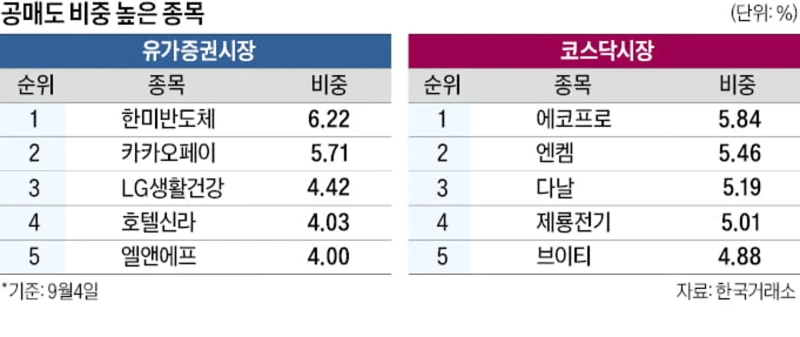
By stock, short-selling balances in stablecoin and secondary battery-related shares increased significantly. In the KOSPI market, Kakao Pay's short-selling balance as a proportion of market capitalization surged from 2.33% (17th) last month to 5.71% (2nd) this month. Kakao Pay had been viewed as a promising stablecoin candidate, but the issuance of exchangeable bonds (EB) by its second-largest shareholder Alipay increased pressure on the stock price. LG Household & Health Care also saw its short-selling proportion rise from 3.12% (8th) to 4.42% (3rd) due to uncertainty in the Chinese market and concerns over weak duty-free sales. Meanwhile, SKC, which ranked 2nd in short-selling proportion last month, fell out of the top 10 amid expectations of entering the glass substrate business.
In the KOSDAQ market, EcoPro, a leading secondary battery stock, recorded a short-selling proportion of 5.84%, ranking first. It rose 0.88 percentage points from a month earlier. Enchem also increased its proportion from 3.96% to 5.46%, jumping from 9th to 2nd. Secondary battery material company PNT (4.24→4.57%) also ranked high. Daeju Electronic Materials (4.34%), which produces anode materials for secondary batteries, newly appeared in the rankings.
Payment solution specialist Danal also faces high short-selling demand. Expectations that it will expand its stablecoin business have pushed it up more than 190% this year, increasing valuation (stock price level relative to earnings) pressure. Bio stock HLB became a short-selling target after the U.S. Food and Drug Administration (FDA) deferred its decision on approval of a liver cancer treatment.
Reporter Jo Ara rrang123@hankyung.com

Korea Economic Daily
hankyung@bloomingbit.ioThe Korea Economic Daily Global is a digital media where latest news on Korean companies, industries, and financial markets.