

CertiK holds regulatory and security workshop in Korea…discusses stablecoins
Summary
- CertiK said that at the workshop held in Korea it focused on stablecoins, regulatory frameworks, and future Web3 trends.
- CTO Kang Li emphasized the importance of proof of reserves, transparency, standardization, and audit cycles when adopting stablecoin projects, and said regulatory compliance can be proven mathematically.
- Lawyer Jin Hyun-su predicted that domestic Web3 regulation will become more granular and that tailored regulations for stablecoins and DeFi will be specified.
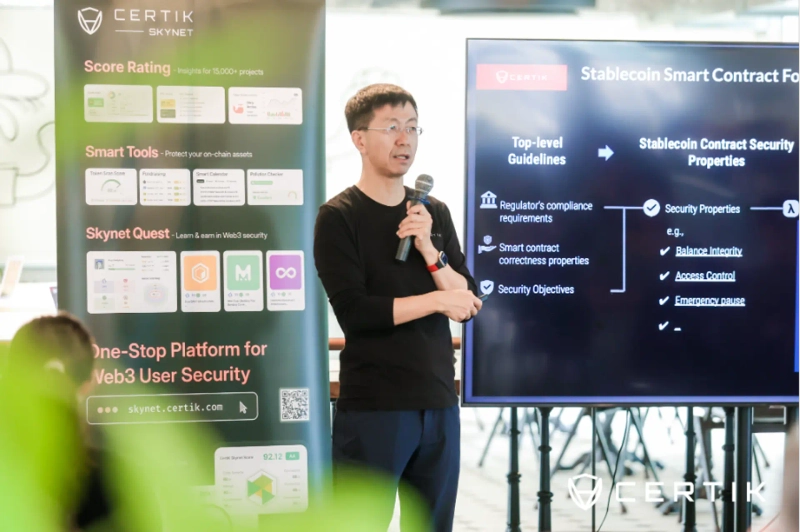
Global Web3 security firm CertiK held a workshop in Korea on virtual asset regulation and security.
CertiK said on the 23rd that it held the "CertiK Espresso" workshop in Seoul on the 22nd to coincide with "Korea Blockchain Week (KBW) 2025." The workshop, held on security and compliance in the virtual asset sector, was attended by domestic and international industry officials and investors. CertiK said, "In-depth discussions were held focusing on stablecoins, regulatory frameworks, and future Web3 trends."
Kang Li (Kang Li), CertiK Chief Technology Officer (CTO), emphasized at the workshop that security and compliance are "not mere supplementary elements but the core foundation of (stablecoin) projects." Kang Li, CTO, said, "(Stablecoins) must go through business design, key infrastructure building, and licensing acquisition from design to actual implementation," and explained, "After stablecoin adoption, there are risks in three areas: assets, operations, and blockchain." He added, "In asset risk management, four things are key: proof of reserves, transparency, standardization, and audit cycles," and said, "When supporting stablecoin projects, CertiK ensures the consistency of reserves and circulating supply and helps build standardized asset management processes to prevent trust risks."
"Regulatory compliance, mathematically provable"
He also mentioned technology that can prove regulatory compliance through mathematical logic. Kang Li, CTO, said, "Existing regulatory reviews have mainly relied on human evaluation," and added, "(However,) through 'Formal Verification' it is possible to prove with mathematical logic whether a stablecoin project meets regulatory requirements." He noted, "This kind of 'mathematical level of rigor' is a core value currently drawing the attention of regulatory agencies."
The workshop also featured a discussion on domestic Web3 regulation with Jin Hyun-su, a lawyer at Decent Law Office. In the discussion, Jin said the biggest challenge for Korean companies is the 'differentiated regulatory burden.' He explained that there are large differences in regulations applied by institutions such as exchanges and foundations, so companies must cope with gaps between authorities' expectations and actual enforcement standards.
Jin predicted that domestic Web3 regulation will be further subdivided over the next two to three years. He said, "It is highly likely that an institutional framework related to stablecoins will be established," and "Customized regulations targeting exchanges, DeFi protocols, etc., will be gradually specified." Jin added, "The importance of establishing local subsidiaries is growing," and noted, "The existing 'offshore structures' are trending toward 'onshore entities.'"
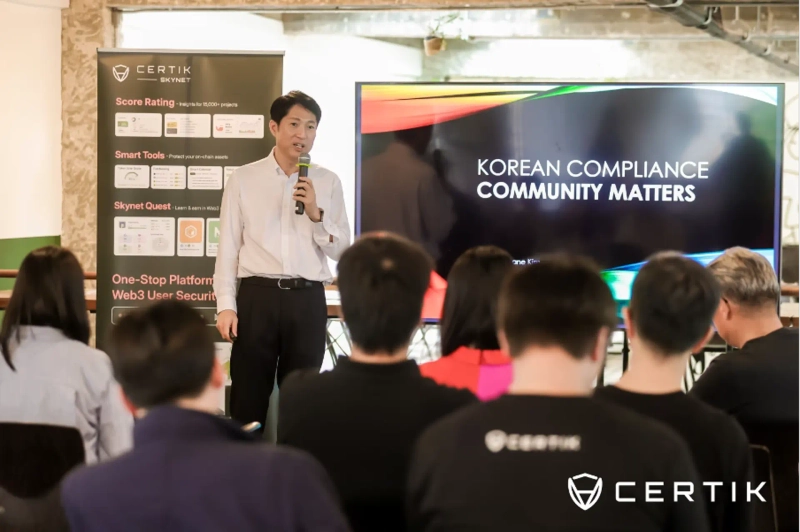
WEMIX: "Reflecting community feedback in operational strategy"
There was also a presentation by Kim Seok-hwan, CEO of the WEMIX Foundation. Kim said, "Single language and cultural homogeneity, high education levels and a competitive social atmosphere, and a background that allows rapid information diffusion make the Korean Web3 market unique," and added, "These particularities have formed an analytical user base with high technology acceptance." He continued, "In Korea, diverse information is shared in online communities, influencing public opinion and policy formation," and "Especially in the Web3 field, where clear legal frameworks are often lacking, community-raised issues frequently lead to investigations or regulatory moves."
He also mentioned WEMIX's mode of operation. Kim said, "When launching new services or setting operational strategies, we first reflect community feedback and connect it to compliance and product design," and stated, "For global Web3 companies entering the Korean market, the community is an element that cannot be neglected."
CertiK plans to strengthen collaboration with domestic virtual asset firms such as KAIA and WEMIX. To target the domestic market, it will also expand the functions of its Korea office. A CertiK official said, "While providing global-level security technology to Korean projects, we are actively recruiting local talent to balance technological suitability and market proximity," and added, "We will continue to strengthen our strategic position in Korea."
Hankyung.com Newsroom open@hankyung.com

Bloomingbit Newsroom
news@bloomingbit.ioFor news reports, news@bloomingbit.io