

PiCK
SKALE Labs Aims to End the On-Chain 'Fee Wars,' Expanding Into AI and Institutional-Grade Blockchain Infrastructure [Engineered: Profiles in Blockchain Architecture]
Summary
- Scale Labs said it will officially launch the privacy L1 'FAIR' applying the PoE consensus algorithm early next year to structurally block fee wars such as MEV.
- It plans to accelerate entry into on-chain gaming, DeFi, and token economy markets with infrastructure that provides privacy enhancements for AI and institutional investors, high-speed transactions, and cutting-edge cryptographic technologies.
- It said it expects improvements to the token economy through the introduction of an SKL token burn model, reducing circulating supply and easing selling pressure.
Jack O'Holleran, SKALE Labs CEO Interview
Fee-competition-blocking consensus algorithm 'PoE'
Targeting institutions and AI with privacy L1 'FAIR'
Also improving game and token economy based on burn model

"SKALE Labs is determined to end the blockchain's 'pay-more-to-go-first' fee race. With FAIR, a high-performance Layer 1 network built with institutional-grade privacy, we're targeting the AI and enterprise markets while continuing to strengthen the SKALE Network's gaming ecosystem and token economy."
Jack O'Holleran, CEO of SKALE Labs, said this in an interview with Bloomingbit on October 21.
In the interview, O'Holleran spoke in detail about SKALE Labs' vision for its blockchain ecosystem — including its new Layer-1 network "FAIR," plans to enhance token economics through SKL fee-burning, and upcoming blockchain-based gaming projects in partnership with major sports leagues.
"FAIR Embeds Privacy Into Consensus With PoE…'FAIR' mainnet launch imminent"
SKALE Labs plans to officially launch its new Layer-1 blockchain, FAIR, in the coming months. FAIR is designed to complement the existing SKALE Network, offering specialized infrastructure for AI agents, institutional investors, and stablecoin-based payments. At the heart of FAIR lies a novel consensus algorithm known as PoE (Proof of Encryption).
To understand why SKALE Labs calls PoE a "game-changer," one must first look at a long-standing problem in blockchain systems — the transaction-ordering profit race, often known in the industry as Miner Extractable Value (MEV). In most blockchains, pending transactions are visible to validators before they are finalized, allowing some participants to reorder or front-run them for extra profit — a structural issue that traditional finance mitigates through regulation and market controls, but which persists on-chain.
Market observers often compare this to a taxi line: a latecomer offers a higher fare to jump ahead in line, while the original passengers end up waiting longer. On blockchains, the same pattern emerges — users who pay higher fees can have their transactions processed first, disadvantaging those who paid less. This dynamic underpins notorious tactics such as front-running and sandwich attacks, which exploit users' pending trades for profit.
PoE aims to eliminate this behavior at the root. Under FAIR's architecture, every transaction is processed inside an encrypted "sealed envelope" from the very first step. Validators and block producers cannot inspect or reorder the contents before inclusion, making it cryptographically impossible to manipulate transaction order or front-run pending trades. In essence, PoE hard-codes fairness into the blockchain's consensus itself.
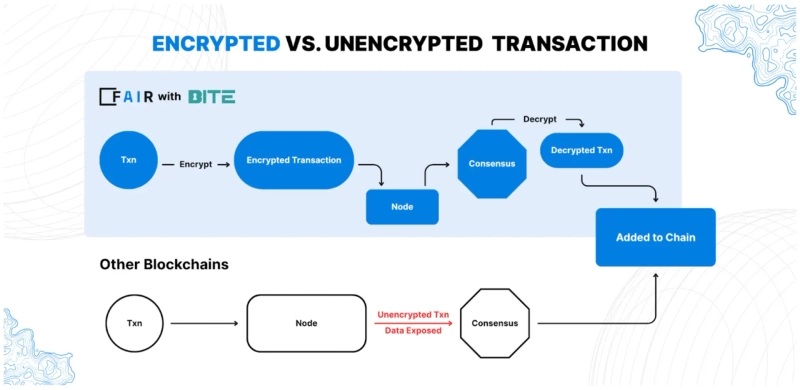
PoE processes every transaction in encrypted form from the very beginning, embedding privacy structurally at the consensus layer itself. This design ensures that participants' financial data and transfer details remain confidential, enabling institutional investors and payment providers to maintain the same level of privacy as traditional financial networks. In essence, PoE goes beyond merely ensuring fairness — it establishes a security and confidentiality framework comparable to conventional finance, overcoming the long-standing privacy limitations of existing blockchains through technical innovation.
O'Holleran stated, "The FAIR testnet built on Proof-of-Encryption (PoE) is currently underway, and we're targeting a mainnet launch by the end of this year or early next." He emphasized, "By officially launching an encrypted Layer-1 network, we aim to establish a competitive edge in both the institutional and blockchain development markets."
The BITE (Blockchain Integrated Threshold Encryption) protocol serves as the core consensus mechanism of the FAIR network — a direct implementation of the previously theoretical PoE model — effectively functioning as the "heart" that processes real transactions.
"A Core Infrastructure for Institutional, AI, and DeFi Adoption"
O'Holleran emphasized that FAIR, powered by PoE, is designed to provide an institutional-grade trading environment while also handling the scale of AI-driven and micropayment transactions.
FAIR integrates advanced cryptographic systems such as BLS signatures, threshold encryption, distributed key generation, and Trusted Execution Environments (TEEs).
The architecture can be understood through a simple metaphor: imagine sending a locked, encrypted letter. The network delivers the message quickly, but the contents remain unreadable during transit. Instead of storing the decryption key in one place, the key is split into multiple fragments, each held by different participants and secured in isolated enclaves—making unauthorized access virtually impossible. Validators, acting as couriers, can confirm that the envelope is valid and properly formatted, but they cannot open or read it—ensuring transaction privacy at the protocol level.
"Traditional blockchains allowed a handful of node operators to monopolize access to transactional information, which discouraged institutional participation," O'Holleran explained. "FAIR implements a privacy framework similar to traditional finance, enabling institutions to participate in a familiar, secure, and compliant environment."
He continued, "In today's stablecoin systems, anyone can view the balance of the recipient's wallet. While this transparency can be useful, it also exposes sensitive financial data. FAIR removes this friction by ensuring that transactions remain private yet still execute in fair and verifiable order. This enables accurate on-chain functions like limit orders, index rebalancing, and DeFi protocols to operate without distortion."
O'Holleran added that the AI sector is increasingly interested in privacy-preserving blockchains. "A typical individual might make 5–10 transactions a month, but an AI agent could execute thousands a day," he said. "Even a 2% slippage per transaction would devastate profitability—MEV losses are far more damaging to AI agents than to human traders. That's why developers in the AI ecosystem are paying very close attention." He predicted that "AI agents will soon become the largest users of both FAIR and SKALE chains."
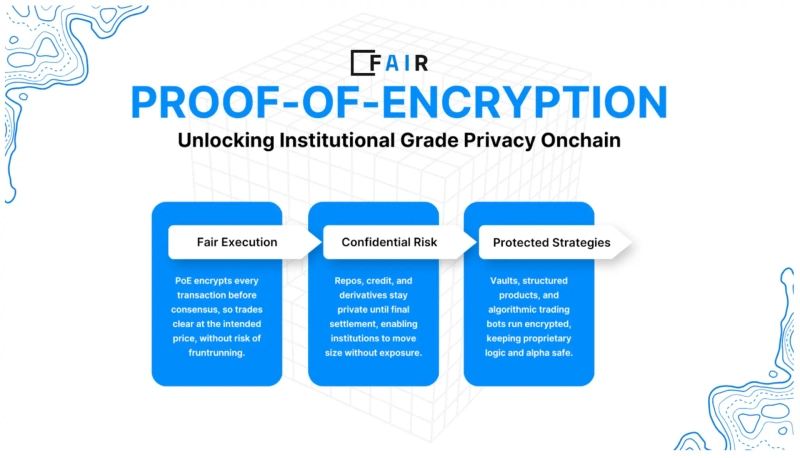
Despite its high level of encryption, FAIR maintains exceptional processing speed. Built with a C++-based high-speed Ethereum Virtual Machine (EVM) rather than the traditional Go implementation, FAIR achieves significantly greater computational efficiency. Its consensus protocol has also been optimized to provide instant transaction finality, combining security and speed without compromise.
"Major Gaming Partnerships and a Token Burn Model Signal the Next Phase of SKALE's Growth"
SKALE Labs is also preparing a major shift across its blockchain gaming and token economy initiatives. The company is developing a large-scale gaming title in partnership with leading sports leagues, while also moving toward introducing a network fee burn model aimed at strengthening the long-term value of the SKL token.
"In blockchain gaming, we still haven't seen a true 'killer app' that reaches mainstream audiences," said O'Holleran. "Most Web3 games today cater primarily to crypto enthusiasts, but we're now building a flagship game with major sports IPs—something that everyday players can access as easily as traditional titles."
He noted that while blockchain gamers currently number between 30–40 million, the global gaming population exceeds 3 billion, adding that "as higher-quality titles and recognizable IPs emerge, mainstream adoption will accelerate rapidly."
Among the existing gaming ecosystems, Nebula, a gaming network built on the SKALE Chain, stands out as one of the most active in the industry. It has recorded more than 692 million transactions and over 51.9 million unique wallets to date. "Nebula is a great example—over 100 games connect wallets daily," O'Holleran explained. "With predictable monthly chain operating costs of just $500–$1,000, developers can build at scale with stable, transparent pricing."
Meanwhile, the SKALE Network is also pursuing the introduction of an SKL token burn model. Under the current system, game studios and project developers purchase SKL tokens to pay chain usage fees, allowing end users to play without paying separate transaction costs. The new proposal would burn a portion of the SKL paid by service providers, reducing overall supply.
"At present, all network fees are distributed to validators," said O'Holleran, "but a proposal is being introduced to burn a set percentage of those fees instead. The goal is to enhance the sustainability of SKALE's token economy."
The plan is expected to be discussed in the SKALE community forum soon, with a governance vote to follow if sufficient support is reached. If implemented, the burn model could help reduce selling pressure by lowering circulating supply—a move many see as a net positive for the broader SKL economy.
"Korea Holds Strong Potential in Blockchain-Powered Payments Tied to Hardware"
O'Holleran noted that South Korea has one of the highest per-capita digital asset ownership rates in the world, positioning it as a key market for blockchain innovation.
He highlighted particularly strong potential in gaming, banking, stablecoin-based payments, and machine-to-machine (M2M) microtransactions.
"If blockchain-based micropayments were to be embedded directly into globally distributed hardware—like Samsung devices found in nearly every household—it would open up an enormous opportunity," he said. "SKALE Labs views Korea as a strategically important market and believes the country is well-positioned to lead this new phase of blockchain-powered commerce."
Kang Min-seung, Bloomingbit Reporter minriver@bloomingbit.io

Minseung Kang
minriver@bloomingbit.ioBlockchain journalist | Writer of Trade Now & Altcoin Now, must-read content for investors.