

Lee Chang-yong says "I'm afraid" of stablecoins…"Concerns about exchange-rate volatility and capital outflows"
Summary
- Lee Chang-yong, governor of the Bank of Korea, said he is most concerned about exchange-rate volatility and capital outflows if a won stablecoin is introduced.
- The governor said a won stablecoin could accelerate domestic investors' overseas investment more than foreign investment inflows, posing risks to the economy.
- The governor emphasized that depegging risk is not completely resolved by DLT and that a bank-centered, gradual approach to introduction is needed.
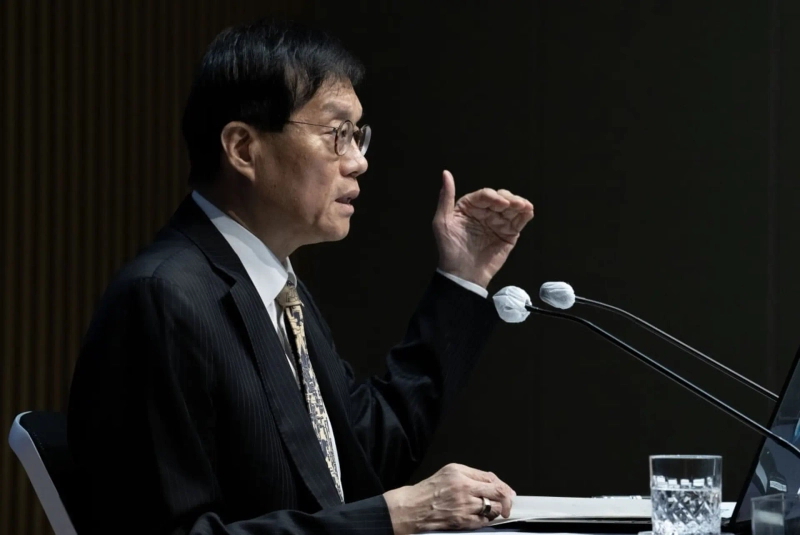
"I am actually afraid. If a won stablecoin is simply introduced, I am worried about exchange-rate volatility and capital outflows in the foreign exchange market."
Lee Chang-yong, governor of the Bank of Korea, said this on the 29th while attending the National Assembly Strategy and Finance Committee's parliamentary audit, responding to a question from Ahn Do-geol of the Democratic Party emphasizing the necessity of a won stablecoin. When Ahn explained that most of the seven risks raised in the Bank of Korea's "Stablecoin White Paper" could be resolved, the governor said, "Among the seven issues, capital outflows are the most worrisome."
The Bank of Korea earlier presented risks of stablecoins in a report published on the 27th, including ▲depegging (value-peg mismatch) risk ▲threats to financial stability ▲gaps in consumer protection ▲undermining the principle of separation between finance and industry ▲circumvention of foreign exchange regulations and risk of capital outflows ▲weakening of monetary policy effectiveness ▲weakening of financial intermediation functions.
The governor's answer continued for about three minutes. He explained, "Compared with the foreign investment coming in, four times as much is going out (as domestic investors' overseas investment)," and "Although the current account is recording an unprecedented surplus, the exchange rate is rising for this reason."
The governor thinks that if a won stablecoin is issued, this trend could accelerate. He pointed out, "If we create a won stablecoin, foreigners could buy it to buy our goods, but on the other hand many people in our country would take the stablecoins abroad," and "In a situation where the places to use it are uncertain, those who would use won stablecoins first are likely to be people who have an incentive to take their assets overseas."
He added, "From the standpoint of the foreign exchange authorities, the introduction of a won stablecoin would be very concerning in terms of exchange-rate volatility and capital outflows," and asked, "Please review this again."
The governor also did not agree with the view that without a won stablecoin, dollar stablecoins would dominate the won payment market. He cited the reason, "Our monetary policy is not shaken like Argentina or Turkey (Türkiye)." He also said, "Introducing a won stablecoin will not prevent the incursion of dollar stablecoins," and "We need to make more efforts to regulate dollar stablecoins."
However, he agreed with the idea that "innovation is necessary," and emphasized, "Let's try it centered on banks first, and if the foreign exchange outflows are controlled, then expand it sequentially."
When Democratic Party lawmaker Kim Young-jin asked for a solution to the depegging phenomenon where a stablecoin's value falls below $1, the governor explained, "Our view is that DLT (distributed ledger technology) cannot completely solve it," and "We do not want to make definitive statements until the technology is fully secured."
Kang Jin-kyu, reporter josep@hankyung.com

Korea Economic Daily
hankyung@bloomingbit.ioThe Korea Economic Daily Global is a digital media where latest news on Korean companies, industries, and financial markets.