

Editor's PiCK
Ruling party tightens grip on Digital Assets Basic Act… “Bank-centric approach will stifle innovation”
공유하기
Summary
- The Democratic Party of Korea said it had reaffirmed its stance that it cannot accept a bank-centered stablecoin issuance framework under the Digital Assets Basic Act.
- The ruling and opposition parties and the industry raised issues including a bank monopoly over stablecoins, a 15–20% cap on major shareholders’ stakes in crypto exchanges, and misalignment with global standards.
- Industry and experts warned the regulations could lead to innovative firms being reduced to subcontractors, a pullback in bold investment, and weakened industrial competitiveness.
Democratic Party Digital Assets TF forum
A string of criticisms of the FSC’s government bill
Ruling party: stance that regulators’ policy is “unacceptable”
Ahn Do-geol: “The door should be opened to non-banks as well”
Industry pushes back: “We’ll be reduced to banks’ subcontractors”
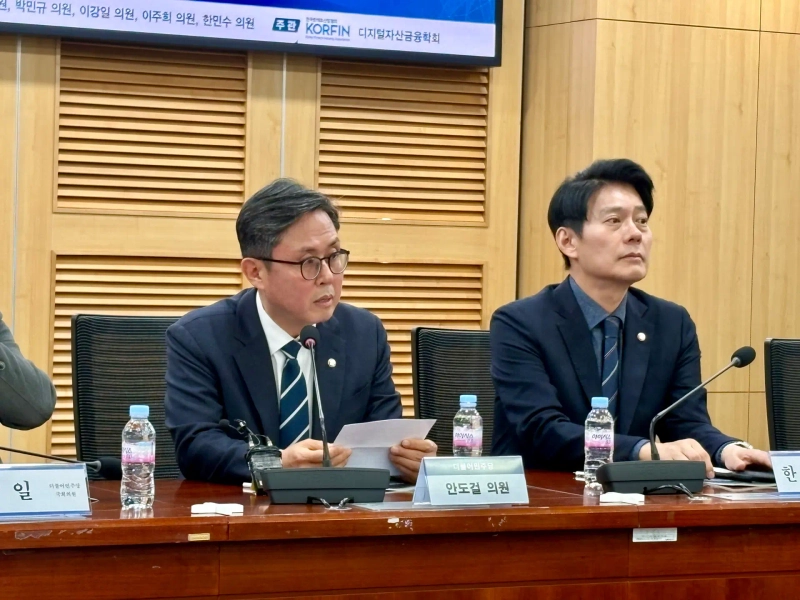
The Democratic Party of Korea said it is difficult to accept regulators’ position on key issues surrounding the Digital Assets Basic Act. Industry backlash is also growing over regulators’ policy, including restricting stablecoin issuers to those centered on banks.
Rep. Ahn Do-geol of the Democratic Party of Korea attended the forum titled ‘A Turning Point for Innovation Opened by Institutionalizing Digital Assets,’ held on the 16th at the National Assembly Members’ Office Building in Seoul, and said, “Bank-centered stablecoin issuance will stifle innovation.” Rep. Ahn serves as secretary of the party’s ‘Digital Assets Task Force (TF),’ launched in September last year. TF lawmakers including Reps. Lee Kang-il and Han Min-soo of the Democratic Party of Korea also attended the event.
His remarks appear to have been directed at financial authorities’ policy. The Financial Services Commission (FSC) is known to have recently told the National Assembly that stablecoin issuers should be limited primarily to banks (50%+1 share ownership). This reflects partial acceptance of the Bank of Korea’s view that, in the early stage of fostering the stablecoin industry, priority should be placed on market trust and stability.
“Not aligned with global standards”
The Democratic Party, however, believes the door should be opened to non-bank players such as fintech firms. The party has maintained this position since the early stages of discussions on enacting the Digital Assets Basic Act last year. Rep. Ahn said, “A more desirable direction is an open consortium in which banks handle trust and stability, while non-financial firms such as fintech companies take charge of innovation and growth.” In effect, the party is maintaining that it cannot accept the regulators’ policy.
He also addressed the contentious issue of limiting major shareholders’ stakes in crypto exchanges. In the government’s draft of the Digital Assets Basic Act being prepared by the FSC, a plan to cap major shareholders’ stakes at 15–20% is reportedly being seriously considered. Rep. Ahn said, “(An exchange) is a kind of market infrastructure and also has a public-good character, so I sympathize with the underlying awareness that there should be an upper limit on ownership,” but added, “(However) imposing a cap on ownership creates issues such as side effects in attracting investment and misalignment with global standards.”
The Democratic Party is not alone in opposing the policy. Rep. Kim Sang-hoon of the People Power Party, who chairs the party’s Special Committee on Stocks and Digital Assets Value-Up, recently voiced opposition to limiting major shareholders’ stakes, saying, “Forced ownership dispersion can blur accountability and accelerate capital outflows overseas.” Rep. Kim said, “The government has consistently shown a hesitant attitude toward revitalizing the (crypto) market, citing anti-money laundering (AML) and other reasons,” and added, “We need to look back at what it means for the current market to restrict the private sector’s achievements through administrative regulation.”
Industry: “We’ll be reduced to banks’ subcontractors”
Industry backlash is also intensifying. Ryu Hong-yeol, CEO of B-DAX, said at the forum following the opening remarks by Democratic Party lawmakers, “Risks related to stablecoins do not stem from the issuer’s industry or nature.” B-DAX is a domestic crypto custody firm that completed a technology verification for a won-denominated stablecoin last year.
Ryu emphasized, “Under the government plan, innovative companies will be reduced to banks’ technology subcontractors.” He said, “If issuers are limited to banks, banks will ultimately monopolize the market and control every process—issuance, distribution, payments, and settlement,” adding that “it could result in effectively binding the stablecoin industry to the banking industry.” He continued, “The crypto market changes and develops quickly, so even if entry by non-financial firms is allowed later, competition will already be over,” and added, “This goes beyond a stability issue and is highly likely to be interpreted as excessive structural control over the private technology industry.”
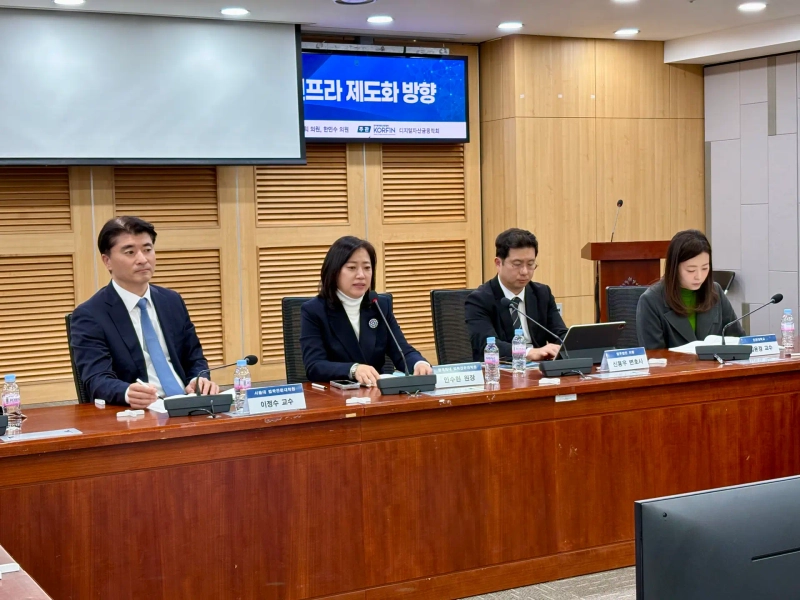
At the forum, a series of criticisms were also raised over the cap on major shareholders’ stakes in exchanges. In particular, analysts warned that the measure could become a “Galapagos regulation” due to low consistency with policies in major economies such as the United States and the European Union (EU). Prof. Kim Yoon-kyung of Incheon National University said, “Major countries such as the U.S., the EU, and Japan implement fit-and-proper regulations for shareholders and executives of (stablecoin) related businesses, but it is hard to find any precedent for a cap on major shareholders’ stakes,” adding, “Artificial ownership dispersion regulations could weaken not only corporate competitiveness but also industrial competitiveness and the national innovation ecosystem.”
Concerns: “Bold investment will become difficult”
Concerns were also raised about the regulators’ position that crypto exchanges should be subject to regulations equivalent to those for alternative trading systems (ATS). Attorney Shin Yong-woo of Jipyeong LLC said, “The Korea Exchange and ATS compete in a limited way within Korea’s Capital Markets Act, but crypto exchanges compete in a global market,” adding that “(crypto exchanges) are fundamentally different in terms of functions and risk-sharing, as well as technological and commercial aspects.”
Shin added, “While the crypto market is changing rapidly on new technologies, if (a major shareholder) holds only a 15% stake, swift decision-making and bold investment could become difficult,” and said, “There is also a need to verify whether dispersing governance is effective from the perspective of user protection.”
Meanwhile, the Bank of Korea and the FSC, which had been scheduled to attend the forum, did not participate, citing scheduling reasons. Some observers believe financial authorities may be reluctant to appear in public amid recent controversy surrounding the government’s draft of the Digital Assets Basic Act.

![[Analysis] “Bitcoin could rise to $113,000 if it regains $98,000”](https://media.bloomingbit.io/PROD/news/bcc9f1a2-24d8-4297-9adf-ca3aee26e2ff.webp?w=250)


![CPI comes in strong…Bitcoin holds $95,000; Ethereum breaks above $3,300 [Lee Soo-hyun’s Coin Radar]](https://media.bloomingbit.io/PROD/news/5a7d8cdd-3c2a-41f0-b182-f172a9629d64.webp?w=250)