Editor's PiCK
Powell’s choice to safeguard ‘Fed independence’… Will he remain a governor even after his chair term ends? [Fed Watch]
공유하기
Summary
- Wall Street said that the stronger President Trump’s pressure for rate cuts becomes, the more likely Chair Powell is to retain his Fed governor seat to protect the Fed’s independence.
- The prediction-market platform Kalshi prices the probability that Powell leaves the Fed before August 2026 at 70%, suggesting markets still see an early exit as more likely.
- Wall Street and economists said that the stronger President Trump’s attempts to intervene in monetary policy become, the more it could lead to the current FOMC members remaining in place collectively and to a strengthening of Fed independence.
As Trump’s push to bring the Fed under his control grows
Some expect Powell to stay on as a governor to defend the Fed’s independence
Wall Street sees Fed governors’ resistance rising as Trump’s pressure intensifies
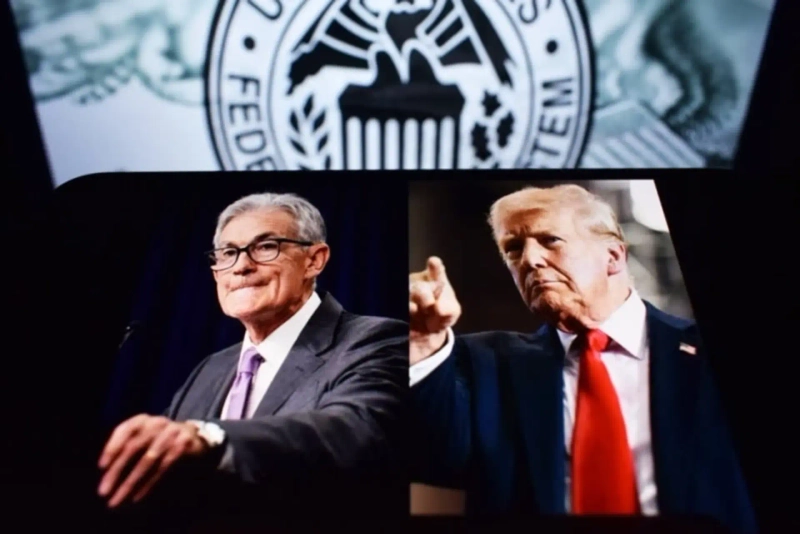
In the United States, attention is rapidly growing over whether Jerome Powell, the current Fed chair, will retain his seat on the Board of Governors even after his term as chair ends. Expectations are building that, as a member of the Federal Open Market Committee (FOMC), Powell could remain a governor to push back against the Trump administration’s pressure for rate cuts.
Powell’s term as chair ends on May 15. President Trump is likely to nominate the next Fed chair before then. In fact, Treasury Secretary Scott Bessent said on CNBC on the 20th (local time) that the nomination could come as early as next week. Powell’s term as a Fed governor, however, runs through Jan. 31, 2028.
Historically, it has been treated as customary for a Fed chair to step down from the Board as well upon leaving the chair. But if the threat to central-bank independence is deemed serious enough, some argue Powell could break with precedent and stay on as a governor. In the late 1940s, former Fed Chair Marriner Eccles remained on the Board in protest of political interference even after President Harry Truman removed him as chair.
President Trump is increasingly making his intent to control the Fed explicit. Alongside continuing public criticism of Powell and other Fed officials, he has also argued that the president should be involved in the rate-setting process.
Some on Wall Street say Trump’s moves to further capture the Board of Governors to exert influence over monetary policy could, paradoxically, increase the likelihood that Powell stays on as a governor. This view has gained further traction after it emerged that the U.S. Department of Justice is examining Powell for possible criminal charges, and after Powell publicly rebutted that the summons was a ‘pretext’ for Trump’s attempt to seize control of the Fed.
Krishna Guha, head of global policy and central bank strategy at Evercore ISI, wrote in a recent report that “this sequence of events greatly raises the likelihood that incumbents such as Chair Powell and Governor Michael Barr will remain in place after May.”
Barr’s term runs through 2032. He previously served as vice chair for supervision, but stepped down from that role early in Trump’s second term to avoid the possibility of being replaced, after which Governor Michelle Bowman was appointed vice chair for supervision.
Philip Jefferson, the vice chair of the FOMC, also has a term that runs through January 2036, leaving him in a position to decide for himself whether to remain.
On Wall Street, there is also a growing view that the more Trump seeks to intervene in monetary policy, the more likely incumbent Fed governors are to stay in their posts as a group.
Nomura economists said in a report that “the likelihood that Powell remains a governor after his chair term ends in May has increased following his recent public statements,” adding that “President Trump’s attempts to intervene in monetary policy could provoke a backlash from the current FOMC members.”
Still, financial markets continue to see Powell’s departure as the more likely outcome. According to the prediction-market platform Kalshi, the probability that Powell leaves the Fed before August 2026 is priced at 70%. That figure assumes that, if Trump’s nominee is confirmed by the Senate, Powell could resign from the Board either immediately after stepping down as chair or within a short period. Republican Sen. Thom Tillis has said he will block Fed nominations until the Justice Department matter is resolved.
Powell himself is avoiding comment on the issue. A Fed spokesperson told CNBC, “There is no additional comment from the Chair’s office.”
Powell was also asked about the matter at a press conference after the FOMC meeting last December, but replied, “For now, I am focused on the remaining term as chair,” and added, “I have nothing further to share.”
Some analysts say Trump’s pressure campaign against Powell could backfire. They argue that pressing for rate cuts could further strengthen the Fed’s internal commitment to independence.
Ed Yardeni, president of Yardeni Research, said, “President Trump’s pressure for Fed compliance could paradoxically strengthen the Fed’s independence,” adding, “As a result, the next Fed chair nominated by President Trump could find it harder than in the past to build internal consensus, and Trump’s control over the Fed could be weaker than he expects.”
New York=Park Shin-young, correspondent nyusos@hankyung.com



![Powell’s choice to safeguard ‘Fed independence’… Will he remain a governor even after his chair term ends? [Fed Watch]](https://media.bloomingbit.io/PROD/news/d10a6e30-5d6e-48d9-b4fd-a9bf6007d09a.webp?w=250)