

"Trade and investment lead Asia-Pacific prosperity"… 'Multilateral trade' phrase omitted due to US opposition
Summary
- "The 'Gyeongju Declaration' stated that trade and investment are essential for the growth and prosperity of the Asia-Pacific region."
- "A phrase supporting a multilateral trade system related to the World Trade Organization (WTO) was excluded from the leaders' communique due to US opposition, but some content was included in the ministerial-level statement."
- "APEC leaders emphasized the importance of the AI ecosystem and fostering culture and creative industries, and said they adopted the first leaders-level AI communique with participation from both the United States and China."
APEC leaders adopt the Gyeongju Declaration…main framework for free trade preserved
Countries held fierce debates through the night until the closing
'WTO acknowledged' in ministerial communique
"Need to build a safe AI ecosystem"
First leaders-level AI communique with US and China participating
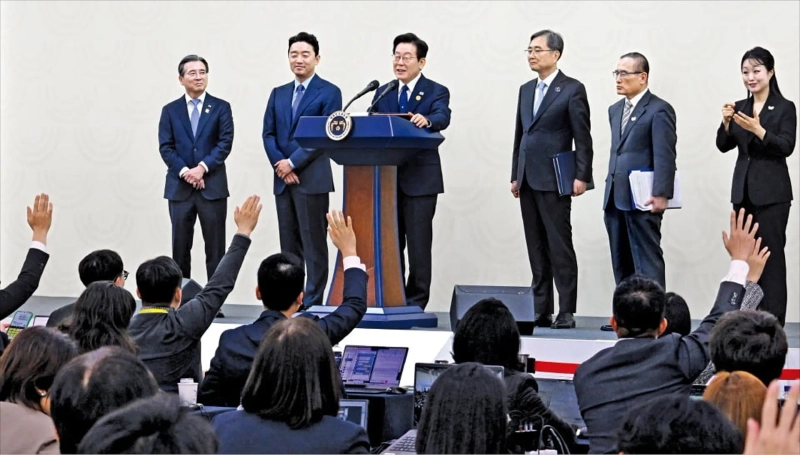
The Asia-Pacific Economic Cooperation (APEC) summit, chaired by South Korea, concluded on the 1st after adopting the 'Gyeongju Declaration' stating that 'robust trade and investment are essential for growth and prosperity in the Asia-Pacific.' A phrase supporting the free trade order, which had always been included in past APEC declarations, was omitted, but the adoption of the communique itself is seen as a good result given the uncertain prospect of reaching agreement.
◇Communique adopted after overnight negotiations
The publicly released Gyeongju Declaration included language that 'the global trading system faces significant challenges, and trade and investment environments that promote resilience and deliver benefits are important.' It also stated that 'we will pursue regional economic integration in a market-driven manner, including discussions on the Free Trade Area of the Asia-Pacific (FTAAP) agenda.' The FTAAP is a concept discussed since the mid-2000s that seeks gradual regional economic integration based on existing regional and bilateral trade agreements (RTAs and FTAs) in the Asia-Pacific.
However, the phrase in the 'Machu Picchu Declaration' adopted at last year's APEC summit in Lima, Peru—'support for a rule-based multilateral trading system centered on the World Trade Organization (WTO)'—was omitted. Instead, it was included in the joint ministerial declaration of the foreign and trade ministers' meeting (AMM) issued the same day. The AMM joint declaration contained language such as 'recognize the importance of the WTO' and 'acknowledge that WTO rules are central.'
Rather than including it in the leaders' agreement, it was modified and placed in the ministerial-level statement. This is interpreted as a result of the US government's rejection of wording related to the free trade order. Since the start of Donald Trump's second administration, the United States has returned to protectionism and has shown a negative stance toward WTO-related wording. For this reason, diplomatic circles had raised concerns that the Gyeongju Declaration might not be issued. In fact, during Trump's first administration, the 2018 APEC summit in Papua New Guinea failed to produce a communique.
Nevertheless, the 21 member economies sought final agreement starting from the day before the closing on the 31st of last month, and, after overnight discussions that continued until around 7:30 a.m. on the day of the closing, they succeeded in reaching agreement. It was reached dramatically about four hours before the end of the summit. President Lee told reporters afterward, "The biggest issue was whether to have a chapter on trade and investment," and explained, "This communique includes the members' will to cooperate for the recovery and growth of the Asia-Pacific region."
◇Fostering culture and creative industries…cooperation on AI and demographic issues
For the first time, the Gyeongju Declaration included language recognizing 'culture and the creative industries' as a 'new growth engine' for the Asia-Pacific region. Member economies emphasized, "They recognize the positive impact that culture and creative industries have on economic growth and affirm the importance of strong intellectual property protection." The Presidential Office assessed, "This will provide an opportunity for our 'K-culture' to establish itself as a growth driver in the Asia-Pacific region."
Leaders adopted the separate 'APEC AI Initiative' and the 'APEC Framework for Addressing Demographic Change' alongside the Gyeongju Declaration. The APEC AI Initiative is the first leaders-level AI-related communique with participation from both the United States and China. The AI Initiative sets out cooperative directions to build a safe and trustworthy AI ecosystem and to ensure that poor countries and low-income groups are not excluded from AI innovation. After the meeting, President Lee handed over the chairmanship to China's President Xi Jinping, the next APEC chair.
Gyeongju=Reporter Lee Hyun-il hiuneal@hankyung.com

Korea Economic Daily
hankyung@bloomingbit.ioThe Korea Economic Daily Global is a digital media where latest news on Korean companies, industries, and financial markets.