PiCK
[Exclusive] “Airdrops also taxable” … Authorities consider adopting a ‘comprehensive approach’ for virtual assets
Summary
- The government said it is pushing a plan to incorporate income related to virtual assets—including rewards from airdrops and staking—into the tax framework.
- It said the National Tax Service is reviewing the adoption of a comprehensive approach and is conducting a research project to establish a legal basis for taxing airdrops and staking.
- It said that if legislative amendments are needed, an overhaul of the virtual-asset taxation regime could be announced in July this year and take effect from January next year.
Forecast Trend Report by Period


Ahead of the rollout of virtual-asset taxation next year
Authorities consider adopting a ‘comprehensive approach’
“Airdrops and staking also taxable”
Likely to be announced in July… to take effect from January next year

The government is pushing a plan to bring income related to virtual assets (cryptocurrencies)—such as rewards from airdrops (free token distributions) and staking (token deposits)—into the tax framework. With the virtual-asset market expanding rapidly, the authorities aim to codify the legal basis for taxing special types of transactions.
According to relevant ministries on the 2nd, the National Tax Service (NTS) internally reviewed applying a “comprehensive approach” to the virtual-asset taxation system after contacting local tax authorities in Tokyo, Japan, late last year. Under this approach, even items not explicitly listed in law are treated as taxable if they constitute an economic benefit. An NTS official said, “We need to introduce a comprehensive concept for virtual-asset income to secure flexibility in determining taxability across various transaction types.”
The authorities’ consideration of a comprehensive approach reflects a view that the current virtual-asset tax system has blind spots. South Korea’s Income Tax Act follows a “positive-list” approach, meaning taxation is generally limited to income explicitly specified in statute. Under that framework, virtual-asset income arising from new blockchain technologies—such as airdrops and staking—would need to be enumerated one by one to clearly establish a legal basis for taxation.
The NTS believes that applying a positive-list approach to virtual-asset taxation would increase administrative inefficiency. A government official explained, “(Under current law) when it is unclear whether a new transaction type constitutes income generated from transfers or lending that are listed as taxable, it becomes difficult and requires tax guidelines or authoritative interpretations.” In other words, the taxability would have to be assessed case by case each time.
Possible inclusion in the tax framework as early as next year
Major countries such as the United States and Japan have already systematized virtual-asset taxation. Japan, in particular, drew the NTS’s attention. Japan effectively applies a comprehensive approach under its Income Tax Act and taxes airdrops and staking based on the “time of receipt” of rewards. The United States has also codified virtual assets acquired through airdrops and the like as “ordinary income” under its tax framework.
The South Korean government has previously offered an interpretation that airdrops could be taxable. According to the National Tax Law Information System, in 2022 the Ministry of Economy and Finance interpreted that “the act of transferring virtual assets free of charge to another person constitutes a ‘gift’ under the Inheritance and Gift Tax Act,” and that “gift tax is levied on the recipient who receives virtual assets free of charge.”
There is growing speculation that airdrop and staking rewards could be incorporated into the tax framework as early as next year. Ahead of the planned rollout of virtual-asset taxation in January next year, the NTS commissioned a related research project late last year. The goal of the study is to prepare detailed guidelines for virtual-asset taxation.
The NTS plans to complete the research project in the first half of this year. A government official said, “We are reviewing whether there are issues that require legislative amendments,” adding, “Once the research is completed, we will begin discussions among relevant ministries.”
Possible announcement in July
If legislative amendments are required, the overhaul could be announced in July this year. This is because, with domestic virtual-asset taxation scheduled to be fully implemented from January next year, legal and regulatory revisions must be completed within this year. The government announces annual tax law amendment proposals every July and applies them from the following year.
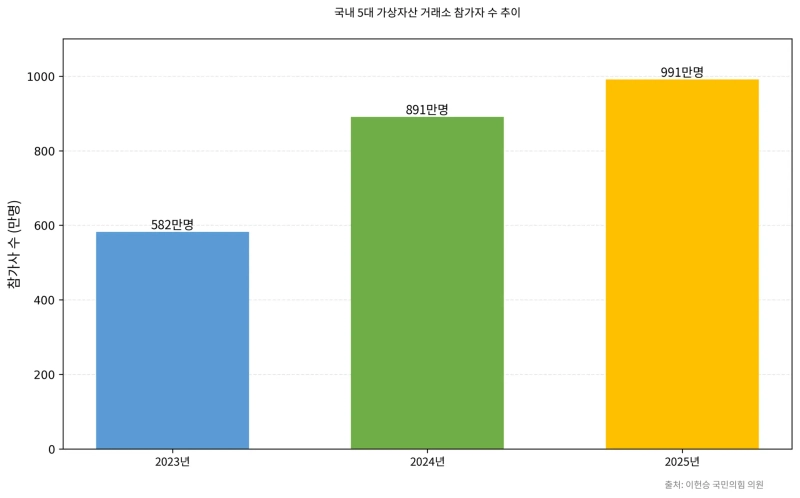
The authorities’ push to refine the tax framework also coincides with the rising number of virtual-asset investors. According to data the Financial Supervisory Service recently submitted to the office of Rep. Lee Heon-seung of the People Power Party, the number of participants at South Korea’s top five virtual-asset exchanges, including Bithumb and Upbit, rose by about 70% over the past two years—from roughly 5.82 million in 2023 to about 9.91 million last year.
Experts also say the tax framework needs urgent refinement. Kim Gap-rae, a senior research fellow at the Korea Capital Market Institute, noted in a recent report: “The ambiguity of South Korea’s tax system regarding airdrops—an idiosyncratic taxation issue for virtual assets—is extremely large,” adding, “If the system is not put in place, uncertainty in taxation could cause confusion among market participants.”
Oh Moon-sung, a professor in the Department of Tax Accounting at Hanyang Women’s University, said, “Under the current virtual-asset tax framework, issues of tax equity could emerge,” adding, “The authorities need to carefully classify income related to virtual assets.”

JOON HYOUNG LEE
gilson@bloomingbit.ioCrypto Journalist based in Seoul