

"Odds of a November rate cut recede"… Government bond yields remain elevated
Summary
- The article reports that the likelihood of the Bank of Korea cutting its policy rate this month has decreased, causing government bond yields to remain elevated.
- It states that the 728 trillion won 'super budget' and weakening expectations for a U.S. rate cut are weighing on investor sentiment in the bond market.
- It reports that the won-dollar exchange rate hit its highest level in about two weeks due to foreign investors' net selling in the domestic stock market and dollar strength.
3-year annual 2.729% 'near peak'
Weight toward holding rates steady amid real estate market instability
'728 trillion won super budget' also burdens the market
Won-dollar exchange rate highest in 2 weeks
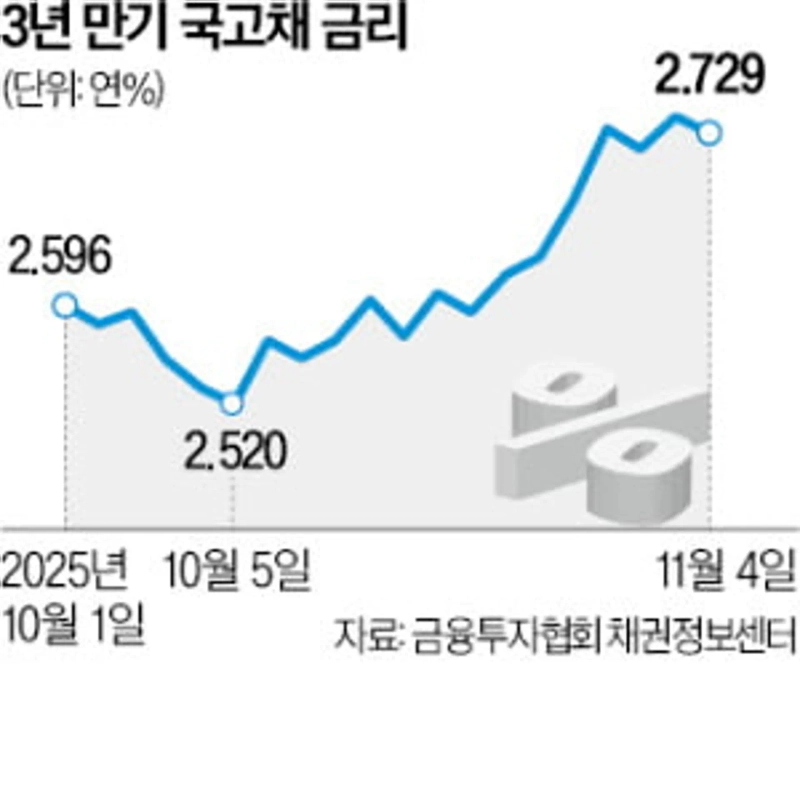
This month, the likelihood of the Bank of Korea cutting its policy rate has diminished, and government bond yields have remained elevated. Concerns about supply and demand due to the government's expansionary fiscal policy and a shift toward risk assets were also cited as factors pushing up bond yields.
On the 4th in the Seoul bond market, the 3-year government bond yield closed at an annual 2.729%, down 0.012% points from the previous day (bond prices rose). Although it was slightly lower than the previous day's year-to-date high (annual 2.741%), it is 0.157% points higher than after the Bank of Korea Monetary Policy Board held the policy rate on the 23rd of last month. The 5-year and 10-year yields also fell by 0.004% points each to annual 2.879% and annual 3.082%, respectively, closing slightly below the previous day's year-to-date highs.
The main reason government bond yields have recently risen is the view that a rate cut by the Bank of Korea this month has effectively become difficult. Stabilization of the real estate market, which the Bank cites as a reason for holding rates, will take more time, and with third-quarter economic growth (1.2%) higher than initially expected, the perception has spread that there is no need to rush a rate cut.
Kim Ji-man, a researcher at Samsung Securities, explained, "At the final Monetary Policy Board meeting of the year to be held on the 27th of this month, the Bank of Korea's economic outlook will also be announced, and growth forecasts for this year and next year are expected to be revised upward, heightening caution in the bond market."
The next year's 'super budget' of 728 trillion won is also negatively affecting investor sentiment in the bond market. If government bond issuance increases, bond prices fall (yields rise). Recent gains in the KOSPI have stimulated risk-on sentiment, leading to a decline in the prices of safe assets such as bonds, according to analysis.
The retreat in expectations for a December rate cut by the U.S. Federal Reserve is also a burden. As U.S. Treasury yields rise, Korean government bond yields could rise further in tandem. According to the CME FedWatch on the Chicago Mercantile Exchange (CME), the probability that the policy rate will be cut by 0.25% points at next month's regular Federal Open Market Committee (FOMC) meeting is 65.1%. This is lower than the 94.4% probability a week earlier.
As U.S. rate-cut expectations fell, the won-dollar exchange rate rose. In the Seoul foreign exchange market that day, the won-dollar exchange rate (as of 3:30 pm) closed the weekly session at 1437 won 90 jeon, up 9 won 10 jeon from the previous trading day. It was the highest level in about two weeks since the 23rd of last month (1439 won 60 jeon). The dollar index, which shows the dollar's value against the currencies of six major countries, was up 0.07% from the previous day at 99.809, reflecting dollar strength. That day, foreign investors net sold more than 2 trillion won in the domestic stock market, which also put upward pressure on the exchange rate.
Reporter Kang Jin-gyu josep@hankyung.com

Korea Economic Daily
hankyung@bloomingbit.ioThe Korea Economic Daily Global is a digital media where latest news on Korean companies, industries, and financial markets.