

U.S. federal government shutdown to reach 'record longest' 36 days as of the 5th…temporary budget bill defeated
Summary
- The U.S. federal government shutdown is expected to set a record as the longest at 36 days.
- The temporary budget bill was defeated in the Senate, and the political stalemate continues.
- Prolonged shutdown is expected to continue causing uncertainty in related markets.
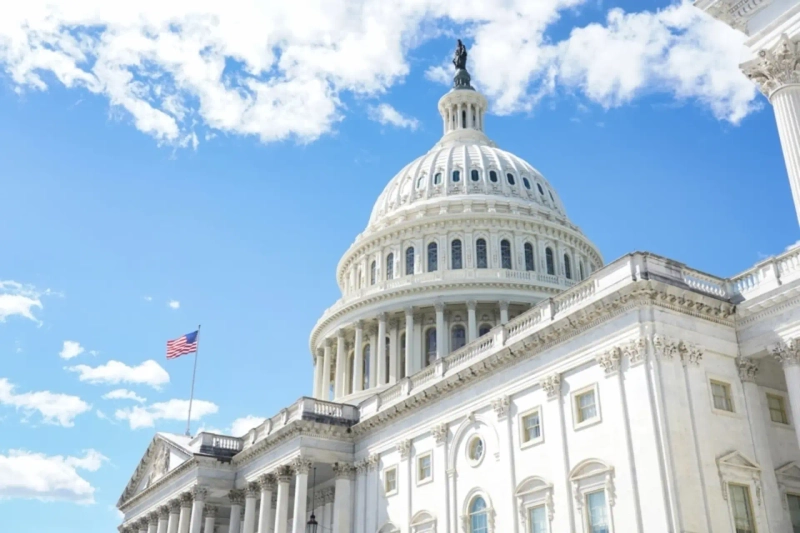
The U.S. federal government shutdown (temporary halt of operations) is expected to set a new record as the longest (36 days) on the 5th (local time).
On the 4th, the 14th vote on the Republican temporary budget bill took place in the U.S. Senate, but it was defeated 54 in favor to 44 against. With Democrats maintaining their opposition, Republicans failed to secure the 60 votes required to pass the bill.
Democratic Senate floor leader Chuck Schumer wrote on social networking service (SNS) that "the amount the average American using Obamacare would have to pay would increase by 114% and 4 million Americans would completely lose their health insurance benefits." The Democrats' position is that the temporary budget bill can only be processed if Republicans agree to extend Obamacare subsidy payments.
Meanwhile, Republicans are demanding that the government be returned to normal operations first and that discussions follow. Republican House Speaker Mike Johnson said on X (SNS) that the Democrats "are more afraid of the backlash from their radical left base than the suffering of hardworking Americans who are not receiving pay."
President Trump urged an end to the shutdown on Truth Social, saying, "If we do not end the filibuster (invoke the nuclear option), the Democrats are much more likely to win both the midterms and the next presidential election."
The 'nuclear option' refers to lowering the vote threshold for ending a filibuster (a lawful obstruction of parliamentary proceedings) from 60 votes to a simple majority through changes to procedural rules; it is called the 'nuclear option' because it destroys the Senate's culture of cooperation and its political fallout is large like a nuclear explosion.
With President Trump, Republicans and Democrats unable to find common ground, the shutdown will, as of the 5th, enter its 36th day and set a new record. The previous record was also set during the Trump administration.
The shutdown during Trump's first term began when the president vetoed measures after judging Congress-passed funding for the Mexico border wall to be insufficient, and it lasted 35 days from December 22, 2018 to January 25 of the following year.
That shutdown was able to end when Congress agreed to pass a temporary budget bill that excluded the $5.7 billion in wall construction funding demanded by President Trump.
There were assessments that President Trump ultimately relented in the face of growing public discontent caused by the prolonged shutdown.
Shin Yong-hyun Hankyung.com reporter yonghyun@hankyung.com

Korea Economic Daily
hankyung@bloomingbit.ioThe Korea Economic Daily Global is a digital media where latest news on Korean companies, industries, and financial markets.