

Trump blocked Blackwell exports but... Jensen Huang: "China will surpass the U.S. in the AI competition"
Summary
- Jensen Huang, NVIDIA CEO, said that despite U.S. export controls on AI chips, China will surpass the U.S. in the AI competition.
- China, through energy subsidies and regulatory easing, enables companies to develop AI at low cost and is said to be ahead of the U.S. in AI patents and paper citations.
- Experts expect that, along with U.S. visa restrictions, the growth of Chinese AI researchers and open-source AI models will generate synergies when combined with manufacturing.
"The West is falling into technological cynicism"…Warning at the UK 'AI Future Summit'
Specifically criticized U.S. regulation and export controls
"Chinese firms get subsidies and free electricity
Chinese chips, though lower in performance, have a cost advantage"
China also surpasses the U.S. in patents and paper citations
Fewer regulations on AI training make deep learning easier
Shows strengths in 'open-source AI models'
Gap in number of top scholars with the U.S. is narrowing
Synergy expected if AI is combined with manufacturing
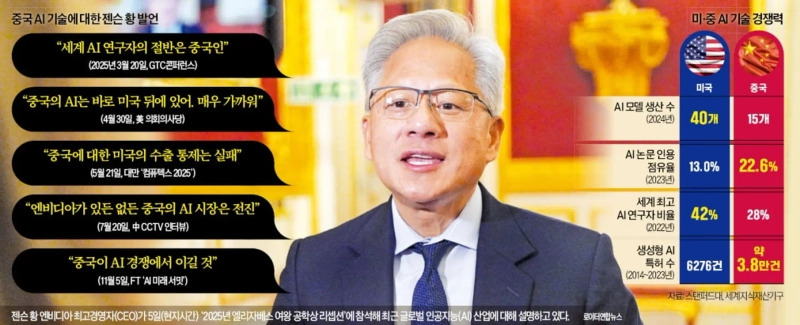
Jensen Huang, CEO of NVIDIA, warned that "China will surpass the United States in the artificial intelligence (AI) competition." He cited China's advantage in energy costs and looser regulation. Huang is concerned that even if the U.S. controls exports of advanced AI chips, the technological gap with China is not large and could be reversed. China recently leads the U.S. in numbers of AI-related patents and paper citations.
◇ "We need more optimism"
At the 'AI Future Summit' hosted by the Financial Times (FT) in London, Jensen Huang said, "The West, including the U.S. and the U.K., has fallen into a cynicism about technological progress."
He pointed to excessive U.S. regulation of AI technology. Huang said, "There could be as many as 50 AI-related regulations being pursued by U.S. states" and emphasized, "We need more optimism." He added, "(In China) electricity is free," saying, "Because of energy subsidies paid to tech companies in China, local tech firms can operate alternatives to NVIDIA AI chips much more cheaply."
Generally, NVIDIA's high-performance AI chips are far superior to Chinese chips in computing power and energy efficiency. But if China provides energy subsidies, companies using Chinese chips would see reduced energy costs, eroding NVIDIA chips' advantage.
Huang's remarks came after U.S. President Donald Trump, following a recent summit with Chinese President Xi Jinping, announced that NVIDIA's advanced 'Blackwell' chips would not be sold to China. He warned that U.S. AI chip regulations could instead lead to the U.S. falling behind China in the AI competition.
This year, Huang has argued that "U.S. AI models are not far ahead of Chinese competitors" and that it is better to have China rely on U.S. technology. At the annual developer conference (GTC) in March, he said, "Half of the world's AI researchers are from China."
◇ "U.S. visa restrictions will increase Chinese AI researchers"
Experts say China may overtake Silicon Valley in AI technology. Unlike the U.S. and other Western countries, China has almost no data-related regulations for AI training and can deploy society-wide resources to AI development. According to Stanford University's 'AI Index' report, as of 2023 China accounted for 22.6% of global AI paper citations while the U.S. accounted for 13%. From 2014 to 2023, the number of generative AI-related patents was 6,276 in the U.S. and about 38,000 in China.
The gap between the U.S. and China in the number of top scholars in AI research is narrowing. According to the White House Council of Economic Advisers (CEA), the share of world-class AI researchers based in the U.S. fell from 59% in 2019 to 42% in 2022. The Trump administration's foreigner restriction policies could push this share even lower. There is also a view that U.S. professional (H-1B) visa restrictions could lead China-born AI researchers in the U.S. to return to China.
Some analyses also argue that China has already overtaken the U.S. in 'open-source' AI models. According to a report by venture capital firm Air Street Capital, China has recorded 540 million cumulative AI model downloads in the app market this year, ahead of the U.S. with 470 million. This was influenced by the popularity of models such as DeepSeek.
China's AI technology could create synergies when combined with its strong manufacturing sector. Chinese EV maker XPeng on the 6th unveiled that it will release next year a robo-taxi (driverless taxi) equipped with its own AI chip, a humanoid robot, and a flying car, and said its autonomous driving features are superior to Tesla's vehicles.
German automaker Volkswagen has decided to jointly develop its own AI chip for advancing autonomous driving functions with Chinese software firm Horizon Robotics.
Reporters Kim Dong-hyun / Lee Hye-in 3code@hankyung.com

Korea Economic Daily
hankyung@bloomingbit.ioThe Korea Economic Daily Global is a digital media where latest news on Korean companies, industries, and financial markets.