

Despite the bull market, half of retail investors suffer '9.3 million won' loss, looking at what they bought…
Summary
- Although the KOSPI index surpassed 4,000, 54.6% of NH Investment & Securities' domestic stock account investors reportedly recorded an average loss of 9,310,000 won.
- The stocks most commonly held by investors with losses were POSCO Holdings, Kakao, and Kumyang, with Kakao holders exceeding 150,000 and Kakao contributing a large share to losses.
- Investors who made gains held Samsung Electronics and SK Hynix in high proportions, and especially Samsung Electronics accounted for 19.5% of profit amounts, indicating the semiconductor sector's strong influence.
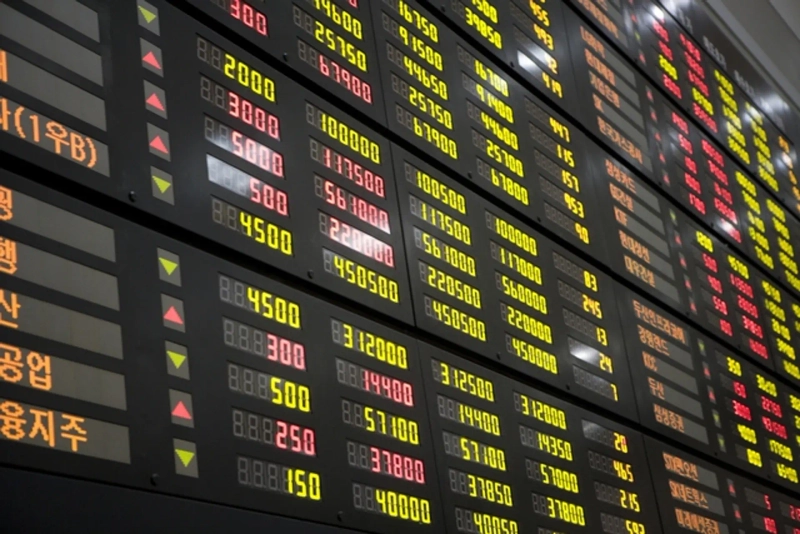
This year, as the KOSPI index, which started in the mid-2000s, surged past 4,000, posts claiming large profits from stock investments have been appearing on social networking services (SNS). However, based on stock account balances, investors with positive returns as of the end of last month were found to be less than 50%.
On the 10th, Yonhap News commissioned NH Investment & Securities to analyze accounts, and as of the 30th of last month, among 2,401,502 customer accounts at NH Investment & Securities holding domestic stocks, the proportion of investors with losses was higher than those with gains. That day the KOSPI index crossed 4,100 intraday for the first time.
As of that day, of the 2,401,502 customers with domestic stock balances at NH Investment & Securities, 1,312,296 investors (54.6%) had losses. Their total loss amounted to 12,215,400,000,000 won, averaging a loss of 9,310,000 won per person.
The largest number of investors incurred losses in the range of 100,000 won or more but less than 1,000,000 won, totaling 349,084 investors (26.6%), but 139,249 investors (10.6%) had losses of 10,000,000 won or more but less than 30,000,000 won, and 53,405 investors (4.1%) recorded losses of 50,000,000 won or more.
Those with losses under 100,000 won numbered 311,107 (23.7%), 1,000,000 won or more but less than 3,000,000 won were 205,765 (15.7%), and 3,000,000 won or more up to 10,000,000 won were 212,944 (16.2%).
By age, investors in their 40s and 50s performed poorly. In particular, 50-somethings recorded losses at a rate of 60.1% (347,285 people). Those in their 40s also saw losses at 59.7% (321,580 people).
The lowest loss rate was among minors at 33.9% (33,231 people). Those in their 20s also had a relatively low loss rate of 44.3% (108,737 people). The loss rate for those in their 30s was about half, at 52.1% (258,258 people).
However, in terms of loss amounts, investors aged 60 and over had the largest average loss at 13,690,000 won. Those in their 50s averaged 12,570,000 won, 40s averaged 9,290,000 won, 30s averaged 4,790,000 won, 20s averaged 2,150,000 won, and minors averaged 1,530,000 won, showing smaller losses for younger age groups.
Looking at loss rates by investment amount, investors with total purchases of 300,000,000 won or more had the highest loss rate at 62.0%. Customers who invested 100,000,000 won or more but less than 300,000,000 won also had a high loss rate of 57.9%, and the remaining investment amount brackets were also at the 50% level.
Among the stocks held by investors with losses, the stock that caused the largest loss was POSCO Holdings. This is based on the proportion of the loss amount for that stock relative to the total loss amount of losing investors; POSCO Holdings' share of the loss amount was 2.7%. Other stocks with high shares of loss amount included Kakao (2.2%), Kumyang (1.7%), EcoPro BM (1.7%), EcoPro (1.3%), Celltrion (1.2%), SK Bioscience (1.0%), SillaJen (0.9%), and Enchem (0.9%).
However, among these stocks, Kakao had the largest number of holding customers at 154,021. This means 8.5% of the 1,312,296 customers with loss-making accounts held Kakao. Kakao's stock price soared to the 160,000-won range in 2021 but is now trading around 60,000 won.
Conversely, the stock most commonly held by customers with gains was Samsung Electronics. Samsung Electronics' share price was in the 50,000-won range until mid-March, but on hopes of a semiconductor market recovery it surged to the 110,000-won range this month. Compared with the start of the year (Jan. 2 closing price 53,400 won), it more than doubled. In accounts with gains, Samsung Electronics accounted for 19.5% of the profit amount.
SK Hynix also had a high share of profit amount at 9.0% and had 92,359 customers holding balances, indicating that the semiconductor sector's rise greatly affected investors' profits.
Also, holders of the ETF that tracks the U.S. S&P 500 index, 'TIGER (TIGER) US S&P500', numbered 146,718.
So-yeon Kim, Hankyung.com reporter sue123@hankyung.com

Korea Economic Daily
hankyung@bloomingbit.ioThe Korea Economic Daily Global is a digital media where latest news on Korean companies, industries, and financial markets.