

PiCK
U.S. Shutdown Ends… 8 Democrats Defect, Budget Bill Passed in Senate [Sang-eun Lee's Washington Now]
Summary
- The U.S. Senate narrowly passed the key temporary budget bill to end the federal government shutdown.
- With the agreement of some Democratic lawmakers, government services will be resumed and back pay will be issued sequentially.
- This budget is a temporary measure through January 30, and passage of the regular budget and future fiscal policy still require further discussion.
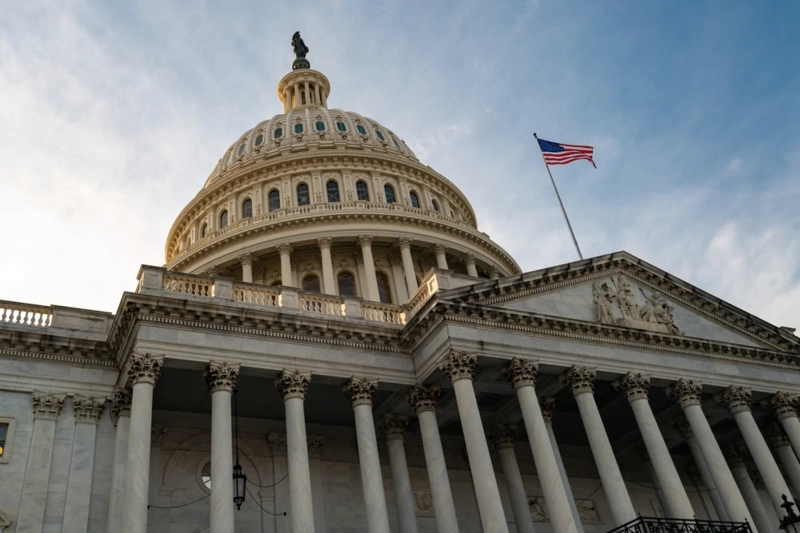
The Republican and Democratic parties in the United States have begun procedures to lift the federal government shutdown. This came after some Democratic lawmakers agreed to an unconditional end to the shutdown, breaking with the party line that demanded an extension of the tax credit for Obamacare (mandatory health insurance enrollment).
The U.S. Senate on the evening of the 9th (local time) passed a temporary budget bill to fund the federal government by a vote of 60 in favor and 40 against. It barely secured the minimum threshold (60 votes) needed to overcome a Democratic filibuster and pass the bill.
As a result, the U.S. government will be able to use funds until January 30 of next year. Federal government services that were suspended after the shutdown began on October 1 are expected to be resumed in stages. Back pay will also be issued. The two parties agreed to rescind the Trump administration's firing of some 4,000 federal employees, prohibit further firings until January 30, and guarantee payment of back pay.
However, this is a temporary budget bill, and spending issues through the end of the next fiscal year in late September will require further discussions. The Democrats received a promise from the Republicans to hold a vote in mid-December on extending the health insurance tax credit, but in effect they conceded with almost no concessions.
Five Democratic lawmakers changed their minds
The Democrats had refused to pass the Republicans' temporary budget bill (CR) while demanding an extension of the Obamacare tax credit, and the Republicans refused to make such concessions, resulting in a 40-day standoff. President Donald Trump urged using the "nuclear option" to eliminate the filibuster that requires 60 votes, making resolution of the deadlock appear even more difficult.
Republican leadership worked behind the scenes to win over some members rather than concede to the entire Democratic caucus. As a result, a total of eight Democratic-aligned senators voted in favor of the bill. Senator John Fetterman (D–Pennsylvania) and two others had originally been in favor, but the remaining five, who had consistently opposed the bill across 14 votes, changed their minds for the first time that day. Former governor Jeanne Shaheen (D–New Hampshire), Maggie Hassan (D–New Hampshire), and Senator Tim Kaine (D–Virginia), from a state home to tens of thousands of federal employees, switched to support. Reuters reported that Democratic Senators Hassan and Shaheen and Independent Angus King (I–Maine) were the three who led the agreement.
Among Republicans, fiscal conservatives Mike Lee (R–Utah), Rick Scott (R–Florida), and Ron Johnson (R–Wisconsin) had been voting against the bill alongside the Democratic mainstream, but some turned to vote in favor on the day. Senator John Cornyn (R–Texas), who had been absent because the vote took place over the weekend, hurried back from Texas to Washington, D.C., to cast the 60th vote.
Shutdown may take days to end
Although the temporary budget bill passed the Senate with 60 votes on the 9th, the shutdown does not end immediately. The amended bill must go to the House for another vote and pass there, and it also requires the president's signature.
During this process, each lawmaker is trying to reflect their final positions. Senator Rand Paul (R–Kentucky) is insisting that marijuana-related provisions be removed. Foreign outlets explained that if these negotiations and procedural requirements are to be completed, the shutdown could continue through the weekend. Passage of the regular budget, not the temporary one, still requires bipartisan agreement.
With the temporary budget's passage, livelihood issues such as the resumption of the low-income food assistance program (SNAP) are at least temporarily eased. Once pay for military personnel, police, and air traffic controllers resumes, airport operations and other services are expected to improve significantly. Earlier, Kevin Hassett, chairman of the White House National Economic Council (NEC), warned on CBS that "if air travel does not recover to normal levels by Thanksgiving (November 27), the fourth quarter economy could see negative growth," and such concerns will be largely alleviated.
The Democrats who voted for this temporary budget hope to use it as a springboard to pursue more constructive discussions on Obamacare. Senator King explained his support, saying, "As long as the shutdown persisted, it was impossible to address the Obamacare issue," and that it was unlikely Republicans would engage in this discussion even if time were extended to Thanksgiving or Christmas.
"Giving up the fight is a mistake" Strong criticism within the Democratic Party
However, there is a dominant current of opposition within the Democratic Party to ending the shutdown without extracting sufficient concessions. The deal ended because of defections, not because the two parties reached a broad agreement.
Senate Democratic Leader Chuck Schumer voted against the bill, but Representative Ro Khanna (D–California) wrote on social media, "Schumer should step down (from his leadership post)," and criticized, "If he cannot lead the fight to prevent soaring American health insurance costs, what is he fighting for?" Representative Greg Casar (D–Texas) called the decision "not a compromise but a surrender." Senators Elizabeth Warren (D–California) and Bernie Sanders (D–Vermont) also said that giving up the fight was "a terrible mistake."
President Donald Trump, returning from watching a football game that day, did not say whether he supported the agreement, only saying, "The shutdown seems like it will end soon."
Washington — Sang-eun Lee, correspondent selee@hankyung.com

Korea Economic Daily
hankyung@bloomingbit.ioThe Korea Economic Daily Global is a digital media where latest news on Korean companies, industries, and financial markets.