

Bloomberg "Trump tariffs have passed their economic and political peak"
Summary
- Bloomberg said President Trump's tariff policy has reached its economic and political peak and that a temporary tariff reduction is necessary.
- In polls, 65% of U.S. voters said they oppose the tariff policy, and even conservative Supreme Court justices expressed skepticism about Trump's tariffs under emergency economic powers.
- It said that amid recent signs of U.S. economic weakening, if the Supreme Court invalidates the tariffs the U.S. average applied tariff rate could fall from 14.5% to 6.5%.
"A temporary tariff reduction is necessary" proposal
Poll shows 65% of US voters "oppose Trump's tariff policy"
Conservative Supreme Court justices also skeptical of 'tariffs under emergency economic powers'
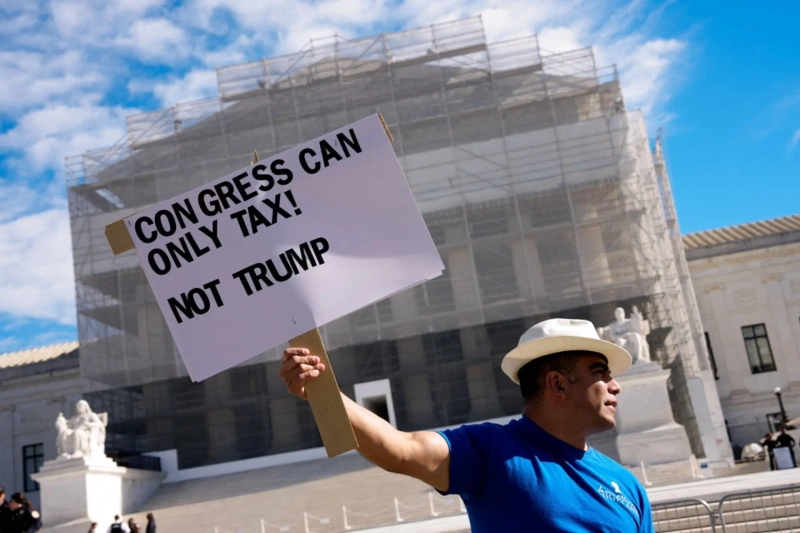
Claims have emerged that President Trump's tariffs have peaked and begun to decline. This means that Trump's tariff policy has reached its limits both as an economic weapon and as a political weapon.
On the 10th (local time), Bloomberg said tariffs have reached a peak and suggested that even if one is convinced of the long-term effects of tariffs, they should be cut temporarily.
Bloomberg made this suggestion citing the Republican rout in all elections last week, including the New York mayoral race, and the skeptical responses of conservative Supreme Court justices to Trump's tariffs. It added that recent polls are also not at all favorable to Trump.
As criticism of his tariffs rose, President Trump on the 9th claimed on his social media that he would give a $2,000 tariff dividend to everyone except the wealthy.
Treasury Secretary Scott Bessent was also surprised by the remark and later in an interview tried to smooth it over by saying it "could mean future tax cuts."
Bloomberg estimated that if "everyone" as Trump said means all U.S. citizens not in the top 10% by income, the cost would exceed $500 billion. That is more than ten times the $29.7 billion in tariff revenue the U.S. Treasury reported in September.
Given the already serious U.S. fiscal deficit, it does not seem feasible. It indicates how anxious President Trump is.
At last week's U.S. Supreme Court hearing, even conservative justices showed skepticism toward Trump's tariffs imposed under the International Emergency Economic Powers Act (IEEPA). This means President Trump is likely to lose.
Moreover, the Democrats scored sweeping victories in all the elections held last week, including the New York mayoral and New Jersey governor races.
Polls related to the tariff issue are also not at all favorable to Trump.
According to a recent Washington Post-ABC News-Ipsos poll, 65% of voters opposed President Trump's tariff policy. 55% said tariffs hit household finances. A Marquette University poll conducted in the swing state of Wisconsin showed that a majority of voters think "tariffs have a negative impact on the U.S. economy."
If public opposition to tariffs is high, maintaining the current tariff policy could also be unfavorable to the Republican Party in the 2026 midterm elections.
Even in U.S. history, tariffs have not always been received favorably.
For most of American history before World War II, debates over protectionism cycled. Almost every tariff case ultimately led to resistance against taxes. Even the Boston Tea Party and the American Revolutionary War ultimately stemmed from anger over import tariffs.
If President Trump loses in the U.S. Supreme Court, the tariffs he imposed under the International Emergency Economic Powers Act would be invalidated. That accounts for about 75% of the increased revenue so far this year.
Of course, even if tariffs under the IEEPA are invalidated, President Trump has several options to rebuild tariff barriers using other laws. However, if reciprocal tariffs are outlawed, it will be difficult to raise tariff barriers further.
According to Bloomberg Economics, if it loses the Supreme Court tariff lawsuit, the U.S. average applied tariff rate is expected to fall from the current 14.5% to 6.5%. That is still higher than the 2.3% in January before Trump took office. This includes 50% tariffs on Brazil and India.
As President Trump hinted at potential negotiations, tariffs on Brazil and India are likely to be reduced. Negotiations are underway with Canada and Mexico over a North American trade agreement. Tariffs on Chinese imports were cut by 10% starting on the 10th.
The problem is that the U.S. economy is weakening.
Until recently, the U.S. economy generally withstood Trump's tariff shock, but recently the labor market has cooled sharply, consumer sentiment is at its worst in three years, and inflation is persistent. Investment has slowed in most sectors except AI-related data centers.
Bloomberg recommended cutting tariffs temporarily even if one is convinced of the long-term benefits of tariff increases. President Trump has also signed tariff exemptions in some sectors and provided short-term waivers to companies to encourage domestic production investment.
Kim Jeong-a, contributing reporter kja@hankyung.com

Korea Economic Daily
hankyung@bloomingbit.ioThe Korea Economic Daily Global is a digital media where latest news on Korean companies, industries, and financial markets.