

PB in the Age of Inflation…Will the 'Consumer Goods Giants' Be Toppled? [Global Money X-Files]
Summary
- Recently, the global market dominance of PB (private brand) products has grown, and investments and acquisitions of PB companies are increasing.
- Global retailers are strengthening price leadership and market dominance by leveraging PB, weakening traditional CPG (consumer packaged goods) firms' pricing power.
- In Korea, analysts noted the difference between Coupang's and traditional retailers' PB strategies, and that Coupang's high margins stem from logistics and platform efficiencies rather than PB sales.
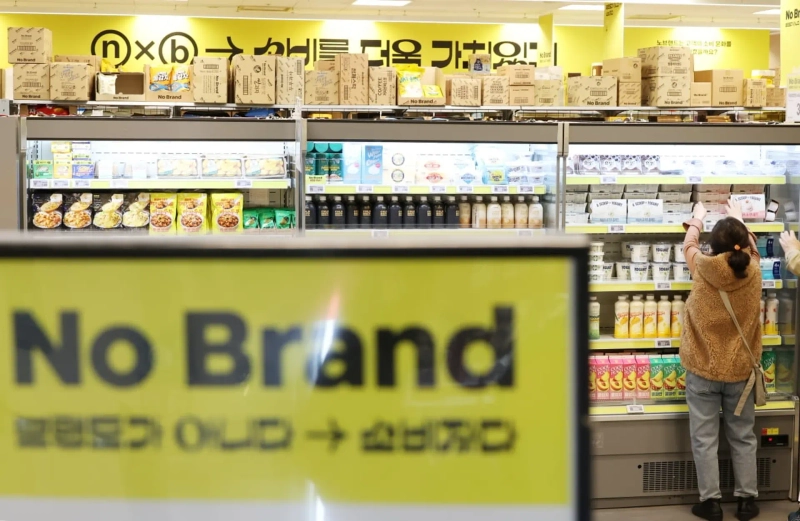

Recently, the global market dominance of private brand (PB) products emphasizing "cost-effectiveness" has been growing. This is due to worsening worldwide inflation. Investments in PB companies by U.S. Wall Street firms and others have also increased.
Investments flocking to PB companies
According to Reuters on the 12th, Investindustrial, a large European private equity firm, announced on the 10th that it will acquire North American PB specialist manufacturer "TreeHouse Foods" at an enterprise value of $2.9 billion. Andrea Bonomi, chairman of Investindustrial, said, "We are confident in the long-term growth opportunities of the PB market and the categories operated by TreeHouse."
Meanwhile, Wall Street's assessment of the CPG (consumer packaged goods) sector, which contains traditional consumer brands, is cold. XLP (Consumer Staples Select Sector SPDR Fund), an ETF representing the consumer staples sector, has a year-to-date return of -3.8%. Compared with the S&P 500's 14.3% rise over the same period, XLP is regarded as the only major sector to record negative returns.
Recent macroeconomic indicators suggest the inflation crisis has passed its peak. According to the U.S. Bureau of Labor Statistics (BLS), the U.S. Consumer Price Index (CPI) rose 3.0% in September, stabilizing. However, some note that consumers' subjective "price fatigue" remains "sticky".
Global consulting firm McKinsey analyzed in a report this year that "consumption habits formed during the pandemic and inflation period have become entrenched." According to McKinsey's survey, three out of four U.S. consumers in the first quarter said they had experienced "trading down" to cheaper products.
Buoyed by these consumer behavior changes, PB is said to have entered a "golden age." According to the Private Label Manufacturers Association (PLMA), PB accounted for 47% of the increase in U.S. retail sales last year. The PB market has also grown globally. This year, global PB value share reached 24.9%, and the European market recorded a high share of 37.6%. Peggy Davis, chair of PLMA, said, "Shoppers clearly recognize the combination of quality, value, and innovation that PB offers."
Retailers strengthened by PB
The rise of PB has also given retailers formidable competitiveness. Global retail giants like Walmart and Amazon have put PB front and center to secure "price leadership." At the same time, they are using vast customer data and media platforms to pressure CPG companies.
These retailers are aggressively expanding their PB portfolios, eroding CPG market dominance. In April, Walmart launched a new PB, "Bettergoods," consisting of about 300 items—the largest food PB launch in 20 years. Most products were priced under $5. Amazon also strengthened its low-cost PB strategy by launching "Amazon Grocery" on the 1st of last month.
This movement has weakened CPG companies' core competitiveness in "pricing power." In the past, brands could pass cost increases on to consumers based on brand trust. But recently, as consumers shift to trusted PBs, price increases have become practically impossible. The mere existence of PB constrains CPGs' ability to pass on price hikes.
Retailers have even launched price-cut offensives. They permanently lowered prices on more than 8,000 items last year, and Aldi announced additional cuts on over 400 items in the U.S. This is not just discount competition; it is interpreted as a signal that retailers have taken the lead in market price-setting. Walmart CEO Doug McMillon said in the May earnings release, "We are working with suppliers to keep prices low."
The big CPGs' counterattack
That said, it is not necessarily the "end of brands." Global CPG giants have defended with solid results despite the PB onslaught. Coca-Cola reported organic revenue growth of 6% in the past third quarter. Global unit case volume also rose 1%. Analysts say this shows that brand loyalty remains strong in beverage categories where PB penetration is difficult.
P&G reported organic sales growth of 2% in fiscal 2026 Q1 (July–September 2025). Although growth is low, it demonstrates defensive resilience. Unilever achieved 3.9% underlying sales growth (USG) in the third quarter. Nestlé recorded real internal growth of 0.6% for the cumulative Jan–Sep 2025 period.
John Moller, CEO of P&G, emphasized, "We will protect long-term investments in brands, innovation, and demand creation against short-term volatility (PB onslaught)." P&G maintained or expanded global share in seven out of ten categories, which analysts attribute to premium innovations in beauty and healthcare offsetting PB's low-price offensive.
Unilever's move to spin off its low-margin ice cream division and refocus its portfolio on high-margin "power brands" fits the same logic. Bain & Company pointed out that "many large CPGs are hampered by 'supply chains built in a bygone era' and 'categories that are disappearing.'"
Impact on national economies
The rise of PB and the strengthening of retail power also affect national economies. In the short term, the spread of PB acts to stabilize consumer prices, as retailers emphasize consumer benefits by asserting "price leadership" amid inflation. This can lead to short-term deflationary pressure.
However, in the medium to long term, there are concerns that innovation across the industry could weaken. If CPG companies' profitability declines, R&D investment is likely to fall, which could hinder long-term product innovation and quality improvement. Additionally, small OEMs supplying PB products may be forced into lower supply prices by retailers' strong bargaining power. Such a structure could harm the balance and sustainability of the industry ecosystem.
The Korean market is said to show global trends in a compressed form. NielsenIQ Korea analyzed that "77% of Korean consumers view PB as a positive substitute for national brands." One distinctive feature of the Korean market is Coupang. Coupang posted record quarterly results in Q3 with sales of 12.8455 trillion won (+20%) and operating profit of 224.5 billion won (+49%).
Coupang's use of PB differs from that of traditional retailers. For E-mart, "No Brand" is a core "product" that generates profit. For Coupang, PBs (such as Gomgom) are evaluated as a strong "negotiation card" and "means" to control NB manufacturers. Coupang's high margins come not from PB sales but from logistics efficiency of "Rocket Delivery" and platform revenue.
[Global Money X-Files examines important but little-known flows of global money. Subscribe to the reporter page for convenient coverage of necessary global economic news.]
Reporter Joo-wan Kim kjwan@hankyung.com

Korea Economic Daily
hankyung@bloomingbit.ioThe Korea Economic Daily Global is a digital media where latest news on Korean companies, industries, and financial markets.