

"They blamed the public for overspending even during the IMF crisis"… Are 'Seohak ants' the main culprits of the 'exchange rate rise'? [Kim Ik-hwan's Ministry Hands-Up]
Summary
- Deputy Prime Minister Koo Yun-cheol said recent residents' expansion of overseas investment has increased the won-dollar exchange rate and the uncertainty of the foreign exchange market.
- While Seohak investors' accumulation of overseas assets was once seen as an 'external exchange safety net' and a factor in reducing financial market volatility, recently they have not been converting to won even when the exchange rate rises.
- Experts point to declining productivity and potential growth and delayed structural reform as fundamental causes of increased overseas investment and won weakness, saying blaming overseas investors alone will not yield strong policy effects.
Deputy Prime Minister Gu: "Expansion of residents' overseas investment
…the won-dollar exchange rate exceeded 1,470 won"
Even though increased Seohak investors exchanged more dollars
'Stalled structural reform' brought about won weakness
Should only Seohak investors be blamed for structural reform?
"They even blamed the public during the IMF foreign exchange crisis"
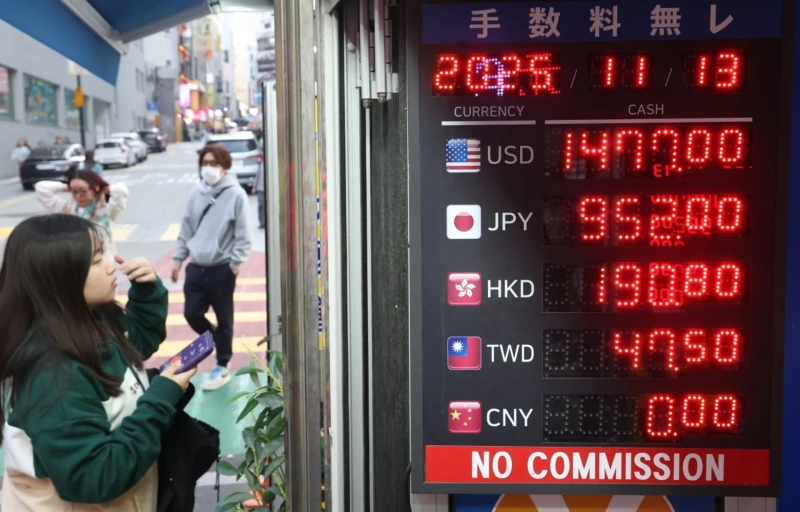
Sleepless 'Seohak ants' have been put on the chopping block. There is a view inside and outside the government that individual investors who bought large amounts of dollars to purchase overseas stocks such as Tesla pushed up the won-dollar exchange rate. Deputy Prime Minister and Minister of Economy and Finance Koo Yun-cheol also pointed out on the 14th that "recent expansion of residents' overseas investment and the like caused the won-dollar exchange rate to at one point exceed 1,470 won."
Seohak investors are recalling the IMF foreign exchange crisis. In 1999, the National Assembly's 'IMF Financial Turmoil Investigation Special Committee' mentioned in its report as one of the causes of the foreign exchange crisis "a surge in overseas travel and study abroad, increased imports of luxury consumer goods, and encouragement of overspending," among others. However, many point out that both the IMF crisis and the current won weakness are structural problems born of gaps in macroeconomic policy responses. For that reason, many evaluate that if foreign exchange policy is designed while focusing only on Seohak investors, the policy effects will not be large.
According to the Korea Securities Depository on the 17th, domestic individual investors have been net buyers of US$27.49629 billion worth of overseas stocks year-to-date through the 14th of this month. That is more than double last year's total overseas stock net purchases (US$10.1 billion). The government views such individual overseas investment as increasing volatility in the foreign exchange market. This concern was also reflected in Deputy Prime Minister Gu's market inspection meeting remarks.
Deputy Prime Minister Gu warned that "uncertainty in the foreign exchange market is increasing due to the expansion of residents' overseas investment, among other factors," and "if foreign exchange supply-demand imbalances persist due to overseas investment, expectations of won weakness could become entrenched." He warned of the possibility of a vicious cycle of 'expansion of overseas investment → won weakness → expectations of exchange gains → additional overseas investment.'
However, there is also analysis that Seohak investors have played a role in defending the won. According to the international investment position, as of the end of June the balance of equity securities such as overseas stocks and funds held by individuals and institutions was US$1.125 trillion, an increase of US$130.7 billion from the end of the previous year. The accumulation of overseas assets has been functioning as a 'foreign exchange safety net.' In the past, when the exchange rate rose, investors sought to realize exchange gains and sold their overseas holdings to convert them into won. That flow helped reduce volatility in financial markets.
But Seohak investors are different these days. Even if the exchange rate rises, there is not a strong demand to convert into won. On the contrary, there are more cases of buying expensive dollars to continue overseas investment. Behind this is Korea's weakened fundamentals. Falling growth potential has lowered domestic investment returns. KDI, in its April 4 report "Macroeconomic Background and Implications of the Increase in Overseas Investment," analyzed that "a slowdown in total factor productivity (TFP) since the 2000s has led to reduced domestic returns, which is the background of the surge in overseas investment."
The view that Seohak investors' overseas investment and the resulting won weakness stem from declining productivity and potential growth and delayed structural reform is gaining traction. The Lee Jae-myung administration also does not show a clear commitment to structural reform and improvement of fundamentals. According to the Ministry of Economy and Finance's '2025–2029 National Fiscal Management Plan,' mandatory expenditures are expected to increase from 364.8 trillion won this year to 465.7 trillion won in 2029, an increase of 100.9 trillion won. Critics warn that if structural problems like these are not addressed and Seohak investors are blamed repeatedly, investor dissatisfaction will only grow.
Kim Ik-hwan reporter lovepen@hankyung.com

Korea Economic Daily
hankyung@bloomingbit.ioThe Korea Economic Daily Global is a digital media where latest news on Korean companies, industries, and financial markets.