

Need to increase foreign exchange reserves vs 1 trillion dollars in external assets is a 'safety net'
Summary
- The market reported concerns that interest and dividends from foreign exchange reserves being used for U.S. investment would reduce the authorities' ability to intervene in the market.
- According to the International Monetary Fund (IMF) and the Bank for International Settlements (BIS) criteria, Korea's foreign exchange reserves were assessed to need an additional 100 billion to 300 billion dollars compared with current holdings, but the foreign exchange authorities said they are sufficient.
- There is a view that net external financial assets exceeding 1 trillion dollars can serve as a foreign exchange safety net, and it was analyzed that this also has the positive aspect of strengthening external soundness.
IMF standard: at least 100 billion dollars more needed
Foreign exchange authorities "Korea is a developed country
Do not quantitatively evaluate reserves"
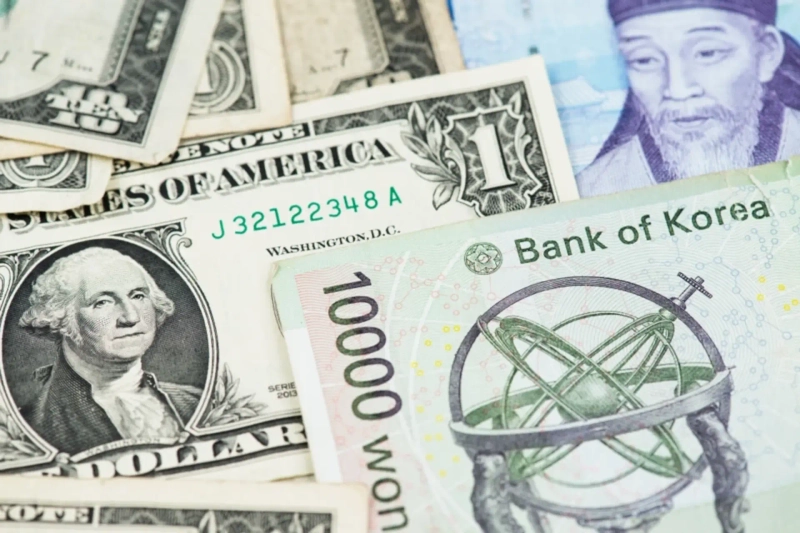
As a result of Korea·U.S. tariff negotiations, annual investments to the U.S. of up to 20 billion dollars have been cited as a major factor in the recent rise of the won·dollar exchange rate. The market is concerned that, as interest and dividends from foreign exchange reserves are used for U.S. investment, the authorities' ability to intervene in the market will be reduced. Some argue that foreign exchange reserves, which serve as a foreign exchange safety net, should be increased, but there are many counterarguments that the increased net external financial assets can fulfill that role.
On the 16th, according to the Bank of Korea, as of the end of last October foreign exchange reserves totaled 428.8 billion dollars. It slightly increased from 42.2 billion dollars the previous month, but it is more than 40 billion dollars less than the record high (469.1 billion dollars) recorded in October 2021. During this period, a sharp decline occurred despite reinvesting operational returns to expand reserves. This is understood to be the effect of the foreign exchange authorities' net selling of over 70 billion dollars in dollars over three years and six months in a phase of rising exchange rates since 2022.
There are various assessments of South Korea's level of foreign exchange reserves. According to standards calculated by the International Monetary Fund (IMF) and the Bank for International Settlements (BIS), South Korea's appropriate foreign exchange reserves are 520 billion to 700 billion dollars. This means that 100 billion to 300 billion dollars more should be accumulated than the reserves currently held.
Compared with neighboring countries such as Japan and Taiwan, South Korea's foreign exchange reserves are relatively small. As of the end of September, Japan's foreign exchange reserves were 1.3413 trillion dollars, which is about 30% of last year's gross domestic product (GDP), and Taiwan's were 602.9 billion dollars, exceeding 70% of GDP. In contrast, South Korea's are about 22% of GDP.
However, the foreign exchange authorities' position is that South Korea's foreign exchange reserves are sufficient. The authorities explain that IMF and BIS criteria are formulas applied to emerging countries. A senior official of the foreign exchange authorities said, "The IMF and BIS no longer make quantitative assessments of South Korea's foreign exchange reserves," and added, "Qualitatively, Korea is evaluated as not lacking in foreign exchange reserves." The official added, "The authorities' market intervention is meant to control volatility and does not determine the level of the exchange rate."
There is also a view that net external financial assets exceeding 1 trillion dollars can sufficiently serve as a foreign exchange safety net. The explanation is that if overseas investors who have invested abroad judge the won to be excessively undervalued, they will buy the won and market functions will operate. The Bank of Korea analyzed in a recent report, "While the pressure for won depreciation has strengthened as net external assets increased, there is also the positive aspect that the foreign exchange safety net has expanded and external soundness has been strengthened."
Kang Jin-kyu, reporter josep@hankyung.com

Korea Economic Daily
hankyung@bloomingbit.ioThe Korea Economic Daily Global is a digital media where latest news on Korean companies, industries, and financial markets.