

Bank of Korea Governor Lee Chang-yong: "Semiconductor demand will grow despite AI bubble... South Korea is in a safer position"
Summary
- BOK Governor Lee Chang-yong said the AI boom will continue despite some bubble concerns, and that South Korea's AI industry is strong in both hardware and software.
- He said that AI technological advancement will increase demand for existing semiconductor chips and place South Korea in a relatively safer position compared to other countries.
- He also emphasized that expanding joint investments with the U.S., diversifying global supply chains, and fostering the renewable energy industry could bring new opportunities to the South Korean economy.
BOK Governor Lee Chang-yong, BBC interview "New opportunities for the South Korean economy"
South Korea's AI industry strong in both hardware and software
If technologies such as physical AI advance
Demand for existing semiconductor chips will also increase
Mentioning $200 billion investment to the U.S.
Combining U.S. basic science and South Korean manufacturing technology
Could create more joint investments
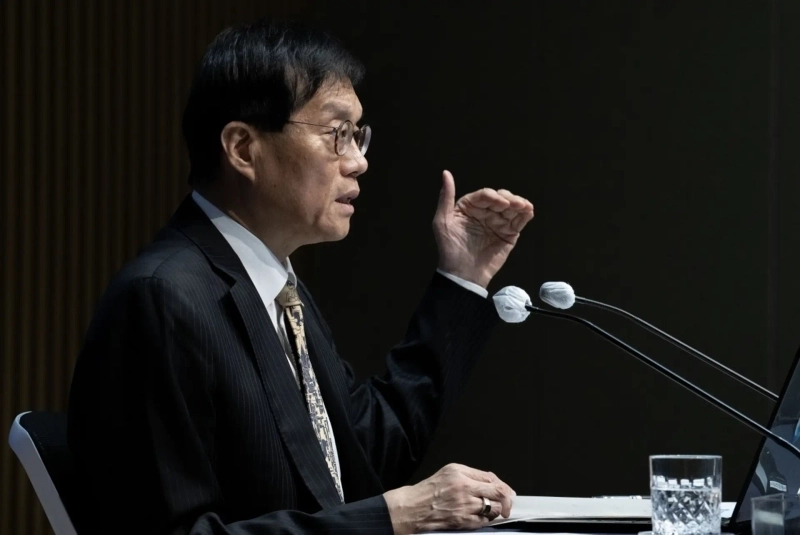
Amid concerns about an artificial intelligence (AI) bubble, Bank of Korea Governor Lee Chang-yong said in a foreign media interview that "even if there is some bubble, the AI boom will continue." He added that, since South Korea holds a strong position in the AI field, new opportunities will come to the economy.
The governor said this in a broadcast interview released that day by the BBC in the United Kingdom. The interview was reported to have taken place on the 12th. He said, "South Korea's AI industry is very strong not only in software but also in hardware," and "I hope AI will become a new engine of growth."
Asked whether a bubble in the AI industry is expanding, the governor said, "This issue is a hot topic even among central bank governors," and "It's not certain who will be the winner, but I think the AI boom will continue."
The governor noted in particular that as the AI industry is activated, demand will increase not only for cutting-edge semiconductors but also for existing semiconductor chips. He explained, "Not only high-performance large servers, but in the future the 'physical AI' field, where AI is combined into everyday products such as small devices and robots, will also be activated," adding, "As massive demand for existing semiconductor chips arises, South Korea will be in a somewhat safer position compared to other countries."
Regarding the economic impact of trade frictions with the United States, the governor said, "Trade conflicts and high tariffs certainly have an impact," but added, "Thanks to South Korea accelerating exports, the first-half data was not bad." He said, "We had expected a larger impact in the second half, but the conclusion of the Korea-U.S. trade agreement greatly reduced uncertainty."
Regarding up to $20 billion a year, a total of $200 billion investment in the U.S., he added, "It would be good if we could create more joint investments that combine the strengths of the U.S. in basic science and South Korea's strengths in manufacturing and applied technology."
He also emphasized that global supply chains were being reorganized even before trade tensions. The governor said, "Businesses have already begun diversifying supply chains to regions outside China," explaining, "Not because of trade tensions, but because China's competitiveness in certain industries has expanded so much that adjustments (of demand destinations, etc.) were necessary."
The governor attended and gave the opening remarks at the 'BOK Regional Economy Symposium' held in Jeju on the 18th. There he stated, "We must consider in balance the deterioration of growth potential due to climate shocks and the impact on industrial competitiveness and exports from responses that are too fast."
The event was the BOK's fourth regional economy symposium, held in Jeju after Seoul, Busan and Gwangju. In line with Jeju's characteristics of a high share of renewable energy, the symposium set climate change and energy transition as its themes. The governor said, "For the expansion of renewable energy to lead to new industries, jobs, and investment, we must reorganize the economic structure toward building supply chains that consider upstream and downstream industries and fostering specialized companies and personnel."
Reporter Kang Jin-kyu josep@hankyung.com

Korea Economic Daily
hankyung@bloomingbit.ioThe Korea Economic Daily Global is a digital media where latest news on Korean companies, industries, and financial markets.