

PiCK
[Exclusive] Democratic Party floor leader also backs 'Stablecoin Act'…"Allow banks and fintech to issue"
Summary
- The Democratic Party of Korea floor leader is directly preparing to introduce a stablecoin bill, so related legislative discussion is expected to intensify.
- The bill reportedly specifies differentiated regulations such as allowing banks and fintech firms to issue stablecoins, banning direct issuance by exchanges, and a 3% separate reserve and capital requirements.
- Overseas stablecoins are also included in the regulatory scope, and the final legislative direction is likely to be determined through consultations among related agencies such as the Bank of Korea and the Financial Services Commission.
Exclusive obtainment of Kim Byeong-gi's draft bill…legislative discussion likely to accelerate
Differentiate capital requirements according to issuance size
Exchanges such as Upbit and Bithumb barred from issuance
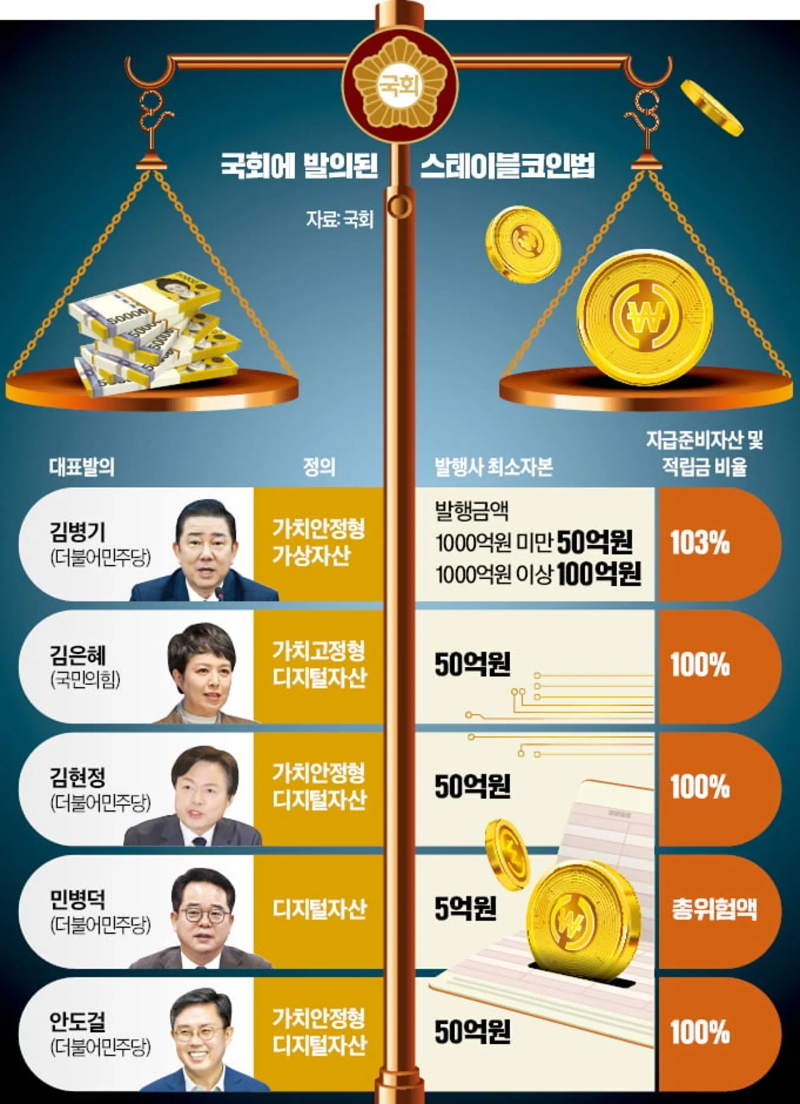
The floor leadership of the ruling Democratic Party of Korea has decided to directly pursue the institutionalization of stablecoins. It is interpreted as an attempt to fill the legislative void at the National Assembly level after the Financial Services Commission failed to speed up preparation of the second-stage virtual asset bill.
According to the National Assembly on the 25th, Kim Byeong-gi, floor leader of the Democratic Party, is preparing to lead the bill tentatively titled the "Act on Issuance of Value-Stable Virtual Assets and User Protection." Co-sponsors include Lee Jeong-mun, chair of the Democratic Party's Digital Asset Task Force (TF), and Kim Hyun-jung. With the ruling party floor leader taking the lead in filing the bill, observers expect it to be pushed essentially as party policy.
◇Must set aside 3% of issuance amount as a separate reserve
What stands out in the bill obtained by the Korea Economic Daily is that it applies differentiated capital requirements according to the size of stablecoin issuance. If the issuance amount is less than 100 billion won, the issuer must have 5 billion won in capital; if 100 billion won or more, it must have 10 billion won. This is interpreted as securing a certain level of soundness while opening issuance eligibility not only to banks but also to fintech firms with relatively smaller capital. However, the bill restricts conglomerate operations by stablecoin issuers so that virtual asset exchanges such as Upbit and Bithumb cannot directly issue stablecoins, aiming to prevent conflicts of interest.
The bill requires that, in addition to 100% reserve assets, issuers set aside at least 3% of the issuance amount as a separate reserve. Since stablecoins are designed to maintain value on a 1:1 exchange with fiat currency, they must hold reserve assets that are stable and immediately liquid. Reserve assets are limited to cash, government bonds of the currency-issuing country, and repurchase agreements (RP) maturing within three months. In addition, at least 3% of the issuance amount must be set aside separately to serve as a loss-absorbing mechanism in emergencies. An industry source said, "This appears to be a stronger regulation than the level required for stablecoins in countries such as the United States."
◇Overseas stablecoins also regulated
Stablecoin issuers must redeem in cash within 10 days if a user requests redemption. Provision of economic benefits such as interest or points on stablecoins is prohibited. However, considering early-stage activation, payment of interest and other economic benefits is exceptionally permitted within one month after issuance.
Regarding issuance infrastructure, the bill mandates the use of public distributed ledgers (public blockchains). This means issuance is allowed only on public networks such as Ethereum and Solana. The purpose is interpreted as securing transparency of reserve assets and a real-time verification system. Overseas operators must also register and obtain permission from the Financial Services Commission. This means dollar stablecoins such as USDT and USDC are included in the regulatory scope.
The Bank of Korea is given the ability to check stablecoin stability and the adequacy of reserve assets while the authority to grant permissions to issuers is vested in the Financial Services Commission. If stablecoins have a large impact on payments and settlements, the Bank of Korea may request suspension of transactions from the Financial Services Commission and can demand submission of related materials from issuers.
◇Government draft to be submitted to the National Assembly
With the ruling party floor leadership moving, expectations are rising that legislative discussion on stablecoins will proceed in earnest. Several stablecoin-related bills filed by ruling and opposition lawmakers, including Ahn Do-geol, Min Byeong-deok, Kim Hyun-jung of the Democratic Party, and Kim Eun-hye of the People Power Party, are already pending at the National Assembly. With Kim Byeong-gi preparing to file a bill as well, there is a view that legislation may accelerate. The Financial Services Commission is also preparing to submit a related bill including stablecoin regulation to the National Assembly.
A Financial Services Commission official said, "We agree with the overall direction of the members' bill, but details need to be discussed," adding, "A government draft has been prepared and interagency consultation remains." A National Assembly source said, "Because multiple related bills are usually merged into a single bill, this bill could have the effect of centering discussion on the ruling party's proposal."
However, coordination among related agencies such as the Ministry of Economy and Finance and the Bank of Korea is cited as a variable. Because stablecoins could affect monetary and foreign exchange policy, it has not yet been decided to what extent each agency will be involved. The Bank of Korea has signaled that strong regulation is needed, arguing that stablecoins could undermine the central bank's core authority over the safety of the payment and settlement system.
Reporters Jeong Sang-won / Jo Mi-hyeon / Seo Hyeong-gyo top1@hankyung.com

Korea Economic Daily
hankyung@bloomingbit.ioThe Korea Economic Daily Global is a digital media where latest news on Korean companies, industries, and financial markets.