

Trump "Now we can focus on the big picture"…Will he reach an economic and security 'big deal' with China?
Summary
- President Trump and President Xi Jinping have announced mutual visits next year, signaling that U.S.-China relations may be entering a thawing mood.
- The leaders' call and subsequent discussions reportedly covered issues important to investors, including economic cooperation, trade, and the resumption of U.S. agricultural exports.
- Possibilities of resolving disputes over tariffs, rare earths, and AI technology were mentioned, but there are also views that the technological hegemony struggle may continue.
Trump to visit China in April next year…U.S.-China relations in 'thawing mood'
First call since Busan 'trade truce'
Focused discussions on economic cooperation and Taiwan
Xi Jinping to make a state visit to the U.S. next year
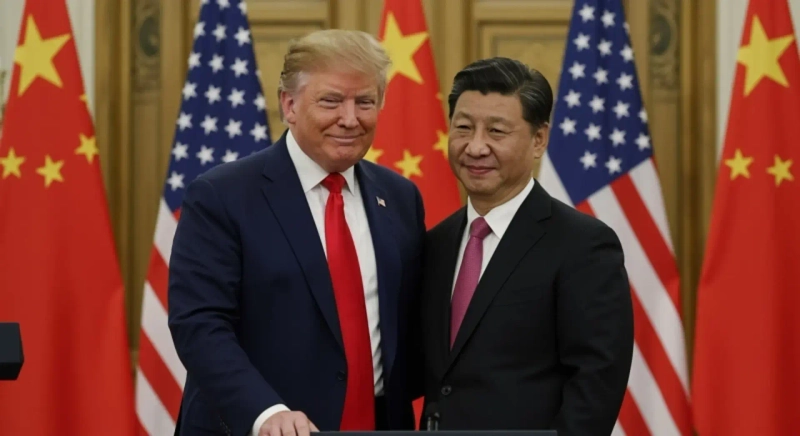
U.S. President Donald Trump said on the 24th (local time) after speaking with Chinese President Xi Jinping that he will visit Beijing in April next year and that President Xi will later make a state visit to the United States next year. It was the first call since the U.S.-China summit on October 30, when they declared a 'trade truce.' Analysts say U.S.-China relations may be entering a thawing mood.
President Trump wrote on social media immediately after the call, "I just had a very good call with President Xi," and called the call "a follow-up to the very successful meeting three weeks ago in Korea." He added, "Now we can focus on the big picture." He also wrote that "President Xi invited me to visit Beijing in April (next year), and I accepted," and that "(President Xi) will make a state visit to the United States sometime next year and will be my guest." He further wrote that "relations with China are very strong."
Xinhua News Agency reported that President Xi said on the call that "it has repeatedly been proven by practice that if China and the United States cooperate, it benefits everyone, and if they fight, everyone gets hurt." Xinhua said Xi explained China's position on the Taiwan issue, saying that "Taiwan's return to China is an important part of the postwar international order." Xinhua reported that President Trump said, "The United States understands the importance of the Taiwan issue to China."
As U.S.-China tensions ease, the atmosphere is emerging for the resumption of U.S. agricultural exports to China. According to ship schedules obtained by Reuters on the day, two U.S. freighters were heading to grain terminals near New Orleans to load U.S. soybeans for export to China. Another ship was scheduled to load sorghum at a grain terminal near Texas. Reuters reported that this is the first export of feed grains to China since mid-March.
Trump and Xi announce mutual visits next year…a full-fledged 'thawing mood'
Will disputes over tariffs and rare earths be resolved…Taiwan urgent for China
U.S. President Donald Trump said on the 24th (local time) after speaking with Chinese President Xi Jinping that "we can now focus on the 'big picture,'" drawing attention to what that big picture might be. Since the two sides, which have sustained conflicts over trade and security, entered a thawing phase through last month's U.S.-China summit in Busan and this leaders' call, there is speculation that the two sides may pursue a big deal on economic and security issues.
◇China raises the Taiwan issue
According to The Wall Street Journal (WSJ), the call was initiated by President Xi. WSJ said it was the first time in about 25 years that a Chinese leader had made the first contact with a U.S. president since then-Chinese President Jiang Zemin sent a telegram to U.S. President George W. Bush offering condolences after the September 11, 2001 terrorist attacks.
Xi's initiation of the call can be interpreted as an attempt to gain President Trump's support on the Taiwan issue. Xinhua reported that Xi said on the call that "Taiwan's return to China is an important part of the post-World War II international order." It is nothing other than pressure that "Taiwan is ours." Former U.S. President Joe Biden said, "I do not support Taiwan independence," but China wants the United States to go further and state that the U.S. is "against Taiwan independence."
China's state-run Global Times explained that "the Taiwan issue was mentioned in January and June calls between the two leaders, but it was not raised in the September call and the October summit," and added that "the fact that the Taiwan issue was raised again this time may be related to recent China-Japan tensions."
The official U.S. position is that it "opposes unilateral changes to the status quo across the Taiwan Strait." But President Trump has been reluctant to explicitly say whether the United States would militarily intervene if Taiwan were invaded. Georgetown professor Evan Medeiros told the WSJ, "President Xi is trying to draw the United States closer to China's thinking about Taiwan's future."
◇Both judge they need to 'focus on domestic affairs'
President Trump's concerns are focused on economic issues. He said about the call with President Xi that "we discussed a variety of topics such as the Ukraine-Russia war, fentanyl, and agricultural products like soybeans."
With his approval ratings plunging, President Trump urgently needs China's cooperation. If he cannot rein in inflation driven by tariff policies, he could lose to the Democrats in next year's midterm elections. That is why the United States cannot cut off cheap Chinese goods. Exports of U.S. agricultural products such as soybeans and sorghum are a key factor that influences the electorate in core support bases. Finalizing an agreement related to the temporary handling of rare earth export controls, which has been shelved as a stopgap measure, is also a key issue.
There are also many security areas where the two sides must cooperate. Regarding the Ukraine war, the United States expects China to support a peace plan and pressure Russia. Chinese state media reported that when Xi focused on the Taiwan issue during the call, President Trump brought up Ukraine to change the subject, and Xi "expressed support for all efforts toward peace." The United States also does not want military conflicts between the two sides in the Indo-Pacific region to deepen excessively.
China likewise needs U.S. cooperation. Although there have been persistent calls to supplement its export-led economic structure with domestic demand stimulus, doing so is not easy.
If the U.S.-China competition for hegemony continues, China must accept not only increased military spending but also slower progress in AI, a core of future competitiveness. If it shifts to a cooperative relationship with the United States, China would gain the strength to continue promoting the Belt and Road Initiative in Central Asia and Southeast Asia. Another advantage would be avoiding exhausting tensions with the United States in Latin America, Africa, and other parts of the Global South.
Given President Trump's mention of the big picture, there is a possibility that the two leaders will, within the limits of their aligned interests, compile economic and security issues and agree to set mutual boundaries and not violate them in a gentleman's agreement. In that case, the world could enter a full-fledged 'G2' (two major powers) era.
It is unlikely that the United States will concede to the level China wants on issues such as Taiwan. It is also uncertain whether Russia and European countries will respond favorably to an agreement between the two powers. Even if the United States and China reconcile their tariff war, many point out that the technological hegemony struggle over AI and semiconductors is likely to continue.
Washington= Sang-eun Lee / Beijing= Eun-jung Kim correspondents selee@hankyung.com

Korea Economic Daily
hankyung@bloomingbit.ioThe Korea Economic Daily Global is a digital media where latest news on Korean companies, industries, and financial markets.