

Gold and silver hit record highs again as U.S. pressures Venezuela…Goldman: "Gold will reach $4,900 by the end of next year"
Summary
- It reported that geopolitical tensions, such as the U.S. blockade of Venezuelan oil, expanded, pushing gold and silver to record highs at $4,400 per troy ounce and $69.45, respectively.
- Wall Street expects the precious metals bull market to continue next year, supported by Fed rate cuts and a weaker dollar.
- Major institutions such as Goldman Sachs and JPMorgan said gold prices could rise to as much as $5,055 per troy ounce next year.
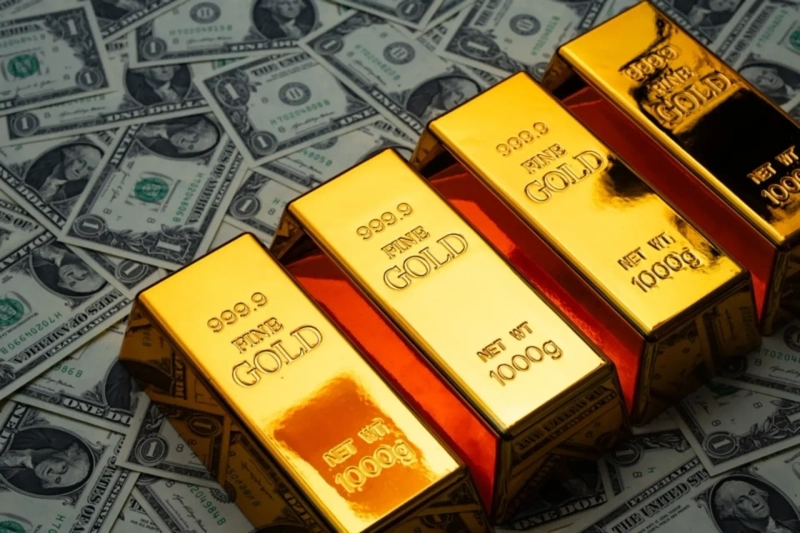
As the United States expanded geopolitical tensions by tightening an oil blockade targeting the Nicolás Maduro regime in Venezuela, the prices of safe-haven assets gold and silver again reached record highs. Due to the gold rush that has continued since the beginning of the year, gold's annual return reached 70%. Wall Street expects that, with the U.S. central bank (Fed) cutting rates and a weaker dollar, the precious metals bull market will continue next year.
○Spot gold breaks $4,400 per ounce
According to Bloomberg on the 22nd, the international spot price of gold exceeded $4,400 per troy ounce for the first time that day. It opened at $4,339.01 per troy ounce at 0:00 (U.S. Eastern Time) and surged to $4,409.57 intraday. This marked another record high after surpassing $4,350 in October. The spot price of silver also maintained its upward trend, reaching $69.45 intraday, following the previous day. In particular, silver, which has been on a steep rise since November, has jumped more than 140% so far this year. Bloomberg said, "Both gold and silver are expected to record their largest annual gains since 1979," explaining that "gold prices surged thanks to increased central bank buying and inflows into gold spot-based exchange-traded funds (ETFs)."
As geopolitical tensions over sanctions on oil tankers intensified recently, global capital appears to have flowed into safe-haven assets. On the 16th, U.S. President Donald Trump announced that he had designated the Maduro regime as a foreign terrorist organization and said that sanctioned tankers bound for Venezuela would be fully blocked. This move aims to block Venezuela's main source of revenue, oil exports, and exert economic pressure on the Maduro regime.
According to Reuters, U.S. forces have seized two sanctioned tankers so far. The previous day, the U.S. Coast Guard said it was tracking the tanker 'Bella 1', which is on the U.S. Treasury's sanctions list, in international waters near Venezuela. Foreign media reported that the vessel was heading to Venezuela to load crude oil. It transported Venezuelan crude to China in 2021 and also has a history of transporting Iranian crude.
Ukraine is expanding the theater of war to the sea, including airstrikes on tankers of the Russian shadow fleet in the Mediterranean. The Ukrainian Security Service (SBU) officially confirmed on the 19th that it had attacked four tankers belonging to the Russian shadow fleet with drones in recent weeks. It was the first official acknowledgment of attacks on Russian tankers since the outbreak of the Russia-Ukraine war.
○'Bullish case' gains strength from Fed's rate-cutting stance
Major investment banks said that gold's appeal would increase as the U.S. central bank (Fed) is expected to cut rates. In a commodities outlook report on the 18th, Goldman Sachs said, "Gold prices will rise to $4,900 per troy ounce by the end of next year," adding, "This forecast could rise further if individual investors expand demand to diversify assets within their portfolios." JPMorgan said that gold could hit $5,055 per troy ounce in the fourth quarter of next year. The firm observed that "recently gold has become both a means to defend against the decline in monetary value and an asset that can attract safe-haven demand away from U.S. Treasuries and money market funds (MMFs), which are dollar-denominated." Morgan Stanley predicted that gold prices could reach $4,500 per troy ounce by mid-next year.
After the release of the U.S. Consumer Price Index (CPI) for November on the 18th, the market raised its probability outlook for Fed rate cuts. Data collection was hampered by a federal government shutdown, but the CPI undershot expert forecasts and the core CPI, which excludes volatile energy and food, was the lowest since April 2021.
According to the CME FedWatch tool, the interest rate futures market reflects a 77.9% probability that the policy rate will be held steady at the January FOMC next year, while the probability of a 0.25% point cut at the March FOMC is priced at 45%, up from 42.4% a week earlier. Dillin Wu, a strategist at the Pepperstone Group, told Bloomberg, "The recent rise in gold prices was due to preemptive moves around expectations of further Fed rate cuts."
On the day, major metals such as copper, aluminum, zinc, and nickel also strengthened. In particular, copper is expected to continue rising as demand surges centered on AI data centers. Citigroup predicted that copper, currently around $11,800 per ton, could reach $13,000 per ton in the second quarter of next year.
Oil prices also rose in the 1% range. Global benchmark Brent futures traded at $61.13 per barrel on the London ICE Futures exchange, up 1.09% from the previous session during intraday trading (4:35 p.m. KST). At the same time, West Texas Intermediate (WTI) futures traded on the New York Mercantile Exchange also rose 1.15% to $57.17.
Reporter Han Kyung-je

Korea Economic Daily
hankyung@bloomingbit.ioThe Korea Economic Daily Global is a digital media where latest news on Korean companies, industries, and financial markets.