

"17.5 million won became 50 million won"…dilemma of overseas Korean retail investors
Summary
- The government announced the introduction of the "domestic market return account (RIA)," which would reduce capital gains tax on overseas stocks by up to 100% to induce overseas Korean retail investors to return to the domestic market.
- Individual investors can also use currency-hedging products to receive tax benefits, and a 5% income deduction of the purchase amount is available.
- However, opinions that the scale of the tax benefits is limited were raised, so market views on the actual effect are mixed.
Overseas Korean retail investors, if 'the bureau chief returns' capital gains tax exempt
Government announces verbal intervention and tax support simultaneously…exchange rate 'sudden brake'
Domestic stocks held for over one year qualify for tax benefits even for investors hedging currency
Foreign exchange authorities dump dollar supply…exchange rate plunges 33.8 won to 1,449.8 won
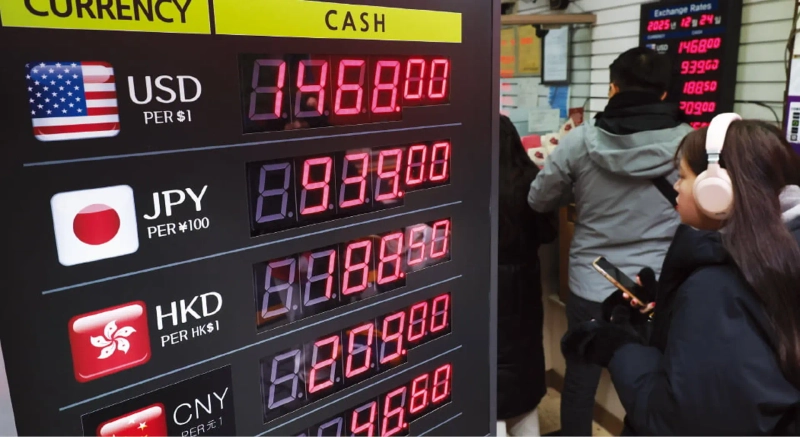
The government said it will cut capital gains tax on overseas stocks by up to 100% for 'overseas Korean retail investors' returning to the domestic market. It also said it would introduce currency-hedging products that individual investors can use. On the 24th, the foreign exchange authorities unusually made strong verbal interventions while announcing such measures to improve foreign exchange market supply and demand. In addition, large dollar sell orders presumed to be actual interventions emerged, pushing the won-dollar exchange rate, which had been above 1,480 for two consecutive days, below the 1,450 level.
The Ministry of Economy and Finance announced the "domestic market return account (RIA)" as part of the "domestic investment and foreign exchange stabilization tax support measures." Currently, capital gains from selling overseas stocks are subject to a 22% tax. However, if an individual investor sells overseas stocks held as of December 23 through an RIA account and invests the proceeds in domestic stocks or equity funds for long-term investment for one year, the capital gains tax will be exempt for one year.
The market expects that some profit-taking on overseas stocks will occur, leading to portfolio adjustments, but some argue its effectiveness is limited, noting the 50 million won sales cap per person.
The government will also introduce a "forward foreign exchange sell product for individual investors" so retail investors can hedge currency and receive tax benefits. Purchasing this product allows a 5% income deduction of the purchase amount when calculating capital gains tax on overseas stocks. When an individual sells forward FX, the bank that buys it will sell dollar spot in the market to neutralize its dollar position. As a result, dollar supply in the market increases.
Shortly after the market opened that day, strong verbal interventions were made in the name of bureau-level officials of the foreign exchange authorities. Kim Jae-hwan, Director General of International Finance at the Ministry of Economy and Finance, and Yoon Kyung-soo, Director General of the International Department at the Bank of Korea, issued strong statements saying, "Excessive won weakness is undesirable. You will soon see the government's strong will and its ability to implement policy."
The exchange rate, which had closed above 1,480 for two consecutive trading days on December 22–23, widened its decline in steps and closed at 1,449.80. It fell 33.80 won from the previous day, marking the largest drop in three years and one month. On the Korea Exchange, foreign investor funds flowed in. Foreigners, who showed nearly 90 billion won in net selling early in the session, turned to net buying and recorded net purchases of about 520 billion won that day.
The sooner the 'bureau chief U-turn,' the greater the tax benefit…100% in Q1 next year, 80% in Q2
The sooner the 'U-turn,' the more tax burden is eased…mixed views on the measure's effectiveness
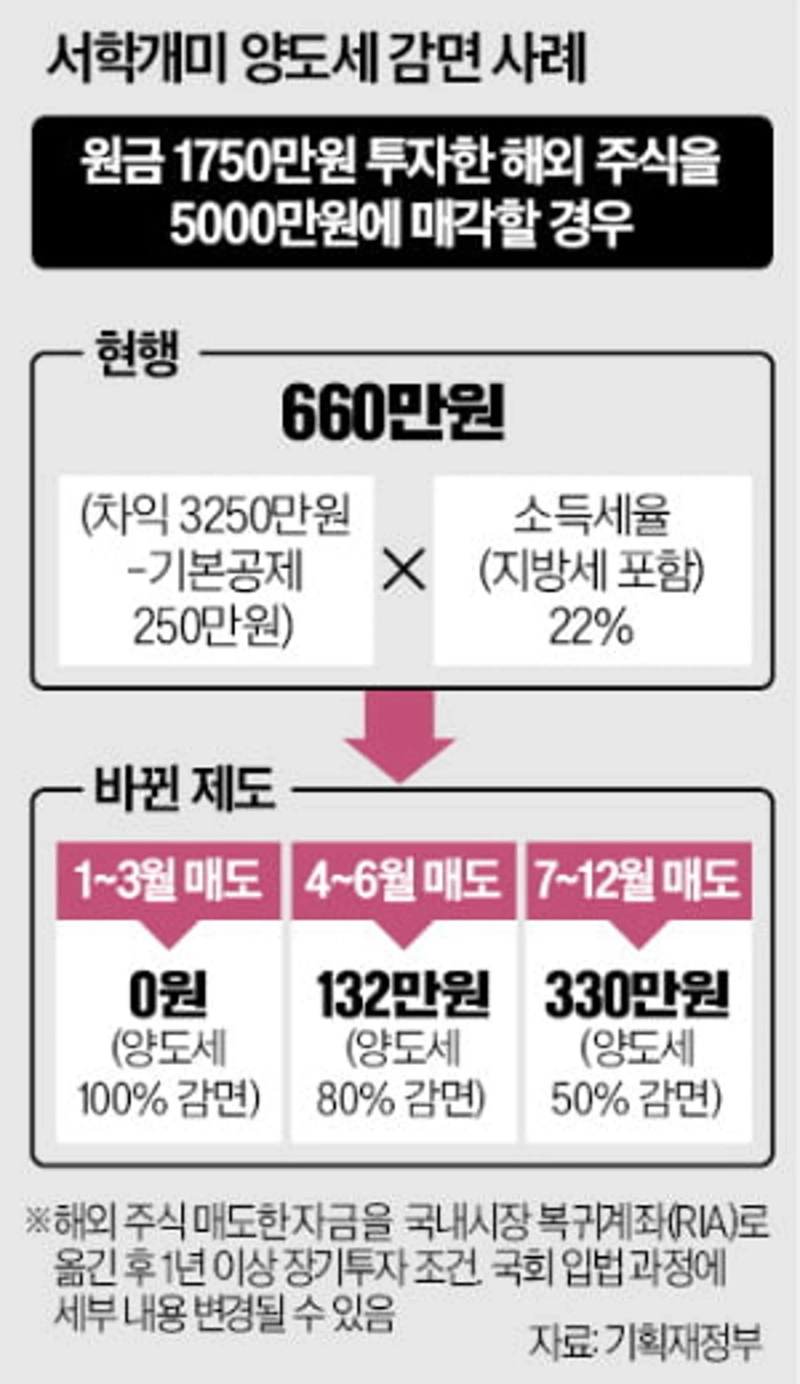
A few years ago, Mr. A, an overseas Korean retail investor, bought U.S. stocks for 17.5 million won that rose to 50 million won, prompting him to consider when to realize gains. Currently, he would have to pay capital gains tax of 22% (including local tax) on the 32.5 million won gain, which is 6.6 million won. However, if he sells the overseas stocks through the "domestic market return account (RIA)" within the first quarter of next year, converts to won, and makes long-term investments in domestic stocks, he would not have to pay any tax.
Even if only 10% return, 46 trillion won flows into domestic market
Among the "domestic investment and foreign exchange stabilization tax support measures" announced by the Ministry of Economy and Finance on the 24th, the tax benefit for the domestic market return account (RIA) is seen as a measure to induce overseas Korean retail investors to return to the domestic stock market and calm the exchange rate. This year, with global stock markets and the exchange rate both rising, many retail investors want to realize gains but are reluctant to bear capital gains tax on overseas stocks.
The Ministry established the RIA as a dedicated stock account for overseas Korean retail investors to pave the way for their return to the domestic market. It applies only to overseas stocks and overseas equity funds with trading contracts concluded by December 23 and will operate for one year.
If proceeds from selling overseas stocks in an RIA are converted to won and invested in domestic stocks or equity funds for at least one year, capital gains tax on the gains will be reduced by 50–100%. If the entire return process (selling overseas stocks, converting currency, and buying domestic stocks) is completed in Q1, 100% relief applies; Q2 gets 80%; the second half of the year gets 50%. The faster investors return to the domestic market, the lower their tax burden.
To prevent tax benefits from concentrating among wealthy investors, discussions are underway to limit the tax reduction to sales amounts up to 50 million won per person. Exact investment periods, sales amounts, reduction rates, and other details for eligibility will be included in the Restriction of Special Taxation Act after deliberation in the National Assembly.
According to the Korea Securities Depository, as of December 23 this year, overseas Korean retail investors held 175.4 billion dollars in overseas stocks. The Ministry expects that even if only 10% of that returns to the domestic market, about 46 trillion won worth of dollars would be converted to won and flow into the domestic stock market.
A "forward foreign exchange sell product for individual investors" that allows investors to lock in profits at a pre-set exchange rate will also be launched. If an overseas Korean retail investor purchases this product, 5% of the purchase amount will be allowed as an income deduction when calculating capital gains tax on overseas stocks. The annual purchase limit will be set at 100 million won, allowing a maximum income deduction of 5 million won.
"Actual tax benefit not large" reactions too
Among investors, some said they would shift part of their portfolio from overseas stocks to domestic stocks. As the U.S. market has cooled while the KOSPI is expected to perform better next year, many see this as a timely opportunity. Mok Dae-gyun, CEO of KCGI Asset Management, advised, "Global capital is moving from the U.S. to non-U.S. markets," and said, "Next year, increasing Korea exposure relative to the U.S. is a good strategy."
However, some investors said the RIA's tax benefit cap might be too small. If the sales amount is limited to 50 million won, the actual benefit might be limited. For example, an investor who invested 40 million won and earned a 25% return and sells 50 million won worth of overseas stocks would receive a tax reduction of about 1.65 million won (22% tax applied on 7.5 million won after subtracting the basic exemption of 2.5 million won). Even with a relatively high 25% return, the benefit remains in the hundred-thousand-won range. A private banker (PB) at a securities firm said, "Overseas Korean retail investors particularly trust U.S. stocks," and added, "They are unlikely to sell promising U.S. stocks just for that level of benefit."
There is also the possibility of various loopholes. For example, investors might receive tax benefits while selling existing domestic stocks and repurchasing overseas stocks. A securities firm official said, "As the domestic stock market heats up, cases of simultaneously buying overseas and domestic stocks have increased," and added, "Some investors will try to maintain their portfolio weights using this method."
Reporters Nam Jeong-min / Jung Young-hyo / Park Han-shin peux@hankyung.com

Korea Economic Daily
hankyung@bloomingbit.ioThe Korea Economic Daily Global is a digital media where latest news on Korean companies, industries, and financial markets.