

"If the U.S. market rises and the Korean market falls, who will be held responsible?"…Retail investors in turmoil
Summary
- The government's tax benefit policy applies to overseas-listed ETFs but is not applied to domestically listed U.S. ETFs, raising controversy.
- The capital gains tax reduction under the RIA system could be exploited as tax-saving manipulation, and the dollar inflow effect may be limited.
- The securities industry warned that exchange rate changes, delays in system construction, and issues of effectiveness and fairness could increase investor confusion.
Both track the NASDAQ100… QQQ gets a break, TIGER faces 49% taxation
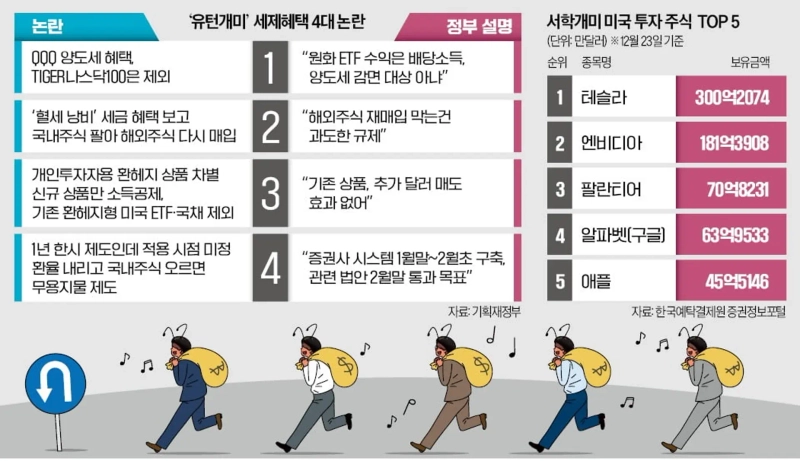
Four major controversies over capital gains tax benefits for 'U-turn' retail investors
① U.S.-listed ETFs receive benefits when returning to Korea… Korean-listed U.S. ETFs are subject to dividend tax
② Cannot prevent tax-avoidance trading for tax savings
③ Existing currency-hedged ETFs also excluded
④ Legal amendment and system construction needed

After the government announced tax measures to provide tax benefits to so-called 'U-turn' retail investors who sell overseas stocks and return to the domestic market, controversy over effectiveness and fairness has erupted in the securities industry. Critics point out that even though these are ETFs that track overseas indices such as the S&P500 and NASDAQ100, benefits are given to ETFs listed in the U.S. market while domestically listed products are excluded. There are also concerns that wealthier investors may reap tax-saving benefits while the government's intended dollar inflow effect may be limited.
Controversy over excluding domestically listed U.S.-tracking ETFs
According to the Ministry of Economy and Finance on the 25th, the investment products eligible for capital gains tax reduction through a domestic market return account (RIA) are limited to overseas stocks and ETFs listed overseas. This means that U.S.-listed 'Invesco QQQ' (tracking the NASDAQ100) and 'SPY' (tracking the S&P500) receive benefits, but domestically listed ETFs such as 'TIGER NASDAQ100' and 'KODEX U.S. S&P500' listed by Mirae Asset and Samsung Asset Management are not included among the reduced-tax products. The government announced the policy yesterday to reduce capital gains tax for individual investors who sell overseas stocks and invest the proceeds in domestic stocks for one year through an RIA. A representative from a domestic asset manager said, "QQQ and TIGER NASDAQ100 have the same product structure in that they track the NASDAQ100 index and diversify into U.S. stocks," and added, "It is not fair to discriminate based on the listing location when selling overseas assets and converting to won is the same."
In response, a Ministry of Economy and Finance official explained, "The tax reduced through RIA is the capital gains tax from stock trading," and "Trading profits from domestically listed ETFs are taxed as dividend income, which requires withholding tax data in the taxation process, so product design would take a long time and was not included in this tax measure." This can be interpreted as meaning that domestically listed ETFs were excluded in the rush to prepare measures. Currently, overseas-listed ETFs are subject to a 22% capital gains tax on trading profits, while trading profits from domestically listed ETFs are classified as dividend income and taxed at a rate of 15.4%.
In particular, dividend income tax becomes subject to comprehensive financial income taxation if interest and dividend income exceed 20 million won annually, raising the top tax rate to 49.5%, which could increase the benefit of a tax reduction. A Ministry official also added, "If the exchange rate does not stabilize despite this measure, we may consider tax benefits for sales of domestically listed ETFs in the future."
Tax-saving trading for the sake of tax reduction is obvious
There are many criticisms that the capital gains tax reduction system using RIA could be used as a tax-saving tool rather than achieving the expected dollar inflow effect. If an investor sells overseas stocks up to the maximum limit eligible for tax relief through RIA (50 million won) and uses the funds to purchase domestic stocks, they can avoid the 22% capital gains tax. At the same time, if they sell domestic holdings purchased through the RIA in a regular account and use the funds to repurchase overseas stocks, they can realize overseas stock capital gains without paying tax while keeping their stock portfolio unchanged. Investors would only bear the securities transaction tax incurred in this process. A private banker (PB) at a securities firm advised, "For investors who can invest simultaneously in the U.S. and domestic markets and can lock their overseas stock proceeds in the domestic market for one year, realizing overseas stock capital gains is unconditionally advantageous." A government official said, "Restricting actions such as selling and repurchasing overseas stocks could be excessive regulation," and added, "If the policy is abused contrary to its intent, we can prepare supplementary measures."
There is also controversy in the securities industry over the ratio of domestic stocks and domestic equity funds that must be invested with the funds from overseas stocks sold through the RIA. Some argue that selling 10 million won worth of Tesla stock and using the money to buy just one share of Samsung Electronics could still qualify for capital gains tax exemption. In response, a government official said, "To receive the tax benefit, you must in effect invest the entire amount from selling overseas stocks into domestic stocks and funds."
"If the exchange rate falls, investment demand will drop significantly"
The 'forward foreign exchange sell product for individual investors' that provides an income tax deduction of 5% of the purchase amount (maximum limit of 5 million won) has also sparked reverse discrimination controversy. The government says it will grant benefits only to newly launched hedging products by securities firms. This means existing hedged investment products already traded in the market will not receive tax benefits. A Ministry official explained, "New hedging transactions supply dollars newly to the foreign exchange market, but existing hedged products do not have this effect." The industry voices concern that "investors who previously bore hedging costs to defend against foreign exchange risk are effectively being discriminated against."
In the securities industry, there are doubts about whether securities firms can build systems for tax reductions by the government's target of February. There is also the possibility that the system could change during legislative discussions in the National Assembly. The securities industry worries that if the exchange rate falls and stabilizes next year, demand for products designed during a high-exchange-rate period could drop sharply. Some say it is not desirable for the government to pursue policies that seem to encourage domestic investment instead of U.S. investment. A former CEO of a major securities firm said, "Investment decisions are a personal matter, but this measure sends a message that investing in the U.S. is a loss and investing in Korea is a gain," and asked, "If the U.S. market rises further next year and the Korean market falls, who will be held responsible?"
Reporters Nam Jeong-min / Jung Young-hyo / Park Joo-yeon peux@hankyung.com

Korea Economic Daily
hankyung@bloomingbit.ioThe Korea Economic Daily Global is a digital media where latest news on Korean companies, industries, and financial markets.