

'Seohak Ants' even being squeezed by exchange rate measures…Will the trend reverse? [Analysis+]
Summary
- The government recently announced measures to stabilize the won-dollar exchange rate, tighten overseas investment, and provide tax support.
- Experts said foreign exchange supply-demand could temporarily improve due to National Pension Service hedging and corporate tax incentives.
- However, the prevailing view is that these measures will likely calm short-term surges and manage volatility rather than cause a trend reversal in the exchange rate.
Verbal intervention and tax support measures pushed the rate below 1,450 won
But 'tightening overseas investment'…"Contrary to expansionary fiscal stance"
"Expect supply-demand improvement from corporate tax incentives and National Pension exchange-rate hedging"
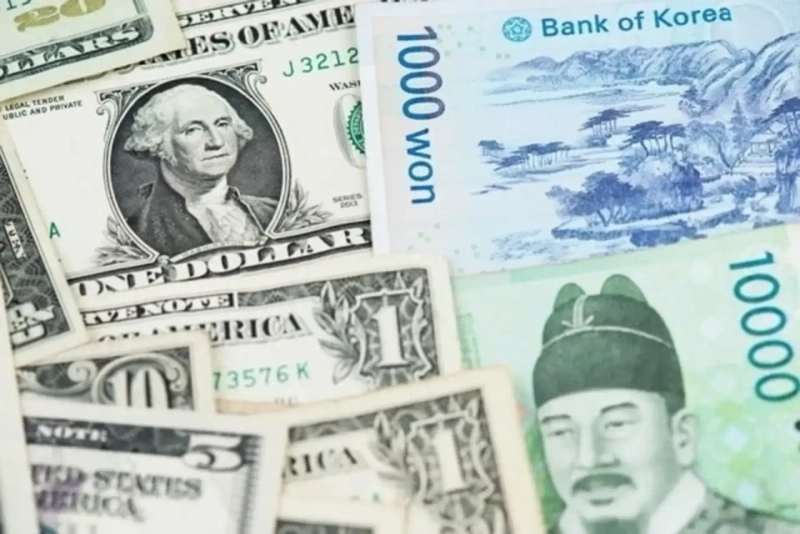
Financial authorities are making strenuous efforts to stabilize the sharply rising won-dollar exchange rate by rolling out measures to stabilize the foreign exchange market. On the 26th, the securities industry formed a consensus that, depending on government policy, the upward trend in the exchange rate would ease. The government pressured securities firms to reduce the intensity of overseas stock investment sales, while offering tax incentives to investors and companies that bring dollars held abroad back into the country. In addition, supply-demand factors are expected to improve with exchange-rate hedging by the National Pension Service and the inflow of foreign funds into the government bond market ahead of inclusion in the World Government Bond Index (WGBI) scheduled for April next year. However, experts generally agree that it will be difficult for the won-dollar rate to continue a sharp downward trend after the short-term surge is calmed.
Won-dollar exchange rate falls into the 1,440 won range for the first time in 50 days…down 33 won
On the 24th at the Seoul foreign exchange market, the won-dollar exchange rate (as of 3:30 p.m.) closed weekly at 1,449 won 80 jeon, down 33 won 80 jeon from the previous day. The one-day drop was the largest since November 11, 2022 (59 won 10 jeon), when expectations of an end to U.S. interest rate hikes spread.
The sudden sharp fall in the exchange rate was due to the government's high-intensity exchange rate stabilization measures and verbal intervention. The Ministry of Economy and Finance and the Bank of Korea, immediately after the market opened on the 24th, issued a "foreign exchange authority market-related message" saying that "excessive weakness of the won is undesirable." Through verbal intervention, they put the brakes on the fall in the won's value.
In particular, the foreign exchange authorities emphasized that "holding a series of meetings over the past one to two weeks and announcing measures by each ministry and agency was a process of organizing the situation to show the government's strong will and comprehensive policy implementation capability, which will soon be confirmed."
The Finance Ministry then unveiled tax support measures for investors and companies that bring foreign currency into the country or mitigate foreign currency outflows.
Tightening overseas investment…Securities industry questions "effectiveness"
The attention-grabbing measure is the tax support for investors. The Finance Ministry established tax support for a domestic stock return account (RIA). If you sell overseas stocks held until the 23rd, convert them into won, and invest in domestic stocks for the long term, you will receive a reduction in capital gains tax on overseas stocks. It also decided to grant capital gains tax benefits when individuals use introduced forward foreign exchange sell products for exchange-rate hedging of overseas stocks.
Prior to this, the Financial Supervisory Service put the brakes on securities firms' overseas stock operations by inspecting overseas investment sales practices and guiding them to stop new marketing. On-site inspections are also being conducted for large securities firms and asset managers with large volumes of transactions in high-risk overseas products. Pressured securities firms have consecutively suspended operations such as running official Telegram channels that provided information on overseas stocks and events that cut overseas stock trading commissions.
Among experts, there is a skeptical view on the effectiveness of exchange-rate stabilization measures that restrict domestic investors' overseas investments.
Choi Ji-wook, a researcher at Korea Investment & Securities, said, "Looking at the Korea Securities Depository, the net buying of overseas portfolios by individual investors has recently slowed due to price adjustments in U.S. stocks," and added, "Tax support requires passage of related legislation, and considering the government's expansionary fiscal stance, the size of the tax reduction is unlikely to be large."
"Expect improvement in foreign currency supply-demand from corporate tax incentives and National Pension hedging"
The securities industry analyzes that some of the exchange-rate stabilization measures beyond tightening overseas investment will have a certain effect because various measures were announced comprehensively.
Among the tax support measures announced on the 24th, expanding the non-inclusion rate of dividends received by domestic companies from overseas subsidiaries from the existing 95% to 100% is expected to be effective.
Kwon Ah-min, a researcher at NH Investment & Securities, said, "Despite recent export strength, companies did not sell dollars due to uncertainties about investment in the U.S.," and added, "In other words, there is sufficient potential dollar selling volume, and this measure draws attention to the possibility of repatriation of dollars retained within overseas subsidiaries."
The extension of foreign exchange swap arrangements between the Bank of Korea and the National Pension Service is expected to materially improve foreign exchange supply-demand. On the 15th, the Bank of Korea and the National Pension Service extended a foreign exchange swap agreement with a ceiling of US$65 billion until the end of next year. When the National Pension Service purchases foreign assets, it will first be supplied with dollars from foreign exchange reserves and return them later, which is expected to indirectly ease downward pressure on the won.
Directly, Choi Ji-wook expected that the National Pension Service's hedging volume would come out and help stabilize the exchange rate. The task force judged that the current exchange rate had risen excessively due to psychological anxiety, and it is interpreted that hedging volumes betting on a future weakening of the dollar could be released. The Ministry of Health and Welfare announced on the 23rd that it will operate a "Strategic Exchange-Rate Hedging Flexible Response TF" consisting of the National Pension Service's fund management headquarters as members.
In the medium to long term, foreign exchange supply-demand is expected to improve with Korea's inclusion in the FTSE WGBI. It is scheduled to be included gradually in eight stages from April to November next year. Jeong Yong-taek, a researcher at IBK Investment & Securities, said, "Korea will be included with a weight of 2.08% of the total index," adding, "Since the global bond passive funds tracking this index amount to about 3,400 trillion won, the market expects inflows of up to about 50 trillion to 70 trillion won."
"Government policy aim likely to be volatility management rather than trend reversal"
However, experts generally agree that it will be difficult for the exchange rate to continue a large decline due to the government's policy effects. They say the measures are likely to calm short-term surges by easing psychological anxiety.
Lee Jin-kyung, a researcher at Shinhan Investment Corp., said, "The government's foreign exchange market stabilization measures will have a meaningful effect in calming the short-term surge in the exchange rate triggered by dollar supply-demand concerns," and added, "In the short term, the won-dollar exchange rate could stabilize downward to the low-to-mid 1,400 won range per dollar." However, she forecasted, "The mid- to long-term exchange rate trend will seek direction reflecting external conditions and fundamental economic factors."
Jeong Yong-taek also said, "Among the many policies recently announced by the government, the most noticeable and repeatedly used word is 'temporary,'" explaining, "The exchange-rate stabilization policy can be interpreted as an attempt to manage the heightened volatility now rather than fundamentally change the situation or trend."
Han Gyeong-woo Hankyung.com reporter case@hankyung.com

Korea Economic Daily
hankyung@bloomingbit.ioThe Korea Economic Daily Global is a digital media where latest news on Korean companies, industries, and financial markets.