

Fed chair·Trump's visit to China·U.S. midterms…'Three major inflection points' that will determine the direction of the economy
Summary
- It said that the replacement of the U.S. central bank (Fed) chair this year and the possibility of interest rate cuts, as well as concerns about Fed independence being undermined, could have a major impact on the bond market.
- It stated that President Trump's China policy and U.S.-China summits could introduce significant volatility to the global economy and trade markets over tariffs, rare earths, and Taiwan.
- It said that depending on the U.S. midterm elections results, the Trump administration's ability to push economic and tariff policies could weaken, prolonging global uncertainty.
This year's global 'big events' lined up
(1) Birth of a 'Trump Fed' imminent
If independence is undermined, shock to the bond market
Wall Street: "Likely to cut rates twice this year"
(2) Four rounds of 'ping-pong diplomacy' between the U.S. and China
Tariff negotiations possible at the April talks
Tensions over Taiwan and rare earths persist
(3) November midterm evaluation of Trump's policies
Republicans may lose majority status
If early lame duck occurs, policy momentum will wane
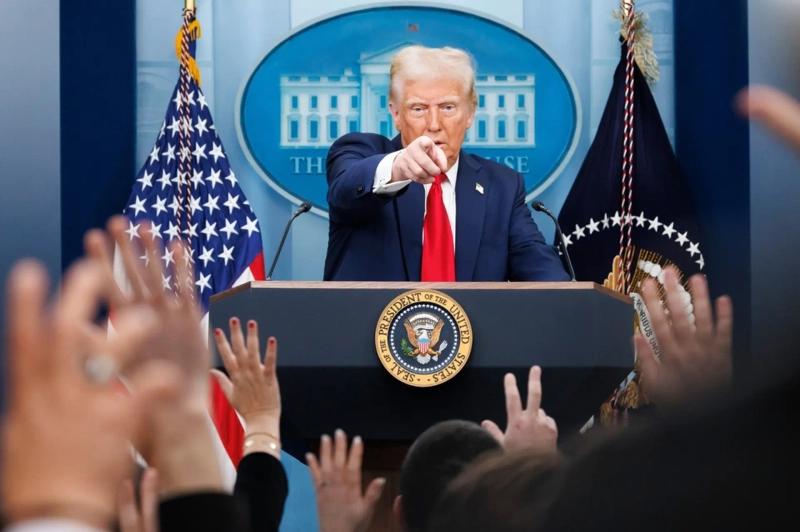
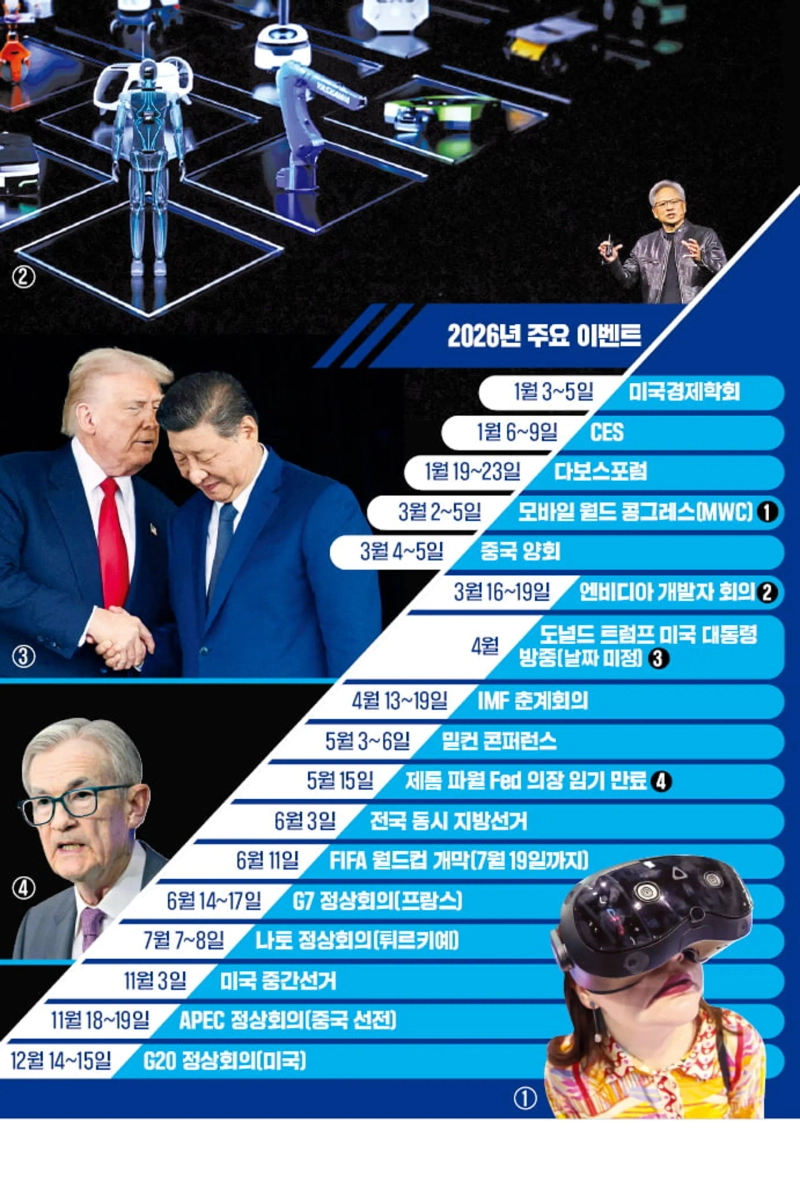
The global economy entered 2026 in a situation that is less uncertain than last year. 2025 began amid extreme anxiety about where the trade and immigration policies of the newly inaugurated second Trump administration would head. The United States has now finished tariff negotiations with most of its trading partners. That does not mean the fog has cleared. Even in the new year, while hard to predict, a series of 'big events' that could have a huge impact on the global economy are lined up. A prominent example is the nomination of Jerome Powell's successor as chair of the U.S. central bank (Fed), whose term expires in May. President Trump's visit to China in April and the U.S. midterm elections in November are also expected to be inflection points for the global economy.
Will Fed independence be undermined?
"The new Fed chair wants to cut rates when the market is doing well. No one who disagrees with me can be chair."
This was a post President Trump put on social media on the 24th, after news that the U.S. economy unexpectedly grew by 4.3% in Q3 last year. Pointing out that stock prices were falling in response to worries that the Fed would raise rates when good macroeconomic news came out, he argued that cutting rates when things are good would make for a 'marvelous' market.
President Trump is looking for someone who can realize this idea through interviews. For that reason, the market views Kevin Hassett, director of the White House National Economic Council (NEC) and one of Trump's closest economic aides, as the most likely candidate. This is the scenario Wall Street fears most: that closeness to Trump would undermine the Fed's independence. In that case, there are also concerns that 'bondholder panic' could lead to large-scale selling of U.S. Treasuries.
Former Fed governor Kevin Warsh and current governor Christopher Waller are also strong candidates. Both were originally hawkish in stance, but have lined up with Trump since his inauguration. They would be more independent compared with Hassett, but many predict that neither would be able to ignore President Trump's demands for rate cuts from the outset.
However, Wall Street believes it would be difficult to implement large rate cuts. New year U.S. economic growth forecasts remain solid in the low 2% range, and the current policy rate is close to the 'neutral rate' that neither hinders nor stimulates economic growth. Most Wall Street banks, including Goldman Sachs and Morgan Stanley, predict that the Fed will cut the current annual rate of 3.50~3.75% twice (a total of 0.5% points) during 2026.
Accordingly, Wall Street expects the 10-year U.S. Treasury yield this year to trade in the 3.75~4.55% range. Furthermore, expectations that the U.S. Treasury will aggressively increase bond issuance to support large tax cuts are pushing bond yields up.
Will the U.S.-China trade war end?
President Trump is scheduled to meet Chinese President Xi Jinping four times this year. The outcome of these meetings is expected to determine the direction of the global economy.
Under Trump's second administration, U.S.-China tensions have seen periods of sharp escalation and de-escalation. The U.S. opened fire by applying high tariffs of up to 145%, and China responded with a prepared card of restricting rare earth exports. This conflict entered a truce when the two leaders met in Busan in late October for the first time in six years. The U.S. lowered tariffs on China and China postponed rare earth export controls for one year.
The first litmus test of the direction of bilateral relations will be President Trump's planned visit to China in April. President Trump will focus on economic issues such as getting China to import more U.S. agricultural products, but President Xi is likely to raise sensitive security issues such as Taiwan.
If the meeting concludes smoothly, President Xi is expected to return the visit to the United States in mid-year. The two leaders could meet twice more thereafter at the APEC summit in Shenzhen, China in November and the G20 summit in Florida, U.S. in December. Frequent meetings between the two leaders would signal a relaxation of tensions, which would be positive news for the global economy, including South Korea.
However, it is highly likely that the two countries will fundamentally continue to maintain a tense relationship. Some tariff adjustments and expanded cooperation may occur, but regulations and competition over key technologies and strategic resources are expected to remain. In particular, if the issue moves into security matters surrounding Taiwan, confrontation between the two countries will become more pronounced.
U.S. midterm elections that heighten uncertainty
The U.S. midterm elections scheduled for November will be a test of whether President Trump will enter an 'early lame duck' phase. In the 2024 elections, the Republican Party swept the presidency, the Senate, and the House, which provided the backdrop for President Trump to boldly push through even potentially controversial early policies. If either the Senate or the House loses ground to the Democrats in the midterms, many policies will face greater difficulty getting past congressional hurdles.
This year, 35 Senate seats and all 435 House seats are up for election. The 100-seat Senate, with six-year terms, holds elections for one-third of its seats every two years, and this year includes two additional special elections. Of the 35 seats, the Democrats are defending 13, while the rest are defended by the Republicans. The Republicans hold 53 of 100 Senate seats. While it is not very likely that they will lose majority status by losing four or more seats, some seats are expected to be taken by the Democrats.
All 435 House seats are up for election. Holding only 220 seats—just two more than the 218 needed for a majority—the Republican Party risks losing majority status in the House. Historically, the ruling party tends to lose seats in midterm elections. Dissatisfaction driven by rising prices and economic polarization is high. The election analysis outlet Cook Political Report classifies 20–25 districts as 'too close to call.' If the Democrats win just 4–5 of these seats, they would regain majority status.
Depending on the election results, it will be decided whether President Trump can continue to push through existing tariff policies. The Trump administration's contingency plan is to introduce other tariff measures if the Supreme Court rules early on that reciprocal tariff measures are illegal, but if it loses momentum by the midterms, it will lose its driving force. That said, it will be difficult for the United States to return to a free-trade stance, which could act as another source of uncertainty for the global trade order.
Washington=Lee Sang-eun / New York=Park Shin-young correspondents selee@hankyung.com

Korea Economic Daily
hankyung@bloomingbit.ioThe Korea Economic Daily Global is a digital media where latest news on Korean companies, industries, and financial markets.