

Lee Chang-yong "Exchange rate in the high 1,400-won range diverges from fundamentals…National Pension Service has large influence"
Summary
- Lee Chang-yong, governor of the Bank of Korea, said the recent exchange rate in the high 1,400-won range diverges significantly from fundamentals of our economy.
- He stated that the expansion of the National Pension Service's overseas investments is a major factor contributing to won depreciation and a supply-demand imbalance in the foreign exchange market.
- He said it is a major advance that the government, the Bank of Korea, and the National Pension Service have begun discussions to build a 'new framework' for overseas investments.
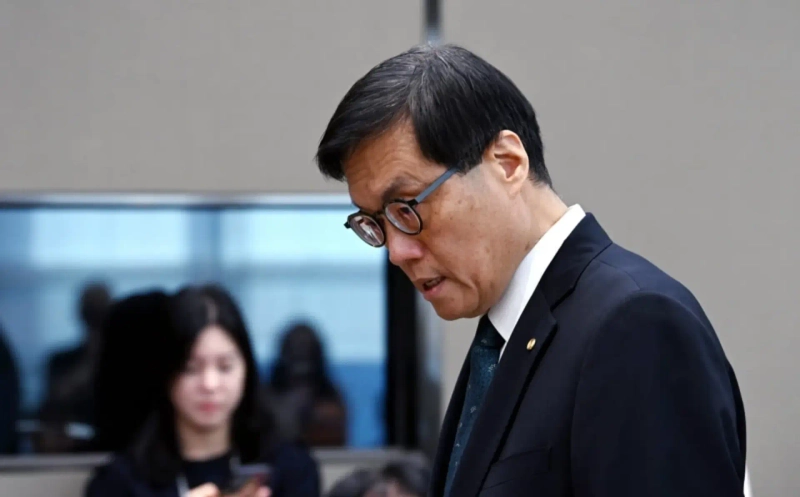
Bank of Korea Governor Lee Chang-yong assessed that the recent won-dollar exchange rate, which has risen to the high 1,400-won range, "diverges significantly from fundamentals." He also pointed out that "the National Pension Service has a large influence when looking at the won depreciation trend."
The governor said this in a New Year's address delivered at the Bank of Korea annex auditorium on Namdaemun-ro, Seoul, at the morning kickoff ceremony on the 2nd. The topic to which he devoted the largest portion of his New Year's address was the exchange rate. He expressed concern that "if a high exchange rate level persists, inflationary pressure could increase again," and that "it could increase the burden on ordinary people, act unfavorably for domestic companies, and deepen polarization."
Regarding the recent high exchange rate trend, the governor said, "It is difficult to determine an appropriate level for the exchange rate," but added, "the recent exchange rate in the high 1,400-won range appears to be at a level that significantly diverges from our economy's fundamentals." He cited the reasons for the higher exchange rate as "the growth rate and interest rate gaps between Korea and the U.S., and the Korea discount," and said, "to improve this, it is necessary in the medium to long term to strengthen domestic industrial competitiveness and expand investment incentives through improvements to capital market institutions."
However, he said the recent exchange rate movements were due to supply-demand factors. The governor said, "Since October last year, the won has depreciated relatively more than the movement of the dollar because the continuously increasing residents' overseas securities investment caused a supply-demand imbalance in the foreign exchange market that exerted strong short-term upward pressure on the exchange rate," and "the foreign exchange authorities had to implement a series of short-term measures as well."
He also emphasized the impact of the National Pension Service's overseas investments. The governor said, "Looking back over the past three years of won depreciation trends, the National Pension Service's overseas investments have been exerting greater influence in the foreign exchange market," and added, "I strongly feel the need to reevaluate the impact on the national economy as a whole alongside protecting the pension's long-term returns." He said, "The scale and timing of the National Pension Service's overseas investments and its currency-hedging operation strategies have been revealed to domestic and foreign markets in an overly transparent way, which has concentrated expectations of won depreciation in one direction and increased the likelihood of influencing the investment directions of other domestic and foreign economic agents."
He also said, "It is time to comprehensively examine how the continued expansion of residents' overseas investments affects our economic growth and the development of domestic capital markets," and warned, "Without reflection on this issue, a dilemma could repeat in which, while the foreign exchange authorities must sell dollars to manage the exchange rate, the National Pension Service mechanically buys dollars according to predetermined plans."
The governor said, "Against this awareness of the problem, it is a major advance that the Ministry of Health and Welfare has formed a task force for flexible responses to strategic currency hedging, and that relevant government ministries, the National Pension Service, and the Bank of Korea have agreed to cooperate to discuss building a 'new framework' for the National Pension Service's overseas investments," and added, "I hope improvement measures will be prepared soon."
Reporter Kang Jin-gyu josep@hankyung.com

Korea Economic Daily
hankyung@bloomingbit.ioThe Korea Economic Daily Global is a digital media where latest news on Korean companies, industries, and financial markets.