

PiCK
Lee Chang-yong shows vigilance over the exchange rate "Only domestically talk of 1,500 won, will manage expectations" [Hankyung Foreign Exchange Market Watch]
Summary
- Lee Chang-yong, Governor of the Bank of Korea, said there is a need to manage domestic institutions' exchange rate rise expectations.
- He said the National Pension Service's overseas investment pace should be adjusted when the exchange rate is high.
- He explained that expanding currency hedging and adjusting the share of overseas investments are necessary.
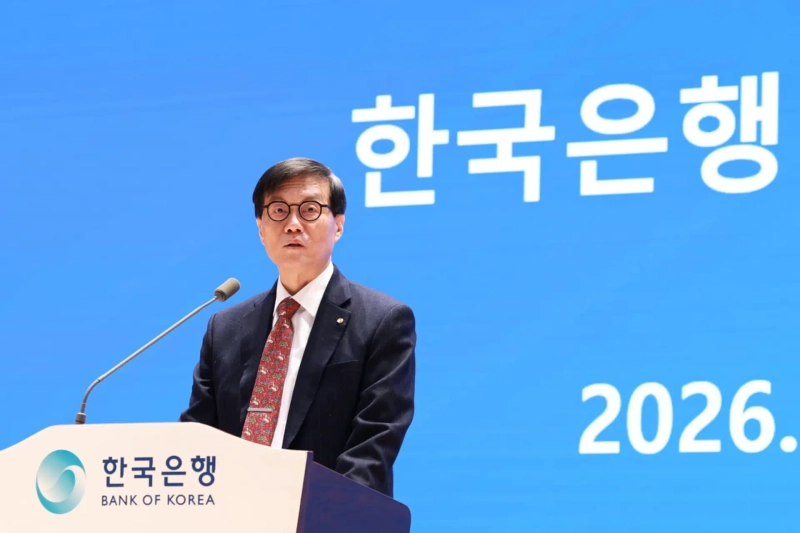
Lee Chang-yong, Governor of the Bank of Korea, said he would continue to maintain vigilance over the high-exchange-rate situation into the early part of the year. He said he would "manage the exchange rate increase expectations formed mainly among domestic institutions." Regarding the National Pension Service's overseas investments, he emphasized that "this is not about blaming them, but that there is no need to buy additional dollars at 1,480 won (a high exchange rate level)."
Governor Lee made these remarks on the morning of the 2nd after holding a New Year's ceremony at the Bank of Korea auditorium on Namdaemun-ro in Seoul and meeting with reporters. In response to the question, "Will vigilance in the foreign exchange market continue into the early part of the year?", he said, "The current exchange rate is being driven by the expectations of domestic institutions," and "there is a need to manage expectations." This suggested that the foreign exchange authorities' market interventions, which continued for year-end exchange rate management, could continue into the early part of the year. He said it was "difficult to talk about an appropriate exchange rate," but explained, "In many respects, it has diverged from the dollar index, and I think the fact that only our rate has risen a lot is because expectations are at work."
Governor Lee pointed out that, unlike overseas investment banks' (IBs) exchange rate forecasts, which are mainly in the low 1,400 won range, domestic institutions are forecasting higher levels such as 1,480 won and 1,500 won. He added, "There is an expectation that '(the U.S.-bound investment amount of) US$20 billion will be withdrawn, and the National Pension Service also mechanically makes overseas investments,'" and said, "This needs to be adjusted."
Regarding the US$20 billion overseas investment amount, he emphasized that "it will never proceed mechanically." Governor Lee said, "The Bank of Korea will act as the vault keeper," and "Monetary Policy Board members will not allow (foreign exchange reserves to be used) in situations that could affect the foreign exchange market."
Regarding the National Pension Service, he said that it is necessary to control the investment pace from a macroeconomic perspective. Governor Lee said, "Even if the National Pension Service makes overseas investments, there is no need to do so at the same pace when the exchange rate is 1,480 won as when it is 1,400 won," and added, "When the exchange rate is high, invest only what is necessary and delay the rest, and when the exchange rate falls, increase the pace — such adjustments are necessary."
Responding to criticism that "the National Pension Service is being mobilized and harming retirement returns," he explained, "When overseas investments affect the foreign exchange market and raise the exchange rate, returns on U.S. investments become very high, but the opposite happens when bringing them back in," and added, "Considering this, more currency hedging should be done than now, and the share going overseas should be reduced a bit." He added, "I am not sure whether this damages returns."
Governor Lee also mentioned that he is a scholar who emphasized the need for the National Pension Service's overseas investments. He served as head of the mid- to long-term investment policy team in the 'National Pension Service Mid- to Long-term Fund Management Master Plan Task Force' organized by the Ministry of Health and Welfare in 2004, when he was a professor in the Department of Economics at Seoul National University. At that time, he emphasized the need to gradually increase overseas investments while mentioning that there could be shocks to the foreign exchange market.
Governor Lee noted, "I was in favor of making overseas investments, but it is theoretically difficult to accept setting currency hedging at 'zero.'" He explained that it is necessary to fix returns when bringing overseas assets back in.
He also said that arguing for 0% currency hedging based on the Canadian case is not appropriate. Governor Lee explained, "Canada issues about 20% in dollar bonds to invest, so it has both dollar assets and dollar liabilities," and said, "This is equivalent to executing about 20% currency hedging." He added, "The National Pension Service said it would issue foreign debt to reduce its impact on the foreign exchange market, and since that provides currency hedging, I think it's a good method."
Governor Lee also said, "Another problem is that as the National Pension Service goes overseas, the domestic market cannot grow," and added, "Considering the national economy as a whole, we need to take into account the cost of people in our country not finding jobs and importers struggling as the exchange rate rises rapidly."
However, Governor Lee also emphasized that analyzing the causes of the high exchange rate is not to blame any specific economic actor. He said, "We have analyzed scientifically and objectively which parts affect the foreign exchange market," and added, "It's a pity that all analysis gets swept aside as if it's about blaming someone."
Reporter Kang Jin-kyu josep@hankyung.com

Korea Economic Daily
hankyung@bloomingbit.ioThe Korea Economic Daily Global is a digital media where latest news on Korean companies, industries, and financial markets.