

U.S. Department of Justice releases indictment against Maduro…claims "state-run drug trafficking" [Lee Sang-eun's Washington Now]
Summary
- The U.S. Department of Justice said the indictment names President Nicolás Maduro and his associates as the leaders of an international drug cartel that abused state institutions.
- It stated that the Maduro regime systematically protected drug trafficking for decades, securing illicit funds through cocaine smuggling.
- U.S. prosecutors emphasized that they applied serious charges such as conspiracy to use drugs for terrorism and conspiracy to import cocaine, saying they pose a threat to U.S. security.
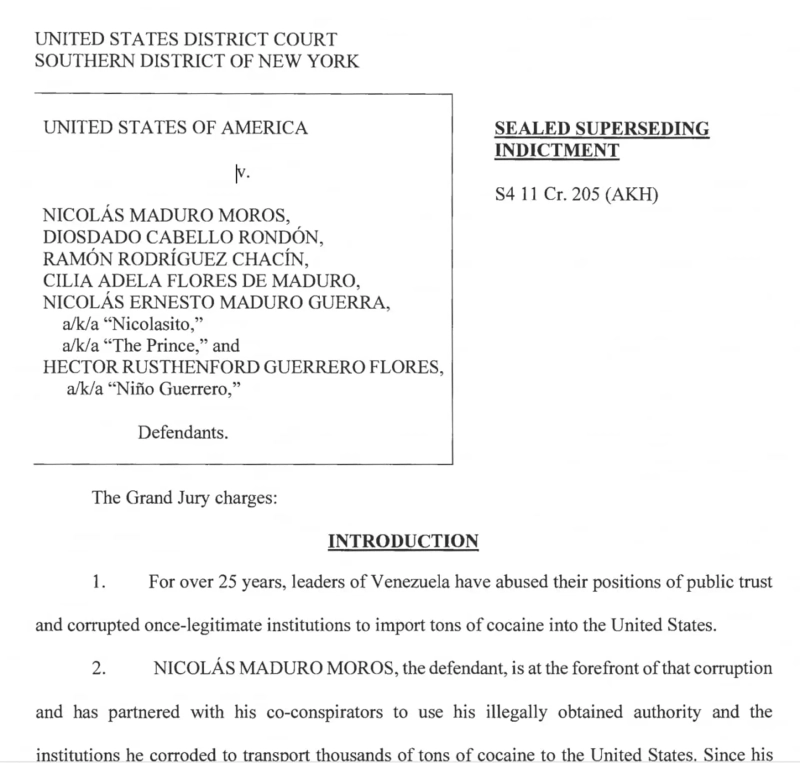
On the 3rd (local time), the U.S. government arrested Venezuelan President Nicolás Maduro and his wife and transferred them to New York. Amid growing controversy over whether the act is permitted under international law, the U.S. Department of Justice released that day the indictment charging President Maduro and his associates to bring them before a New York court.
In the indictment from the U.S. Attorney's Office for the Southern District of New York, U.S. prosecutors described President Maduro not as a mere corrupt politician but as the leader of an international drug cartel that abused state institutions for criminal purposes. The U.S. alleged that the Maduro regime, for more than the past 25 years, had transformed the Venezuelan government into a criminal enterprise known as the 'Cartel de Los Soles' and smuggled thousands of t of cocaine into the United States.
It went on to emphasize that officials of the Maduro regime had formed 'Narco-Terrorism' partnerships not only with foreign terrorist organizations such as the Revolutionary Armed Forces of Colombia (FARC) and the National Liberation Army (ELN), but also with violent organizations such as the Sinaloa Cartel (Mexico) and Tren de Aragua (TdA). Specifically, the U.S. government's analysis said FARC and ELN controlled cocaine production in the Colombian highlands; the Sinaloa Cartel and the Zetas controlled routes through Central America and border control from Mexico into the United States; and TdA controlled transportation networks within Venezuela and along the coast.
The indictment stated that they used drug proceeds to consolidate their power and, using illegally obtained authority, transported thousands of t of cocaine to the United States. It added that they waged a "relentless cocaine trafficking campaign" aimed at the United States and, as a result, "thousands of tons of cocaine were distributed in the United States."
The U.S. also included as a reason for the indictment that they abused Venezuelan organizations and authorities to systematically shield drug trafficking. For example, U.S. prosecutors alleged that between 2006 and 2008, when Maduro served as foreign minister, he helped drug traffickers evade international law enforcement by issuing Venezuelan diplomatic passports to them in exchange for money. The indictment also alleged that when bringing drug proceeds into Venezuela, they disguised private flights as diplomatic flights to evade inspection.
U.S. prosecutors alleged that Interior Minister Diosdado Cabello, a key figure of the Maduro regime, conspired between 2003 and 2011 to transport 5–20 t of cocaine at a time to the United States via container ships, and that Maduro's son Nicolás Ernesto Maduro Guerra (aka 'Nicolasito') used a jet owned by Venezuela's state oil company (PDVSA) around 2014–2015 to transport drugs from Margarita Island, with armed soldiers mobilized for plane loading operations, the U.S. prosecutors claimed.
The indictment stated that Maduro's wife Cilia Flores took bribes in return for arranging meetings between drug traffickers and the head of the drug enforcement agency, and that thereafter the trafficker paid an additional $100,000 each time a plane carrying cocaine took off, some of which went to Cilia Flores.
U.S. prosecutors brought four charges against them: conspiracy to commit narco-terrorism, conspiracy to import cocaine into the United States, possession of machine guns and destructive devices, and conspiracy to possess weapons.
U.S. prosecutors said that their actions were 'hostile acts' against the United States, citing as evidence a recording of a meeting around 2015 in which Maduro's and Flores's nephews met with a DEA confidential informant. Those who called Maduro "father" said they were "at 'war' with the United States" and mentioned that they planned to use drug proceeds as campaign funds to maintain the Maduro regime's power.
The indictment justified the arrest and transfer to the United States by saying that President Maduro and his associates had for decades "abused public trust and corrupted institutions that were once lawful," thereby threatening U.S. security.
Washington = Correspondent Lee Sang-eun selee@hankyung.com

Korea Economic Daily
hankyung@bloomingbit.ioThe Korea Economic Daily Global is a digital media where latest news on Korean companies, industries, and financial markets.