

Concerns over Takaichi 'money printing'… Japan government bond yields highest in 27 years
Summary
- Reported that Japan's 10-year government bond yield exceeded an annual 2.1% and reached the highest level in 27 years.
- Said that rapid yen depreciation and the Japanese government's fiscal expansion and record-high budget triggered selling of government bonds.
- BOJ Governor Ueda emphasized that he will continue raising interest rates depending on economic and price conditions.
Emphasized "bold investment" at New Year's press conference
10-year yield at an annual 2.1% amid fiscal expansion stance
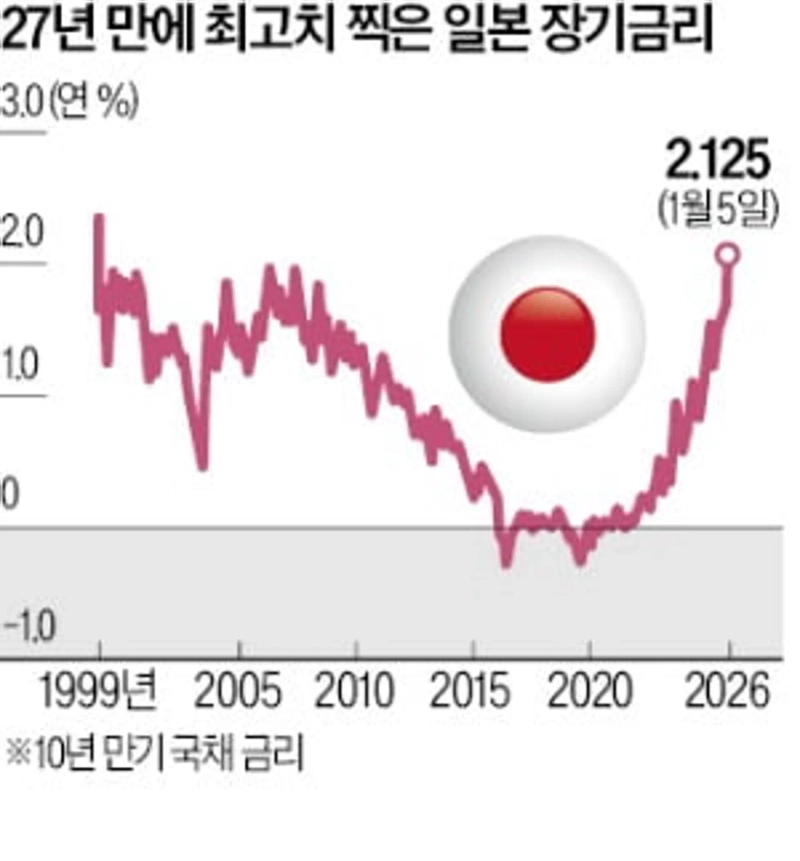
Japan's 10-year government bond yield exceeded an annual 2.1%, marking the highest level in 27 years. This was due to rapid yen depreciation and concerns about fiscal expansion. Prime Minister Sanae Takaichi made it clear she has no intention of stopping 'money printing'.
Concerns over Takaichi 'money printing'… Japan government bond yields highest in 27 years
On the 5th in the Japanese bond market, the 10-year government bond yield, a long-term rate indicator, surged to as high as an annual 2.125%. It is the highest level in 27 years since February 1999. The 30-year government bond yield reached an all-time high of an annual 3.460%. Bond prices plunged.
A sharp fall in the yen's value in the Tokyo foreign exchange market was a contributing factor. Against the backdrop of the US economy's strength, selling of the yen and buying of the dollar spread, pushing the yen-dollar rate that day to the low 157 yen per dollar. The rapid yen depreciation raised expectations that the Bank of Japan would speed up rate hikes, prompting further selling of government bonds.
BOJ Governor Kazuo Ueda reiterated at a bankers' New Year gathering that "interest rates will continue to be raised as economic and price conditions improve." The Nikkei index's close-based jump of 2.97% from the previous trading day, helped by gains in US semiconductor stocks, also led to yen selling and dollar buying.
Concerns about Japan's fiscal situation are also a reason the market is shunning government bonds. The Japanese government set this year's budget proposal at a record-high 122.3092 trillion yen. The principal and interest repayments on government bonds also rose to a record-high 31.2758 trillion yen.
At her first press conference of the year, Prime Minister Takaichi repeatedly emphasized the need for active fiscal policy. She said, "The New Year budget includes many bold investments that look to the future," and added, "We will create a 'virtuous cycle of investment and growth' by linking investment to strong economic growth and enabling additional investment through increased tax revenues."
Prime Minister Takaichi also faces a number of diplomatic tasks this year. Showing eagerness for an early meeting with US President Donald Trump, she plans to visit the United States this spring. Regarding the US overthrowing Venezuelan President Nicolás Maduro, Takaichi refrained from making a specific evaluation, saying, "We will pursue diplomatic efforts for the restoration of Venezuelan democracy and stabilization of the situation."
On China, she repeated the existing stance, saying, "We are open to various dialogues and have not closed the door." She added, "We will appropriately respond from the perspective of national interests going forward."
Tokyo=Il-gyu Kim, correspondent black0419@hankyung.com

Korea Economic Daily
hankyung@bloomingbit.ioThe Korea Economic Daily Global is a digital media where latest news on Korean companies, industries, and financial markets.