After finally bringing the FX rate down… global headwinds and even retail investors’ ‘suction move’ [Analysis+]
Summary
- The won-dollar rate is nearing 1,470 won, with dollar demand rising as expectations for US rate cuts weaken and geopolitical risks intensify.
- Net purchases of US stocks by Korean retail investors have climbed to a record high, acting as a structural driver of expanded dollar demand.
- Experts say dollar strength and a domestic dollar-demand-heavy structure are likely to persist, increasing the chances of further gains in the won-dollar exchange rate.
Forecast Trend Report by Period


Won-dollar rate again threatens 1,470 won
Yen rattled again on Japan’s expanded fiscal-spending signal
The won, also swayed by strong ‘coupling’ sentiment with the yen, comes under pressure
Expectations for US rate cuts fade
Geopolitical headwinds from Iran and elsewhere, plus even ‘Seohak ants’
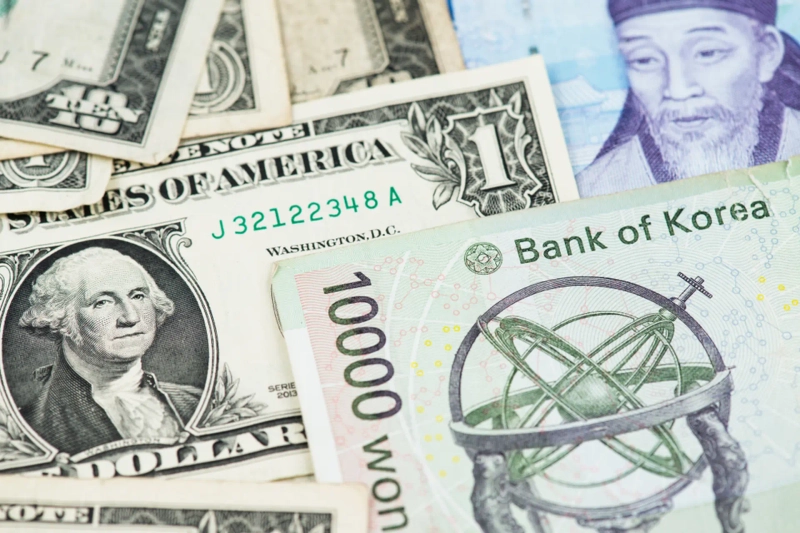
The won-dollar exchange rate is edging back toward 1,470 won. Dollar demand is rising as expectations for US rate cuts have weakened on improving US economic indicators, while geopolitical risks emerging in places such as Venezuela and Iran are also boosting demand for the greenback.
On top of that, sentiment linking moves to the Japanese yen and an explosive buying spree by so-called “Seohak ants” (Korean retail investors who buy US stocks) is further stoking dollar demand.
According to the financial investment industry on the 13th, the won-dollar rate in the Seoul FX market closed at 1,468.40 won in daytime trading, up 10.80 won from the previous session. The rate briefly touched 1,470 won intraday. Based on the intraday high, it marked the highest level since last month’s 24th (1,484.90 won).
After peaking at 1,483.60 won on Dec. 23 last year, the rate plunged nearly 54 won in just three days to around 1,420 won on authorities’ intervention and the National Pension Service’s FX hedging. It soon rebounded and ended the year at 1,439 won. The uptrend has continued into the new year, retracing more than half of the earlier decline.
The rate on the previous day moved in tandem with yen weakness. Over the weekend, reports that Japanese Prime Minister Sanae Takaichi could dissolve parliament and call an early general election heightened downward pressure on the yen.
With expectations gaining traction that expansionary fiscal policy would be strengthened as Prime Minister Takaichi has vowed, the prospect of a cheaper yen appears to have encouraged selling. The yen-dollar rate climbed as high as 158.199 yen intraday. That is the highest level in a year since January last year (158.877 yen).
The recent steep rise in the exchange rate has largely been driven by improving US economic data, which has dampened expectations for rate cuts. The US unemployment rate for December last year, released by the Labor Department on the 9th (local time), fell to 4.4% from 4.5% the previous month.
According to CME Group’s FedWatch, which gauges expectations for the US policy rate, the probability that the Federal Open Market Committee (FOMC) meeting on the 28th will keep rates on hold stands at 95%. That is sharply higher than 68% a month earlier.
Geopolitical risks surfacing across the world are also stimulating dollar demand.
US President Donald Trump is openly signaling ambitions to arrest and extradite Venezuela’s President Nicolás Maduro and to seize Greenland, a Danish territory.
In Iran, foreign media reports said casualties from large-scale anti-government protests may have exceeded 2,000, and President Trump has even mentioned possible military intervention in Iran.
As a result, the dollar index has risen from the low 98 level at the start of the year to the low 99 level on the previous day.
In Korea, “Seohak ants” have been aggressively buying since the start of the year.
According to the Korea Securities Depository, net purchases of US stocks by individual Korean investors totaled $1.942 billion from the start of the year through the 9th, the largest since related statistics began in 2011. That is about 43% higher than the same period a year earlier ($1.357 billion).
The figure fell to $1.873 billion last month due to demand for profit-taking sales at year-end and tax planning on capital gains, but buying interest appears to be returning in the new year.
Markets view the exchange-rate upswing less as a temporary swing in investor sentiment than as a structural factor—rising dollar demand driven by expanded overseas stock investment.
While the government rolled out a series of measures at year-end, including expanded FX hedging by the National Pension Service, FX-market stabilization steps, and tax measures related to overseas investment, the impact on improving FX supply and demand is limited as individuals’ overseas stock investing has become a medium- to long-term asset-allocation tool.
Moon Da-woon, a researcher at Korea Investment & Securities, said, “Overseas stock investment by Korean investors, which had slowed in the fourth quarter (October–December) last year due to the burden of a high exchange rate, has recently been increasing again,” adding, “As dollar demand rises, the market mood is that the exchange rate is unlikely to fall much further.”
As the won-dollar level has begun to swing again, it has become more difficult for the Bank of Korea to adjust rates at the Monetary Policy Board meeting to be held on the 15th.
The policy rate currently stands at 2.50% per year. After cutting it by 0.25% point in May last year, the BOK has maintained a hold stance for four consecutive meetings in July, August, October, and November. The market sees another “hold” as the most likely outcome at this meeting as well.
The BOK had hesitated to cut rates mainly due to rising real estate prices, but recently the FX-rate variable has also been acting as a constraint.
So Jae-yong, a researcher at Shinhan Bank, said, “With geopolitical risks supporting a stronger dollar—such as the US signaling ambitions including the arrest of Venezuela’s president and designs on Greenland—domestic flows are also continuing to favor dollar demand, making further gains in the exchange rate highly likely.”
Noh Jeong-dong, Hankyung.com reporter dong2@hankyung.com

Korea Economic Daily
hankyung@bloomingbit.ioThe Korea Economic Daily Global is a digital media where latest news on Korean companies, industries, and financial markets.