US makes unprecedented verbal intervention for the won… Government: "Will introduce new FX regulations"
Summary
- The government said it may move to curb speculative dollar demand from individuals and financial firms by macroprudential regulations, including raising the cost of converting into dollars.
- Following US Treasury Secretary Scott Bessent’s remarks that the won’s weakness is inconsistent with fundamentals and Korea-US coordination, the won-dollar exchange rate fell, but it said it is too early to view this as a trend reversal in won weakness.
- It said that despite the government’s potential to adjust the pace of the US investment fund and the verbal intervention, FX-authority measures alone have clear limits in stabilizing the won-dollar exchange rate and curbing speculative dollar demand.
Forecast Trend Report by Period


Korea, US mount joint response to stabilize FX
Bessent offers unusual support for defending the exchange rate
Bank of Korea ends 'rate-cut cycle'
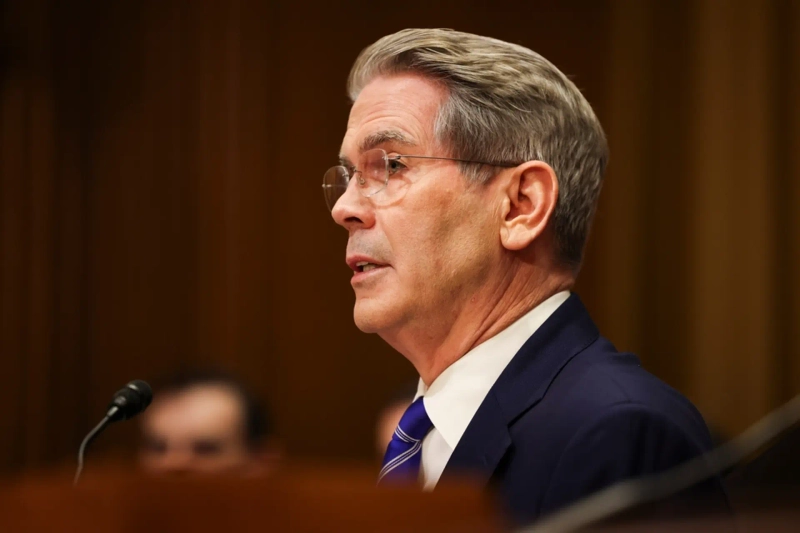
The government said on the 15th it would introduce new macroprudential regulations if the won-dollar exchange rate continues to rise. The authorities are said to be reviewing measures that would raise the burden on financial institutions in the process of converting won into dollars. Ahead of that, US Treasury Secretary Scott Bessent issued a warning-style verbal intervention, saying in a press release that “the recent weakness of the won is not consistent with Korea’s economic fundamentals.” This is the first time a US Treasury secretary has verbally intervened in Korea’s foreign-exchange market.
Choi Ji-young, director general for international economic management at the Ministry of Economy and Finance (deputy minister-level), said at a year-end press briefing at the Government Complex Sejong that “domestic speculative demand arising from expectations of further FX gains is creating the current (high exchange-rate) situation,” adding that “if the impact of tax support measures to be implemented from next month—such as the Return-to-Domestic-Investment Account (RIA)—is limited, we will move to macroprudential regulatory steps.” He added, “We will target financial institutions first, but if necessary, we will not rule out measures aimed at individuals.”
Bessent wrote on his X (formerly Twitter) on the 14th (local time) that he had discussed with Finance Minister Koo Yun-cheol that “the recent weakness of the won is not consistent with Korea’s strong economic fundamentals.” Koo and Bessent are reported to have held bilateral talks in Washington, DC on the 12th. Choi explained that Bessent’s remarks “reflect the fact that a stable path for the won is an important factor in bilateral economic cooperation, including the execution of Korea-US strategic investment.”
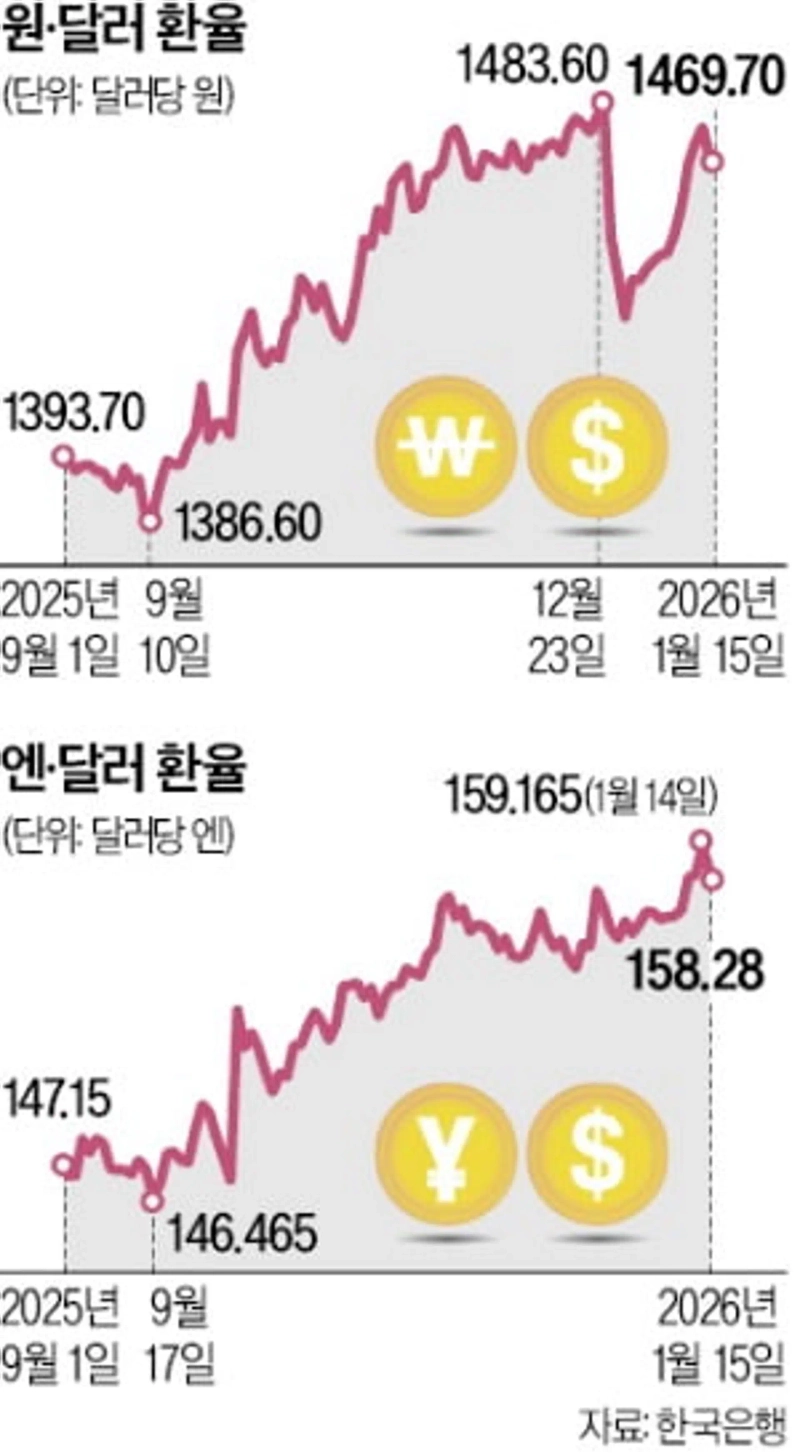
The Bank of Korea held a Monetary Policy Board meeting the same day and kept the base rate unchanged at 2.5% per year. In its policy statement, the board deleted the phrase “possibility of cutting rates.” In the Seoul FX market, the won-dollar exchange rate (as of 3:30 p.m.) ended daytime trading for the week at 1,469.70 won, down 7.80 won. It fell for the first time this year.
Raising conversion costs, throttling US investment pace… market reaction ‘lukewarm’
Shared concern over ‘disruptions to US investment’… considering macroprudential steps targeting financial firms
Korean FX authorities’ mention of introducing FX soundness measures stems from the view that dollar demand from individuals and corporates is excessive. Analysts say the US Treasury secretary’s unusual verbal intervention toward Korea’s FX market took into account the possibility that the US investment fund set to begin operating this year could face disruptions. Thanks to coordinated Korea-US action, the won-dollar’s upward streak snapped after 11 trading sessions. Still, many say it is too early to judge that the won’s weakness has shifted into a structural reversal.
FX authorities to raise dollar conversion costs?
Choi Ji-young, director general for international economic management at the Ministry of Economy and Finance (deputy minister-level), held an emergency briefing at the Government Complex Sejong on the 15th and said, “We are designing a new type of macroprudential measure that differs from past approaches that targeted financial firms.” He also cited the “three-piece macroprudential set” introduced in 2010, including limits on FX derivatives positions, the FX stability levy, and taxation on foreigners’ bond investments. Choi said, “It will not be a simple approach of applying the past measures with only a change in direction,” adding, “Soundness measures targeting financial institutions will ultimately change individuals’ speculative dollar-demand behavior.”
The government is reportedly considering regulations that would impose additional costs on financial firms—such as brokerages and banks—when they convert into dollars. This burden could also be passed on to individuals. If dollar conversion costs rise, financial firms could shift the costs to individuals and companies. The idea is that higher conversion costs would curb speculative demand aimed at securing dollars before they rise further.
Korea may adjust the pace of the US investment fund
The FX market is also closely watching Bessent’s remarks—effectively a verbal intervention in Korea’s FX market—that “the recent weakness of the won is not consistent with Korea’s economic fundamentals.” Immediately after his comments, the won-dollar rate fell by nearly 10 won in overnight trading. The remarks could be read as a message that the US would tolerate market intervention by Korean FX authorities to prevent a decline in the won’s value. Choi said, “We did not request a verbal intervention from the US,” but explained that “we conveyed to the US Treasury our view that ‘if FX market volatility and instability increase, we may have to limit the execution of US-bound investment.’”
Bessent’s remarks were also interpreted as implying that Korea could adjust the pace of investment deployment for the US investment fund worth $200 billion. Korea has agreed that if it faces FX market instability during the process of investing in the US, it can adjust the size and timing of the US investment fund. This is reflected in language from the Korea-US leaders’ joint factsheet released in November last year: “If US-bound investment causes market instability, such as disorderly moves in the won’s value, Korea may request adjustments to the investment and its timing.” Taking this into account, Bessent stressed that US-bound investment should proceed without disruption, saying the “US investment agreement will further deepen the economic partnership between the United States and Korea and spur the revival of US industrial capacity.” Bessent has also moved to verbally intervene in Japan’s FX market recently. At a meeting with Japanese Finance Minister Satuki Katayama on the 12th, he said “excessive FX volatility is inherently undesirable.”
Watching FX market impact closely
In financial markets, some analysts said Bessent’s verbal intervention could be effective in the short term in curbing a rapid spike in the won-dollar exchange rate. Others countered that it is hard to say the FX market has entered a stabilization phase on the back of this episode.
Park Sang-hyun, managing director at iM Securities, said, “Along with simultaneous verbal interventions by the US and Japan and our announcement of macroprudential measures, the won’s short-term strength may continue,” but added, “These measures alone have clear limits in curbing strong speculative dollar demand from individuals and others.” By contrast, Ahn Dong-hyun, a professor in the Department of Economics at Seoul National University, said, “After strong intervention by FX authorities, the perception spread in the market that the 1,480 won level is a psychological resistance line,” adding, “No matter how much the authorities try to push down the won-dollar rate, it is as plain as day that it will rise again as dollar demand increases.”
By Lee Gwang-sik / Kim Ik-hwan / Nam Jeong-min, bumeran@hankyung.com

Korea Economic Daily
hankyung@bloomingbit.ioThe Korea Economic Daily Global is a digital media where latest news on Korean companies, industries, and financial markets.