IMF warning… “Korea’s FX-risky dollar assets exceed 20 times the size of the FX market”
Summary
- The IMF said Korea’s dollar assets exposed to FX risk are disproportionately large, at around 25 times FX market trading volume.
- The IMF warned that in countries with a high ratio of FX exposure in dollar assets, a rush to hedge—with simultaneous dollar forward selling—could amplify volatility.
- The National Pension Service’s “strategic FX hedging” and the government’s push for forward-selling products for retail investors were described as steps driven by the need to manage exchange-rate volatility risk and FX risk.
Forecast Trend Report by Period


“FX exposure is disproportionately large relative to the FX market”
A ‘rush to hedge’ could amplify volatility
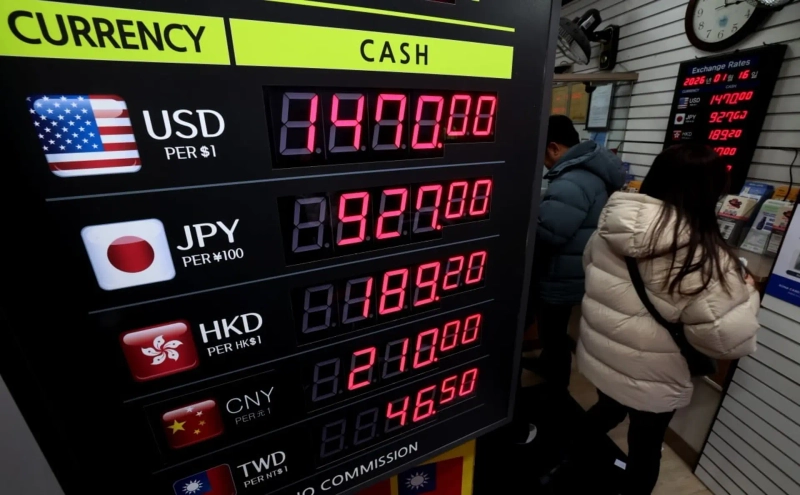
An international institution has sounded the alarm that Korea’s stock of dollar assets exposed to currency risk is excessive relative to the size of its foreign-exchange market.
This is seen as a structural factor recently adding to upward pressure on the won–dollar exchange rate, and it suggests the currency could be vulnerable to heightened volatility during periods of uncertainty in global financial markets.
According to the International Monetary Fund’s (IMF) Global Financial Stability Report, Korea was classified as a country with a notably large share of FX-exposed dollar assets relative to the scale of its FX market.
This is based on an indicator presented in the report published in October last year: “FX-exposed dollar assets relative to FX market size (monthly trading volume).” The metric is used as a structural gauge of how much exchange-rate shocks a country’s FX market can absorb.
The report showed Korea’s FX-exposed dollar assets at roughly 25 times its FX market trading volume.
Among major economies (excluding Hong Kong and the Cayman Islands), this was similar to Canada (CAN) and Norway (NOR). Norway is also known for substantial overseas investment, centered on its sovereign wealth fund.
Taiwan (TWN) had the highest ratio, at roughly 45 times. Taiwan’s dollar-asset stock is broadly similar to Korea’s, but its smaller FX market pushes the ratio higher.
In terms of absolute asset size, Japan (JPN) is the largest, but because Japan’s FX market is also large, its ratio was estimated to be below 20 times.
Major European economies—including Germany, France, Italy, Spain, the Netherlands, and Austria—posted single-digit ratios of FX-exposed dollar assets relative to their FX markets.
Given that major European economies as well as Canada and Japan are in quasi-reserve-currency blocs, the metric can also be read as a warning sign effectively aimed at Korea and Taiwan.
For non-reserve-currency economies with high ratios of FX-exposed dollar assets, it is difficult for FX markets to absorb shocks stemming from swings in the dollar’s value over a short period.
The IMF noted that “in some countries, FX exposure to dollar assets is disproportionately large relative to the depth of the FX market.”
The IMF also focused on the possibility of a so-called “rush to hedge,” in which global investors with FX exposure move to hedge all at once. If dollar forward selling occurs simultaneously, volatility could be amplified, particularly in FX markets where the ratio of dollar FX exposure is high.
The National Pension Service’s move to step up “strategic FX hedging” can be interpreted as an effort to manage such exchange-rate volatility risks in advance.
By contrast, so-called “Seohak ants”—retail investors who typically buy overseas equities while remaining FX-exposed—are raising the need for risk management not only at the individual portfolio level but also from a macroeconomic perspective.
In this regard, the Ministry of Economy and Finance said in its “Tax Support Measures for Domestic Investment and FX Stability,” announced late last year, that it would roll out “forward-selling products for retail investors” through major securities firms.
If an individual sells a forward at a specific exchange rate, the bank that buys it must sell dollars in the spot market to match its dollar sell/buy position. For individuals, this is expected to help manage FX risk, while for the FX market it is expected to increase the supply of dollars.
Choi Su-jin, Hankyung.com reporter naive@hankyung.com

Korea Economic Daily
hankyung@bloomingbit.ioThe Korea Economic Daily Global is a digital media where latest news on Korean companies, industries, and financial markets.