‘Sell America’ signs over Greenland dispute… Danish pension fund: “To sell all U.S. Treasuries”
Summary
- Danish pension fund AkademikerPension said it has decided to sell all of its U.S. Treasuries holdings of about $100 million.
- It said that if Europe’s selling of U.S. assets broadens, it could deliver simultaneous shocks to the bond market, stock market and currencies.
- It reported that amid intensifying trade tensions, U.S. Treasury yields and the VIX Index rose, gold and silver prices hit record highs, and the dollar index fell.
Forecast Trend Report by Period


Danish pension fund AkademikerPension has decided to sell all of its U.S. Treasuries holdings—about $100 million—by the end of this month. As U.S. President Donald Trump, who is in conflict with Europe over the annexation of Danish territory Greenland, ramps up pressure by threatening additional tariffs on Europe, Denmark is moving to respond using “capital” as a weapon.
Concerns that the Trump administration’s “Greenland tariffs” could trigger selling of U.S. assets weighed broadly on New York equities, U.S. Treasuries and the dollar.
Europe turns to capital as leverage
According to Bloomberg and other foreign media on the 20th (local time), AkademikerPension decided to fully withdraw from U.S. Treasury investments, citing U.S. government fiscal fragility. Chief Investment Officer (CIO) Anders Schelde said, “The United States is basically not a country with strong credit quality, and U.S. government finances are not sustainable in the long run,” adding, “The only reason to hold U.S. Treasuries is for risk management and liquidity, and we concluded we can find an alternative to that.” The fund manages about $25 billion in retirement assets for teachers and academics.
Schelde suggested that Trump’s threat to annex Greenland influenced the decision to sell U.S. Treasuries. While drawing a line by saying, “This decision is not because of the conflict between the United States and Europe,” he added, “Of course, that situation did not make the decision harder.”
The fund’s U.S. Treasury holdings are small relative to the overall market, but the move signals that European institutional investors can use capital to respond to Trump’s threats. According to Deutsche Bank, European countries hold about $8 trillion in U.S. stocks and bonds—twice the total held by the rest of the world combined. NATO allies alone hold close to $3 trillion in U.S. Treasuries.
Nigel Green, CEO of global financial advisory deVere Group, explained, “Capital markets themselves can emerge as a means of geopolitical pressure,” adding, “Capital pressure would simultaneously shake confidence in financial markets, currencies, bond markets and stock markets, making it harder to control.”
Could a trade war expand into a capital war?
Ray Dalio, founder of Bridgewater Associates, warned in an interview with CNBC that day, “We cannot ignore the possibility of a capital war,” adding, “It means the propensity to buy U.S. Treasuries and the like may not be the same as before.” If countries holding U.S. Treasuries no longer trust the United States, they will not seek to buy additional U.S. assets; yet the U.S. will continue issuing large amounts of debt, which could become a problem.
Some argue that even if Europe threatens to sell U.S. Treasuries, the practical impact would be limited. According to the U.S. Treasury Department, Europe ($3.635 trillion) holds a volume of U.S. Treasuries nearly similar to Asia ($3.794 trillion), but unlike Asia, Europe’s holdings are mostly in private investors’ hands rather than central banks. Moreover, selling U.S. Treasuries could push yields higher and asset values lower, increasing losses for European investors.
Carsten Brzeski, an analyst at ING Group, said, “There is almost no way for governments to force private European investors to sell dollar assets,” adding, “If there is anything they can do, it would be to incentivize investment in euro-denominated assets.”
U.S. bond prices fall
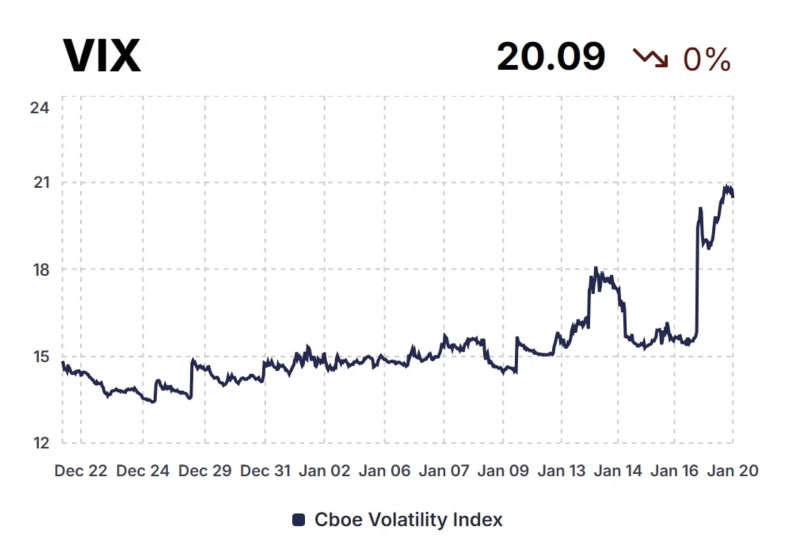
‘Sell America’ sentiment (selling U.S. assets) dominated the market that day. The S&P 500 Index closed down 2.06% from the previous session. It was the biggest drop since Oct. 10 last year, when the United States and China clashed over rare-earth exports. The Chicago Board Options Exchange (CBOE) Volatility Index (VIX), known as the “fear gauge,” rose to 20.09 near the close of New York trading, the highest in two months since last November.
In the bond market, U.S. Treasury yields rose (bond prices fell) as tariff tensions with Europe combined with the impact of a sharp jump in Japanese government bond yields. At 4 p.m., the 10-year U.S. Treasury yield was trading at 4.293%, up 0.06% point from the previous day—the highest level since early September last year. The 30-year U.S. Treasury yield rose 0.08% point at the same time.
Amid worries over escalating trade tensions, investors flocked to safe havens, with both gold and silver hitting record highs. Gold futures prices broke above $4,700 per troy ounce, and silver futures also surged intraday to as high as $95.78. Silver has risen more than 30% so far this year.
By contrast, the dollar weakened. The dollar index, which tracks the greenback against six major currencies, fell 0.8% from the previous session to 98.6 at the same time.
Reporter Han Kyung-je

Korea Economic Daily
hankyung@bloomingbit.ioThe Korea Economic Daily Global is a digital media where latest news on Korean companies, industries, and financial markets.