"Trading stocks 24 hours like crypto"… NYSE to build a tokenized securities platform
Summary
- ICE, the parent company of the New York Stock Exchange (NYSE), said it has completed development of a tokenized securities platform that records and trades traditional financial assets on a blockchain and is pursuing regulatory approval.
- The platform tokenizes stocks and ETFs to support 24-hour trading, fractional investing, and instant settlement using stablecoins, and it is also reviewing ways to use tokenized deposits for settlement and clearing with partners including Citigroup and BNY Mellon.
- Analyst Hwang Soo-wook warned that 24-hour trading could lead to fragmented liquidity, greater price volatility, and higher burdens from market surveillance, rules, and costs.
Forecast Trend Report by Period


NYSE completes development of a tokenized securities platform
Tokenizing stocks and ETFs to enable 24-hour trading
Fragmented liquidity and volatility remain challenges
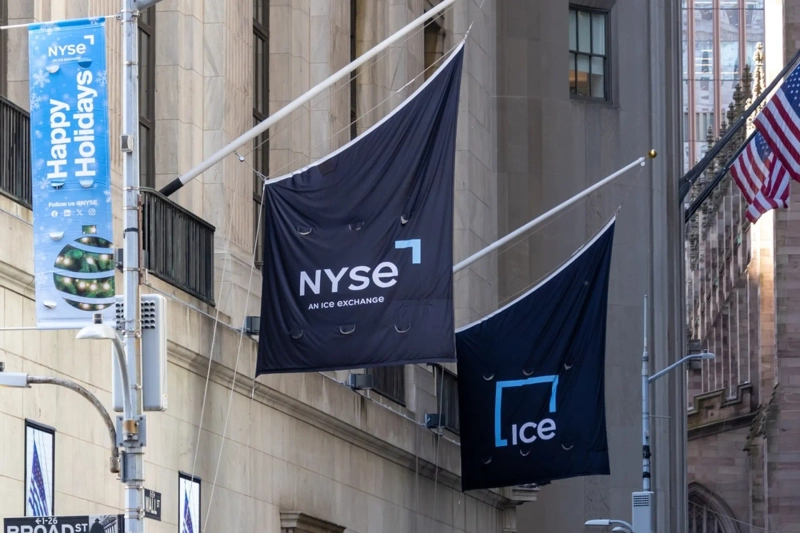
The New York Stock Exchange (NYSE) is moving to establish a blockchain-based trading platform for tokenized securities (ST). If regulators grant approval, infrastructure enabling 24-hour trading by issuing U.S.-listed stocks and exchange-traded funds (ETFs) in token form is expected to become a reality.
On the 19th (local time), Intercontinental Exchange (ICE), NYSE’s parent company, said it has "completed development of a tokenized securities platform designed to record and trade traditional financial assets on a blockchain in digital form" and added that it is "seeking regulatory approval."
According to ICE, the platform is designed to support fractional investing via dollar-denominated orders and to enable immediate settlement after trade execution. Stablecoins will be used as the settlement instrument, and the company is also reviewing a plan—together with partners such as Citigroup and BNY Mellon—to use tokenized deposits for settlement and clearing.
Behind NYSE’s push for a tokenized securities platform is growing global investor demand for out-of-hours trading. Reuters reported that in recent years, calls have rapidly increased for an environment in which trading can continue beyond regular U.S. stock-market hours, prompting regulators to move to overhaul rules related to extending trading hours.
Nasdaq is currently undergoing an approval process to allow stock trading for 23 hours a day, five days a week, while major brokerages such as Robinhood and Charles Schwab are also moving to extend trading hours or expand related infrastructure.
Against this backdrop, NYSE’s move is seen as a structural shift that goes beyond a simple extension of trading hours. Hwang Soo-wook, an analyst at Meritz Securities, said, "This attempt is closer to a declaration to redesign stock-market infrastructure for a 24-hour regime," adding, "24-hour trading isn’t achieved simply by keeping a matching system open; settlement, cash funding, margin, custody, and risk management all have to change as well."
He continued, "The fact that NYSE is separately pursuing a tokenized securities platform suggests it is also contemplating a structure that operates trade proceeds in digital form—such as stablecoins or tokenized deposits—to process settlement immediately," and added that it "can be interpreted as a strategic attempt to lock in instant settlement and a new settlement standard."
Still, commercialization of NYSE’s tokenized securities platform faces the remaining hurdle of regulatory approval. Because tokenized securities differ from existing trading and settlement methods, a key variable will be how regulators such as the U.S. Securities and Exchange Commission (SEC) classify them as an official market and apply frameworks for market surveillance and investor protection.
NYSE said, "If the platform is approved, it will become possible to issue and trade tokenized securities with the same legal effect as existing stocks," adding, "Holders of tokenized securities will also be guaranteed the same rights as existing shareholders, including receiving dividends and exercising voting rights."
Concerns are also being raised about potential side effects of a 24-hour trading regime. Hwang said, "If trading is open 24 hours, liquidity will be fragmented by time zone; in particular, quotes could thin out at night and on weekends, widening spreads," adding, "In thin markets, even small orders can drive excessive price volatility, and price noise may be amplified immediately after news." He added, "Market surveillance, trading halts, circuit breakers, and the handling of corporate actions would effectively need to operate around the clock, making rules and oversight systems more complex and potentially increasing costs."

Suehyeon Lee
shlee@bloomingbit.ioI'm reporter Suehyeon Lee, your Web3 Moderator.