Won’s purchasing power falls to Asian financial crisis-era levels…63rd out of 64 countries
Summary
- Korea’s real effective exchange rate fell to 90.29 last year, the third-lowest since the FX and financial crises, indicating a sharp drop in the won’s purchasing power.
- The average won-dollar exchange rate hit 1,422 won 16 jeon, the highest since 1998, as the pace of decline in the won’s nominal value accelerated.
- Rising overseas investment, confirmed investment in the U.S. tied to Korea-U.S. tariff negotiations, and expanding outbound foreign direct investment were cited as accelerating the upward trend in the exchange rate.
Forecast Trend Report by Period


Last year’s average monthly real effective exchange rate at 90.29
Third-lowest since the FX and financial crises
Growth-potential and rate gap with the U.S. persists
Pace of decline in the won’s nominal value accelerates
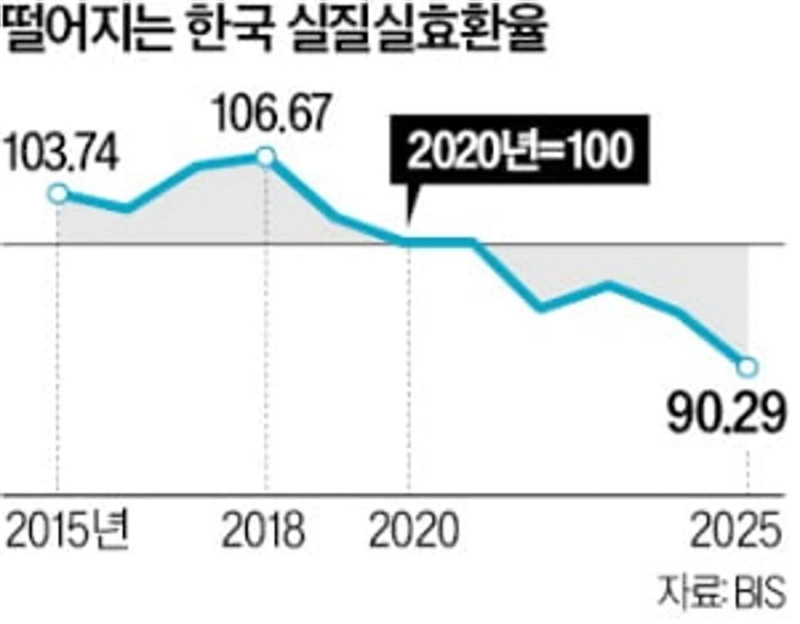
With the won-dollar exchange rate surging to multi-year highs, South Korea’s won was found to have suffered its sharpest deterioration in purchasing power since 2009, during the global financial crisis.
According to the Bank for International Settlements (BIS) on the 25th, Korea’s average monthly real effective exchange rate (REER; 2020=100) last year came to 90.29. Since the BIS began compiling the data in 1994, this is the third-lowest reading on record, following 1998 (82.92) during the Asian foreign-exchange crisis and 2009 (86.96) immediately after the financial crisis.
The REER measures how much purchasing power a country’s currency has relative to its trading partners. It is calculated by reflecting exchange rates and prices among trading partners; a reading below 100 is viewed as undervaluation relative to the base year (2020).
In cross-country comparisons as well, the won ranked near the bottom. Korea’s REER ranking last year was 63rd out of 64 countries, the second-lowest after Japan (72.61). The pace of decline was also steep: Korea’s REER fell 4.29 points year on year. Over the same period, China fell just 2.99 points, while Japan rose 1.77 points.
The immediate driver of the sharp drop in the REER was a plunge in the won’s nominal value. Last year’s average won-dollar exchange rate was 1,422 won 16 jeon, the highest annual average since 1998 (1,398 won 88 jeon) in the wake of the foreign-exchange crisis. The won weakened rapidly amid gaps in growth and interest rates versus the United States. According to the Organisation for Economic Co-operation and Development (OECD), Korea’s potential growth rate through 2022 was 2.45%, above the U.S. (2.40%), but in 2023 the U.S. (2.44%) overtook Korea (2.41%) for the first time.
In addition, as overseas investment by retail investors and the National Pension Service increased, supply-demand conditions in the FX market have structurally shifted. According to the Bank of Korea, overseas stock investment from January to November reached $102.421 billion (about 150 trillion won), up 145.6% ($60.722 billion) from a year earlier.
Moreover, last year’s Korea-U.S. tariff negotiations confirmed up to $20 billion a year in investment in the U.S., accelerating the upward trend in the exchange rate. Ahn Dong-hyun, a professor in the Department of Economics at Seoul National University, noted, “As the business environment worsens, including the introduction of the Serious Accidents Punishment Act and the Yellow Envelope Act, companies’ direct investment is also moving overseas.”
Reporter Kim Ik-hwan lovepen@hankyung.com

Korea Economic Daily
hankyung@bloomingbit.ioThe Korea Economic Daily Global is a digital media where latest news on Korean companies, industries, and financial markets.