Dollar hits 4-year low after Trump calls it “doing great”
Summary
- The report said the Dollar Index slid back to levels last seen four years ago after President Trump made remarks that appeared to tolerate dollar weakness.
- It said that amid policy uncertainty and weakening confidence in U.S. assets, the creator of the dollar smile theory warned the move is likely the start of a further decline in the dollar.
- It said that as the dollar’s value fell and the debasement trade gained traction, international gold prices broke above $5,200 per troy ounce and silver also rose.
Forecast Trend Report by Period


Gold tops $5,200
The dollar slid back to levels last seen four years ago after U.S. President Donald Trump made remarks that appeared to tolerate a weaker greenback. With “Sell America” fears already growing over the U.S. push to take control of Greenland and controversy over encroaching on the Federal Reserve’s independence, markets expect uncertainty over the U.S. economy and foreign policy to continue underpinning the dollar’s downtrend.
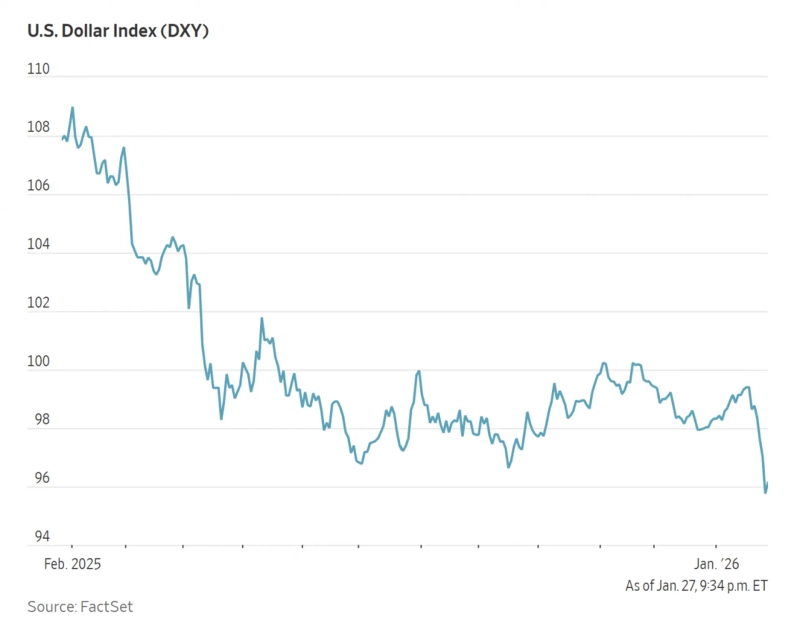
On the 27th (local time), the U.S. Dollar Index—measuring the dollar against a basket of six major currencies—fell as much as 1.53% intraday to 95.55, its lowest since February 2022. It has closed lower for four straight sessions and is down nearly 3% so far this year. The move reflects talk that U.S. and Japanese authorities could jointly intervene in FX markets to support the yen, along with broader concerns over pressure on the Fed, President Trump’s drive to annex Greenland, and a widening U.S. fiscal deficit—factors that have eroded confidence in dollar assets. Since Trump took office, the euro has risen 16% against the dollar and the Swiss franc has gained more than 19%.
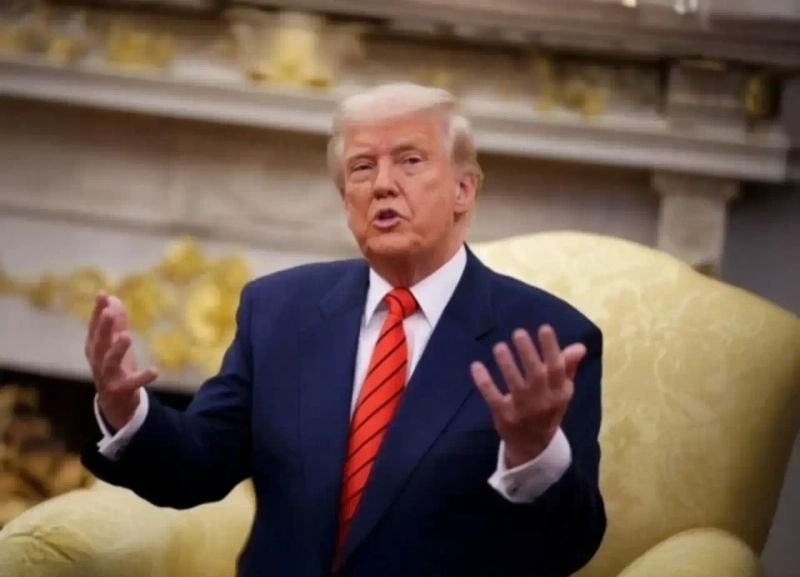
The dollar’s losses deepened after Trump said he was not concerned about dollar weakness. Asked by reporters whether he worries about a weaker dollar, he replied, “You can tell from the industries we’re building—the dollar is doing great.” He added, “I fought very hard with China and Japan,” saying, “because they were always trying to devalue their currencies.”
Markets took the comments as a signal that Trump is comfortable with a weaker dollar. A softer greenback would support his goals of reviving U.S. manufacturing and boosting exports. The Wall Street Journal (WSJ), citing experts, reported: “Trump administration officials have denied wanting a weak dollar, but Trump’s latest remarks amount to a degree of official acknowledgment of an interpretation that has spread through the market.”
The FX market also saw a stronger yen. In New York trading, the yen strengthened to the 152.1-per-dollar range, its highest level in three months. A similar move was seen in Tokyo trading on the 28th. According to Nikkei, Japan’s Finance Minister Satsuki Katayama, after attending an online meeting of G7 finance ministers, said on FX: “If necessary, we will work closely with U.S. authorities and respond appropriately,” spurring yen buying.
As recently as the 23rd, the yen had weakened to 159 per dollar, but it reversed sharply (yen strengthening) after reports said the New York Fed checked in with FX dealers on the dollar/yen rate, signaling possible market intervention. Some analysts also say a stronger yen, which helps curb rises in import prices for food and energy, could reflect a U.S. desire to back Japan’s pro-U.S. Prime Minister Sanae Takaichi.
Markets are increasingly betting the dollar’s weakness will persist this year, as the drivers behind the decline show little sign of easing. Trump’s bid to take control of Greenland has fueled pushback from allies in Europe and elsewhere, stoking fears they could sell U.S. assets such as Treasuries. Attention is also focused on whom Trump will name to succeed Fed Chair Jerome Powell, whose term ends in May this year.
Bloomberg said: “The dollar’s decline has been further accelerated by Trump’s unpredictable policy decisions,” citing factors such as Greenland annexation, pressure on the Fed, concerns over a deeper fiscal deficit from tax cuts, and a leadership style that has intensified U.S. political polarization. The dollar’s weakness was also reinforced by rising odds of a U.S. federal government shutdown after Senate Democrats raised issues with the Department of Homeland Security budget bill following fallout from a Minneapolis fatal shooting by immigration enforcement agents.
Stephen Jen, former Morgan Stanley currency strategist who coined the “dollar smile” theory—under which the dollar tends to strengthen when the U.S. economy is either very strong or in recession—warned: “This move is very likely the start of a phase in which the dollar falls another rung,” adding, “today’s currency analysts are not prepared for the (unfamiliar) scenario in which a weaker dollar coexists with a strong U.S. economy.”
Safe-haven demand flowed into gold. Spot gold prices surged above $5,200 per troy ounce for the first time on record. Spot silver also traded above $110 per troy ounce. Precious metals rose as a “debasement trade” gained traction, with investors cutting U.S. asset exposure amid the dollar’s decline.
Reporter Han Kyung-jae

Korea Economic Daily
hankyung@bloomingbit.ioThe Korea Economic Daily Global is a digital media where latest news on Korean companies, industries, and financial markets.