A day after 'tariff threat,' says "we’ll find a solution"…Won strengthens on Trump’s 'TACO' [Lee Sang-eun’s Washington Now]
Summary
- A day after threatening to raise tariffs on South Korea to around 25%, President Trump said he would work with South Korea to find a solution.
- As it became more likely the threat to restore tariffs would not materialize, stocks extended gains and the won-dollar exchange rate fell to the 1,422-won range.
- According to Trading Economics, the U.S. dollar index (DXY) came in at 96.084, down about 0.14% from the previous day.
Forecast Trend Report by Period


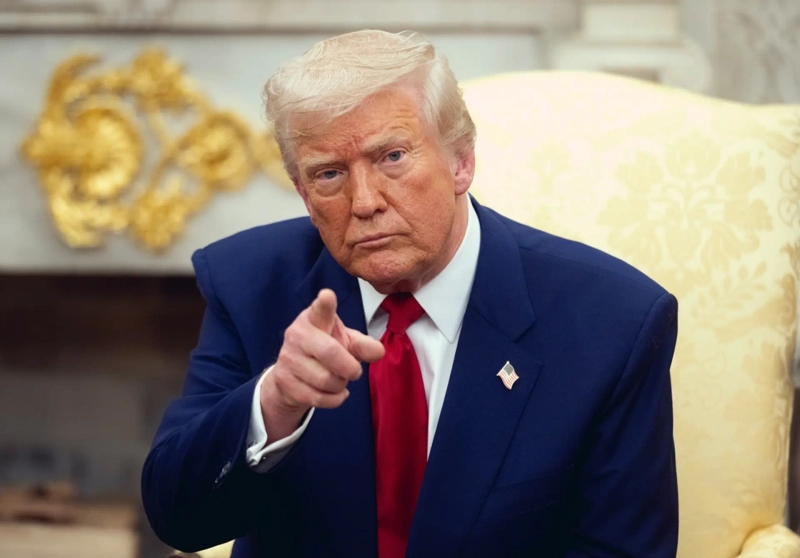
Just a day after threatening to restore tariffs on South Korea to around 25%, U.S. President Donald Trump said he would look for a solution. The move suggested that raising tariffs itself was not the goal, but rather a demand that Seoul follow through on its pledge to invest in the United States. Still, after the European Union (EU), he has again shown that he can flip negotiating commitments at any time, leaving a blemish on trust between allies.
On the 27th (local time), before departing the White House for Iowa, President Trump was asked by reporters about tariffs on South Korea and said, "We’ll work out a solution." He repeated, "We’ll work out a solution with South Korea." In effect, he signaled willingness to resolve the issue through talks with Seoul rather than moving straight to a tariff hike.
In a post on social media the previous day, he criticized South Korea for failing to legislate a special act on investment in the U.S., saying he would raise both product-specific tariffs—such as auto tariffs—and reciprocal tariffs back to 25% from 15%. However, he did not mention a specific deadline, and with no accompanying legal steps such as an executive order, many interpreted it as a strategic statement aimed at pressuring Seoul.
The abrupt tariff-hike bombshell came just three days after Prime Minister Kim Min-seok visited the U.S. last week and met with Vice President J.D. Vance, jolting the South Korean government and National Assembly. The government immediately convened a countermeasures meeting and decided to dispatch Trade Minister Kim Jeong-gwan—who is visiting Canada—and Trade Minister for Negotiations Yeo Han-koo, who had been in Korea, to the United States. The two are expected to meet later this week with Commerce Secretary Howard Lutnick and U.S. Trade Representative (USTR) Jamieson Greer, respectively. The Democratic Party of Korea expects that if it begins the bill-review process next month, the special act could pass between late February and early March.
In response to inquiries from outlets including The Korea Economic Daily about the tariff hike, the White House press office said, "The simple reality is that South Korea reached a (trade) deal with the Trump administration to secure lower tariffs." It added that while "the President reduced tariffs on South Korea," South Korea has "made no progress" in fulfilling its end of the bargain.
The Wall Street Journal (WSJ) reported, citing sources, that when Vice President Vance met Prime Minister Kim, he said South Korea should not take disadvantageous measures against U.S. companies including Coupang. However, a White House official told the WSJ that President Trump’s decision to raise tariffs was "unrelated" to U.S. companies (such as Coupang) or religious issues (such as Pastor Son Hyun-bo).
On the tariff-hike threat, USTR Greer said in an interview with Fox Business that "we and South Korea concluded a trade deal, but South Korea has not fulfilled its commitments," adding that it "has failed to pass related legislation and only introduced a new law on digital services." The digital-services bill is interpreted as referring to an amendment to the Act on Promotion of Information and Communications Network Utilization and Information Protection. The Korea Fair Trade Commission’s push for online platform regulations opposed by U.S. big tech is also an issue the U.S. government is watching warily.
He also cited slow progress on measures related to non-tariff barriers. Greer said, "They promised to allow more U.S. cars to be sold in South Korea and to remove some non-tariff barriers on agriculture, but those promises are not being kept."
Greer, however, avoided portraying the current Korea-U.S. relationship as deteriorating. "I think they’re getting the message again," he said, adding, "In fact, we spoke early this morning, and when South Korean trade officials visit here later this week, we’ll hear directly from them." He also said, "South Korea is an ally, and there’s no ill will," projecting confidence the issue can be resolved.
As it became more likely that the threat to restore tariffs would not materialize, stocks extended gains and the won-dollar exchange rate stabilized sharply. The won-dollar exchange rate fell to the 1,422-won range. According to Trading Economics, the U.S. dollar index (DXY) was at 96.084, down about 0.14% from the previous day.
Washington=Lee Sang-eun, correspondent selee@hankyung.com

Korea Economic Daily
hankyung@bloomingbit.ioThe Korea Economic Daily Global is a digital media where latest news on Korean companies, industries, and financial markets.