PiCK
[Q&A] Powell: "Growth outlook shows clear improvement"…Avoids political remarks [Fed Watch]
Summary
- Powell said the U.S. economy is showing solid growth and that the growth outlook has clearly improved.
- He said the current policy rate is near the upper end of the estimated neutral rate range, and that whether there will be additional rate cuts will be determined by future data.
- He said the tariff-driven overshoot in inflation could ease after peaking around mid-year, potentially creating room for policy easing.
Forecast Trend Report by Period


"Won’t comment" on Trump pressure, etc.
"U.S. economy shows solid growth"
"Inflation and employment-cooling risks have eased, but have not fully disappeared"
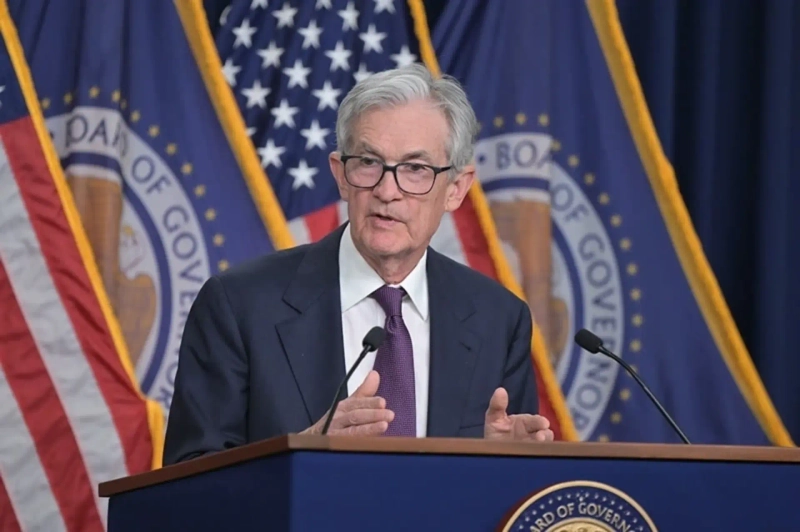
Federal Reserve Chair Jerome Powell on the 28th (local time) struck a cautious tone, refraining from further comment on pressure from the Donald Trump administration, including the issuance of a subpoena against him.
After the Federal Open Market Committee (FOMC) voted to hold the benchmark rate at 3.50–3.75%, Powell said at a press conference that, when asked why he had issued an unusual statement regarding the grand-jury subpoena, "Please refer to the statement released on the 11th. I will not elaborate further or repeat myself here."
However, regarding Fed Governor Lisa Cook’s attendance at the Supreme Court hearing, he said it was "the most important legal matter in the Fed’s 113-year history," signaling an intent to protect the Fed from pressure from the Trump administration.
On the U.S. economy, he said it is continuing to post solid growth, while citing weakening employment and prices remaining above target as risks. The following is a Q&A.
▶ You personally attended the Supreme Court hearing last week related to the Lisa Cook case. Treasury Secretary Scott Bessent criticized it as a political act. Why did you attend, and how do you respond to that criticism?
"I don’t respond to comments by other public officials. I don’t think that’s appropriate. But I can explain why I attended. This case may well be the most important legal matter in the Fed’s 113-year history. Had I not attended, it would have been harder to explain why. There is precedent—former Fed Chair Paul Volcker attended a Supreme Court hearing. I judged it appropriate, and that’s why I went."
▶ Is the recent decline in the unemployment rate a reliable figure? What is the basis for judging a '(labor-market) stabilization'?
"The statistical distortions from the government shutdown eased substantially in December compared with November. They haven’t disappeared entirely, but they are now minimal.
We removed the phrase in the statement that 'downside risks to employment have increased' because recent data have shown some signs of stabilization. I would caution against over-interpreting it, but at the same time cooling signals also coexist. We concluded that the previous wording no longer accurately reflected the data.
Another factor is the growth outlook. Since the last meeting, the outlook for economic activity has clearly improved, and that matters for labor demand and employment over the medium to long term."
▶ Unlike your previous stance of not directly engaging in political controversy, the video statement on January 11 was unusual.
"I’ll refer you to the statement released on January 11. Today I will focus on this press conference, the economy, and today’s policy decision."
▶ Have you decided whether you will continue to serve as a Fed governor?
"I have nothing to say on that today."
▶ Why do you want to step down in the current situation?
"That’s not something we’re addressing today."
▶ The dollar has moved sharply recently. What is your assessment of the drivers of dollar weakness and volatility?
"The Fed does not comment on the dollar. Oversight authority over exchange rates and currency policy rests with the Treasury. That’s not the Fed’s role."
▶ The statement’s language on growth and employment strengthened somewhat. Should we read that as meaning the timing of additional rate cuts has been pushed back?
"The data that have come in since the last meeting show a clear improvement in the growth outlook. Both the Beige Book and a range of indicators suggest the economy is getting off to a solid start this year. Inflation was broadly within the expected range, and the labor market showed some signs of stabilization. Overall, the outlook has strengthened."
▶ What about the timing or pace of further easing?
"After three rate cuts, the Fed is in a good position to respond to risks on both sides of its dual mandate. Future decisions will be made meeting by meeting, based on the data, the outlook, and the balance of risks. There are no decisions about future meetings at this time. The economy is growing solidly, the unemployment rate is broadly stable, and inflation is somewhat elevated."
▶ There is an assessment that the current policy rate is at the upper end of the neutral-rate range. Are you in the process of moving it lower, or is this level a stopping point?
"The current rate is within the estimated neutral range and toward the upper end. A significant number of participants do not view the current policy stance as strongly restrictive. It could be neutral or slightly restrictive. No one can know precisely.
Looking at the December Summary of Economic Projections (SEP), some participants expected further normalization, but a substantial portion has already taken place. Since September 2024, we have cut a total of 175 bp. We are at a good place to watch the data from here."
▶ Was the possibility of a cut at this meeting or in March discussed? Is there a consensus on conditions for additional cuts?
"There was broad support within the Committee for holding today. We are not at the stage of trying to set a clear bar for the next cut. Tensions between employment and prices have eased, and both upside risks to inflation and downside risks to employment have moderated somewhat. The judgment depends on the data."
▶ Have tariff effects already been reflected in prices?
"Mostly, yes. A significant portion of the overshoot in goods prices is due to tariffs. That is a problem that is easier to resolve than demand-driven inflation. Tariffs are likely to operate as a one-time price increase. In services, disinflation continues.
We think the tariff effects will peak around mid-year and then ease. If so, there could be room for policy easing. At the same time, if the labor market deteriorates again, that would also be a consideration. The Fed has a dual mandate."
▶ If a new Fed Chair is nominated, how would the transition of duties proceed?
"That’s up to Congress. I won’t speculate."
▶ Are risks to employment and prices balanced at this point? Must the next move be a cut?
"Both upside risks to inflation and downside risks to employment have declined, but they have not disappeared. It’s hard to say it’s a perfect balance. Policy is in a good place, and we will go where the data lead."
▶ How do you assess recent moves in inflation-expectations indicators?
"Short-term inflation expectations have fallen significantly, and long-term expectations are consistent with the 2% target. Expectations are stable and reflect confidence in a return to 2%."
▶ In the past, you cut rates because you judged labor-market risks to be larger. Is that still the case?
"At that time the labor market was weakening, and we responded. Now risks on both sides have eased. We are not judging which side is riskier."
▶ Do you agree with the view that global investors are hedging dollar exposure due to policy uncertainty?
"We have seen very little data supporting that phenomenon."
▶ To resume easing, what would you need to see in the labor market?
"We look at the labor market and inflation together. Labor-market weakening is a reason to cut. But if inflation were to worsen at the same time, that would be a very difficult situation. We judge it holistically."
▶ If prices rise again and the labor market does not weaken, is a rate hike possible?
"I wouldn’t rule out the possibility. But it is not anyone’s base case."
▶ Could the U.S. face a similar situation due to fiscal issues, like turmoil in the Japanese government bond market?
"The U.S. fiscal path is not sustainable. The debt level itself is manageable, but the trajectory is a problem. The earlier it is addressed, the better. But I won’t directly link it to a near-term market crisis. Long-term rates do not move one-for-one with the short-term policy rate."
▶ If the Fed’s political independence is undermined, what impact would that have on households?
"Independence is not an institutional device to protect policymakers; it is a device for the public. Every advanced democracy adopts it. If you lose it, it’s hard to regain trust. Independence has enabled central banks to serve the public interest."
▶ Is the recent employment slowdown an illusion or a structural change?
"Labor-supply growth has essentially stopped, and labor demand has slowed by almost the same magnitude. That’s why the unemployment rate rose. It’s difficult to say definitively whether this is a structural change. It’s a highly unusual situation and hard to interpret."
▶ Is the improved growth outlook due to fiscal stimulus?
"Consumption was strong even before the fiscal effects fully kicked in. Financial conditions were also supportive. AI investment centered on data centers is also contributing to growth. Consumer surveys are negative, but the divergence with resilient actual spending continues."
▶ The wealthy are supporting consumption while many households feel burdened by living costs. What discussion was there on this?
"Rising asset prices are supporting consumption among higher-income households. Lower-income households are cutting back and showing saving behavior. The Fed recognizes that price stability is the key tool to reduce the burden on households."
▶ Is there concern that AI will replace jobs?
"Every technological innovation eliminates some jobs and creates others. Over the long run it raises productivity and provides a foundation for wage growth. The overall effect of AI is still uncertain."
▶ When do you expect inflation to cool?
"On a 12-month basis, core personal consumption expenditures (PCE) inflation is 3.0%. On the surface there has been no progress. But most of the overshoot is goods prices due to tariffs. We think the tariff effects will peak around mid-year."
▶ What is your assessment of geopolitical risks?
"So far, in terms of energy and trade, the U.S. economy has held up relatively well. The measures actually implemented were weaker than the initial announcements, and a substantial portion is being absorbed by businesses."
▶ If you cut rates amid strong growth, doesn’t that risk stoking inflation?
"The key is how quickly potential growth is rising. If productivity increases, potential growth rises as well. Quarterly GDP is highly volatile."
▶ Is the divergence between growth and employment due to productivity?
"Rising productivity explains part of it. There are also recent signals of stabilization in the unemployment rate. It’s still too early to be definitive."
▶ What advice would you like to give to your successor as Fed Chair?
"Honestly, there are a few things I’d like to say. First, do not get involved in elected politics. Don’t get pulled into electoral politics. Never do that. Second, the channel through which the Fed secures democratic legitimacy is Congress. Appearing before Congress to explain and communicate is not a passive burden; it is an obligation that must be carried out proactively and regularly. If you want democratic legitimacy, you have to build it directly through your relationship with Congress, the oversight body elected by the people. I have also put a lot of effort into that. Lastly, it’s easy to criticize government agencies. But once you meet Fed staff, you’ll see it. These are among the most capable people you have worked with or will work with. Some may not be perfect, but there is no professional workforce as dedicated to the public welfare as the Fed’s."
New York = Park Shin-young, correspondent nyusos@hankyung.com

Korea Economic Daily
hankyung@bloomingbit.ioThe Korea Economic Daily Global is a digital media where latest news on Korean companies, industries, and financial markets.