PiCK
U.S.-driven risks hit all at once… Bitcoin plunges below $82,000 and altcoins wobble across the board [Lee Soo-hyun’s Coin Radar]
Summary
- Bitcoin gave up the key $82,000 support level, triggering panic selling and about $770 million in long liquidations, the report said.
- For Ethereum, amid the possibility of breaking below $2,900 and $2,750 support, a further downside scenario toward $2,400–$2,250 was raised.
- Worldcoin saw volatility surge as it plunged 17% after a rally on OpenAI-integration speculation, alongside selling pressure from token unlocks, the report said.
Forecast Trend Report by Period



<Lee Soo-hyun’s Coin Radar> is a weekly column that tracks trends in the cryptoasset (cryptocurrency) market and explains what’s behind them. Going beyond a simple list of prices, it provides a multidimensional analysis of global economic issues and investor behavior, offering insights to help gauge market direction.
Major Coins
1. Bitcoin (BTC)
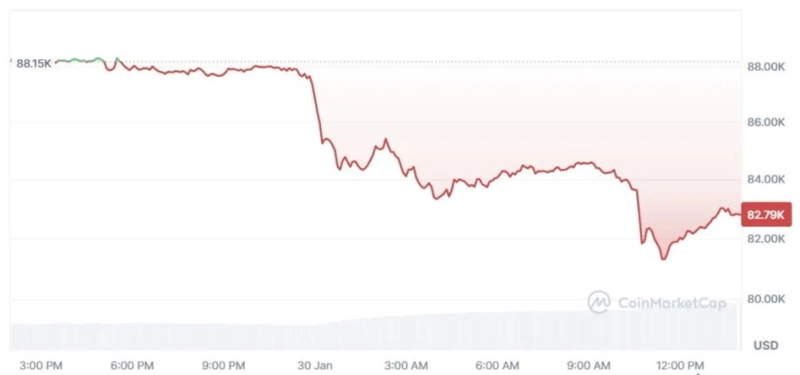
This week, Bitcoin appeared to hold within a range before turning sharply volatile after midnight on the 30th. It dropped nearly $3,000 from the peak, falling to below the $82,000 level. As of the 30th, it is still trading around $83,000 on CoinMarketCap.
Many see the decline not as the result of a single issue but as the product of multiple U.S.-related risks overlapping at once. The most immediate trigger was a sharp selloff in U.S. tech stocks. On the 29th (local time), Microsoft shares in particular plunged more than 11% in a single day, rattling markets. While earnings themselves were not especially bad, concerns over slowing cloud growth and rising investment costs came to the fore, marking the stock’s worst day since March 2020. In the aftermath, the Nasdaq fell 1.5% and risk-off sentiment spread quickly across risk assets. Bitcoin found it hard to avoid that tide.
U.S. political risk also piled on. The U.S. Senate rejected the House budget bill in a procedural vote, reviving concerns about the possibility of a federal government shutdown. President Trump and the Democratic Party later reached a temporary agreement to avert a shutdown, but by then a significant amount of anxiety had already been priced in.
Geopolitical tensions added to the burden. After the U.S. released footage of an aircraft carrier operating in the Indian Ocean and President Trump issued hard-line remarks toward Iran, renewed friction between the U.S. and Iran came back into focus. Such geopolitical risks tend to spur demand for safe havens and also contributed to downside pressure on Bitcoin.

Uncertainty ahead of the selection of the next Fed chair also weighed on the market. With President Trump signaling on the 30th that he would announce the next Fed chair, reports said the final shortlist had been narrowed to former Fed Governor Kevin Warsh and BlackRock Chief Investment Officer (CIO) Rick Rieder. According to sources familiar with the matter, President Trump was said to be leaning toward Kevin Warsh. As the likelihood rose that Warsh—seen as relatively hawkish—could be nominated, expectations for rate cuts retreated, adding another headwind for Bitcoin.
Against this backdrop, Bitcoin showed signs of panic selling on the morning of the 30th, plunging by more than $2,000 in just minutes and swiftly losing the key $82,000 support level. Once that zone broke, automatic stop-losses and forced liquidations occurred simultaneously, accelerating the decline. CoinGlass data showed roughly $770 million worth of positions were liquidated in just one hour, most of them long positions.
Looking ahead, the potential for heightened volatility remains high in the short term. Glassnode assessed that Bitcoin failed to establish itself above the short-term holder cost basis, reverting to a bearish structure, and left the door open to further downside. CoinDesk cited $81,000 as initial support and said that if this area breaks, the mid-$75,000 range could come into play. For now, it appears to be a zone where prices can swing sharply depending on macro variables.
2. Ethereum (ETH)
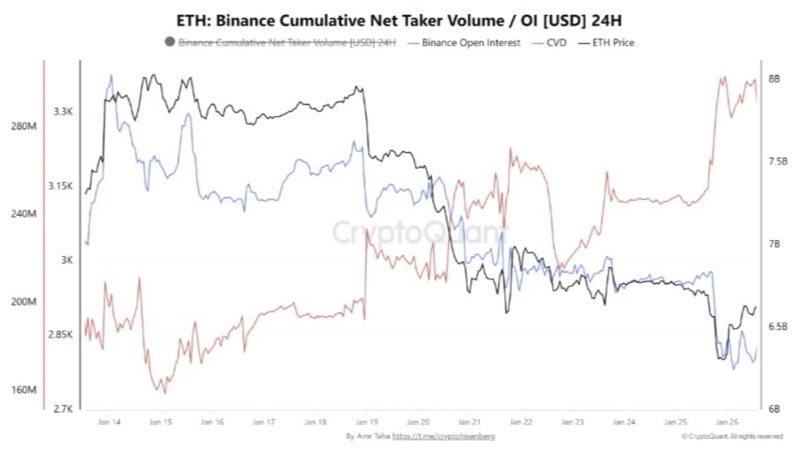
Ethereum also swung sharply alongside Bitcoin, at one point sliding to below $2,800 and entering a technically uncomfortable zone.
Many analyses suggest this pullback was driven less by spot selling and more by leverage unwinding in derivatives markets. According to CryptoQuant, Ethereum derivatives open interest fell sharply over the past two weeks, from about $8.0 billion to around $6.4 billion. The interpretation is that the price was pushed lower as accumulated leverage was rapidly unwound rather than by new waves of selling. In fact, while open interest declined, cumulative market-order flow remained in an uptrend, suggesting it was not a phase in which short positions were being aggressively built.
Technically, the break below $2,900 amplified the downside. CoinMarketCap data show that as this level gave way, Ethereum simultaneously broke the 30-day moving average and the 50% Fibonacci retracement zone. MACD also signaled accelerating downside momentum, and the sideways structure that had persisted for two weeks has now broken down.
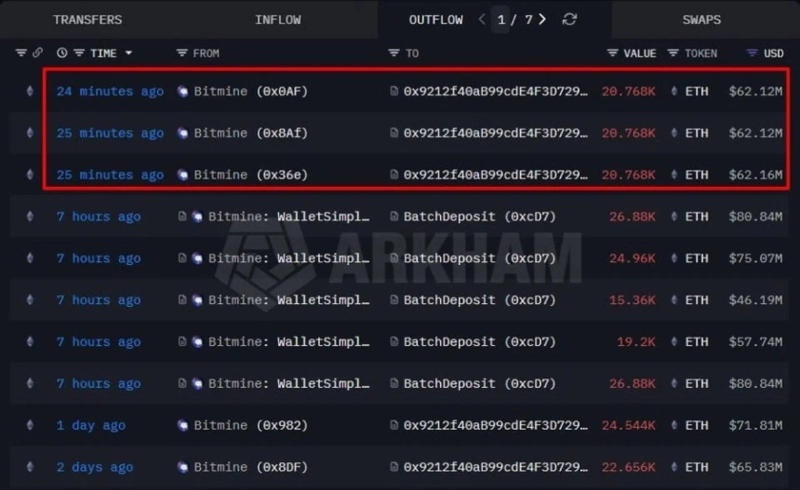
Still, there was no shortage of positive factors. On the 28th, Bitmine added staking of roughly 60,000 Ethereum, briefly providing a catalyst for a rebound to $3,000. Bitmine’s total staked amount stands at around 2.32 million, and its annual staking income is estimated to be sizable.
On the fundamentals side, attention is also on the deployment of the new 'ERC-8004' standard on mainnet. ERC-8004 is an Ethereum Improvement Proposal designed to enable AI agents to be registered and verified on-chain. With the standard in place, AI agents belonging to different organizations and platforms can discover one another, check reputations, and interact without prior trust relationships. This has fueled assessments that Ethereum has laid groundwork to expand as infrastructure for an AI economy.
Technically, $2,750 is the next key support. If that level is decisively lost, the possibility of a retest of the $2,400 range also opens up. Crypto-focused outlet Cointelegraph offered an even more explicit outlook, saying: "After breaking below the lower boundary of a triangle pattern, Ethereum retested the area that had acted as resistance but failed, increasing the probability of further declines. Ethereum’s price could fall to $2,250 by mid-February." That said, the analysis adds that if the price recovers the lower boundary of the triangle pattern and breaks above $3,065, the bearish scenario could be invalidated.
3. XRP (XRP)
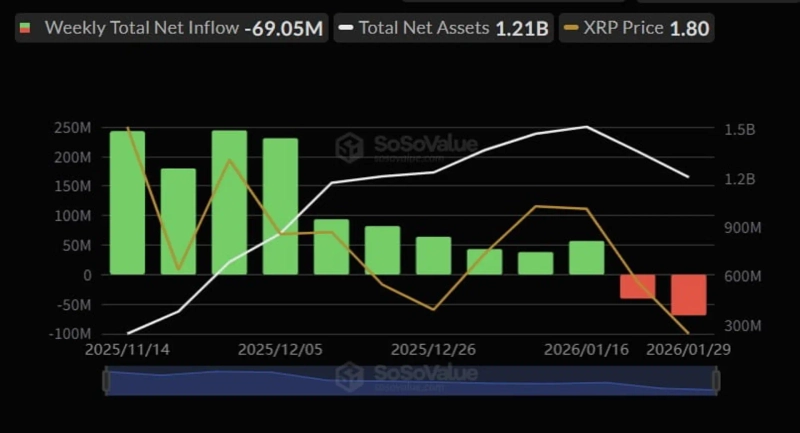
XRP showed a particularly sluggish performance during this correction. The price stayed below the $1.8 level and struggled to mount a rebound. As of the 30th, it is trading at $1.76 on CoinMarketCap.
The biggest shift was that flows into spot XRP exchange-traded funds (ETFs)—which had acted as a key support—wobbled for the first time. Last week, spot XRP ETFs saw net outflows of about $41 million (about ₩5.88 billion), marking the first weekly net outflow since listing. Total net assets also fell from $1.6 billion to $1.36 billion.
Some analyses say selling accelerated after the break of the key support at $1.87. Crypto-focused outlet CoinDesk noted that “with $1.87—technically a major support—clearly breaking, heavy volume and selling pressure accelerated and a short-term downtrend was confirmed.” The inflow of sell-side pressure at that time was said to have quickly pushed the price down to $1.8.
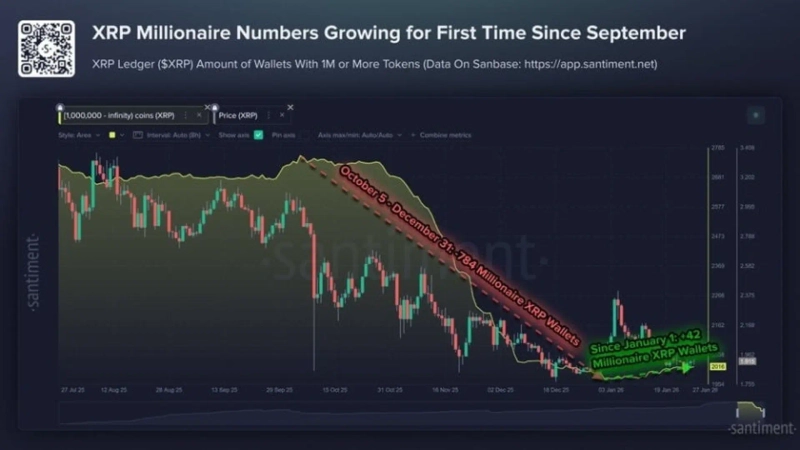
However, on-chain indicators are sending mixed signals. That’s because the number of wallets holding at least 1 million XRP turned back to growth for the first time in four months. On the 29th, on-chain analytics firm Santiment said via X that “the number of wallets holding at least 1 million XRP turned positive for the first time since last September, rising by 42 on a net basis.” This is interpreted as a sign that whale-class investors are accumulating even during a short-term correction, which is positive from a medium- to long-term supply-demand perspective.
In terms of outlook alone, a cautious view is prevalent. CoinDesk pointed to $1.8 as a key support and warned that if it breaks, there is a risk of a decline to $1.73. With price action moving below this level, further downside cannot be completely ruled out. Cointelegraph is even leaving open the possibility that, as in the past, XRP could remain in a range around $2 for an extended period—suggesting that sluggish trading may persist until a clear breakout emerges.
Issue Coin
1. Worldcoin (WLD)
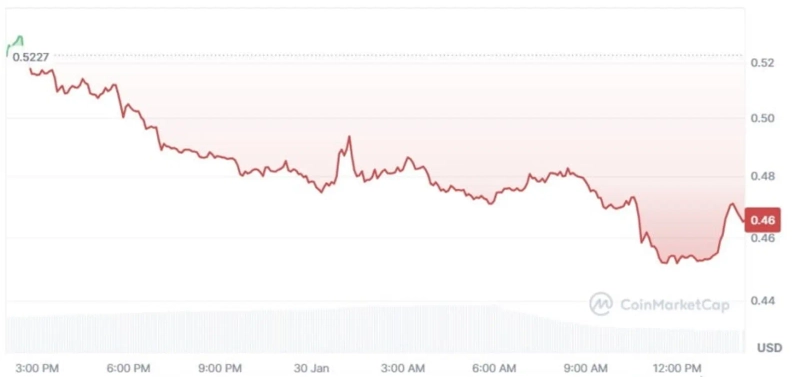
One of the coins showing the biggest volatility this week was Worldcoin. It surged in a short period amid talk of potential integration with OpenAI, but then plunged just a day later, giving back much of the gains.
On the 29th, Worldcoin fell more than 17% in a single day on CoinMarketCap. Considering that the average decline across the broader crypto market that day was below 5%, the drop was notably steep. With the overall market already in a fear-driven phase, highly volatile altcoins effectively absorbed the shock in full.
The core reason for the decline was a short-term surge driven by unconfirmed catalysts and the ensuing profit-taking. Worldcoin jumped more than 20% over two days as speculation spread that OpenAI was reviewing biometric authentication technology, but there was no official announcement or concrete follow-up news. With the price having run ahead on expectations alone, buying interest also faded very quickly.
Token unlock overhang also compounded the move. Recently, about $20 million worth of Worldcoin was released into the market, increasing circulating supply and adding selling pressure at a time when demand had weakened. The fact that mid-cap altcoins tend to be more vulnerable when Bitcoin dominance is high also appears to have contributed to the magnitude of the drop.
The market is now effectively calling on Worldcoin to “bring verified catalysts, not rumors.” Technically, the $0.47 level is being cited as a key support, and if that area fails to hold, volatility could increase further. For the time being, the market is likely to focus less on expectations and more on whether there is tangible progress in the actual business.

Suehyeon Lee
shlee@bloomingbit.ioI'm reporter Suehyeon Lee, your Web3 Moderator.