Retail Investors Pile In and a 'KRW 103trn' Record Breaks… “KOSPI Not Overvalued” [Weekly Outlook]
Summary
- With the KOSPI stabilizing above 5,000 and investor client deposits at KRW 103.7072 trillion hitting a record high, the market said the bullish trend could continue.
- Brokerage analysis said it would maintain an overweight long-term preference for AI infrastructure plays such as semiconductors, power equipment, nuclear power, and energy storage systems (ESS).
- It said the KOSPI’s PER is 10.8x, around the five-year average, while variables include U.S. tariffs, the Fed chair nomination, major economic indicators and earnings releases.
Forecast Trend Report by Period


Client deposits hit 'KRW 100trn'…Will the KOSPI keep flying in February on the back of ‘Donghak ant’ investors?
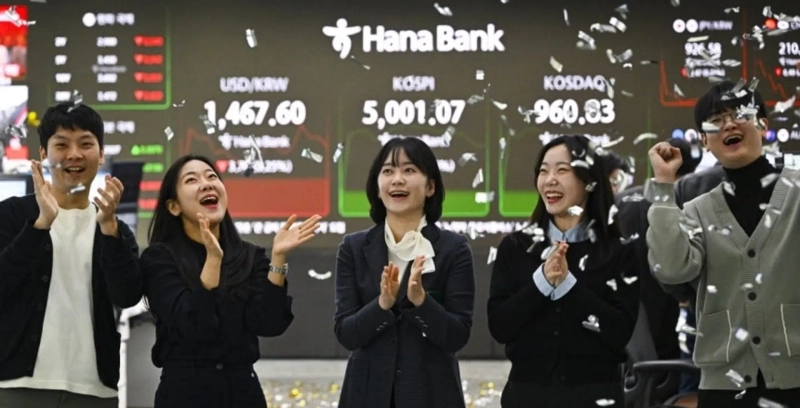
The KOSPI has settled above the 5,000 level. Attention is now on whether gains can extend again this week (2–6). Brokerages say the bullish run is likely to continue, as investor client deposits have topped KRW 100 trillion and earnings expectations are also rising.
According to the financial investment industry on the 1st, NH Investment & Securities put this week’s expected KOSPI range at 4,900–5,300. It cited earnings momentum as an upside driver. Consensus estimates for listed Korean companies’ full-year 2026 operating profit were revised up by 13.7% over the past month.
Na Jeong-hwan, a researcher at NH Investment & Securities, said, “On strong earnings outlooks for semiconductor companies such as ASML and Seagate, returns for Korea’s semiconductor sector have remained among the top performers,” adding, “While the recent rally has been steep, we maintain an overweight long-term preference for AI infrastructure plays—including semiconductors, power equipment, nuclear power, and energy storage systems (ESS)—given that earnings are backing the move.”
Although the KOSPI has been setting fresh highs day after day, some argue it has not entered an overvaluation zone. The KOSPI’s 12-month forward price-to-earnings ratio (PER) stands at 10.8x, staying around its five-year average. Kang Jin-hyeok, a researcher at Shinhan Investment Corp., said, “PER has risen, but earnings estimates are being revised upward on the back of semiconductor blowout results,” explaining that “strong earnings prospects are underpinning the KOSPI’s strength.”
Rising investor client deposits are also seen as a positive. As of the 29th of last month, client deposits were tallied at KRW 103.7072 trillion, an all-time high. Client deposits refer to funds investors keep in brokerage accounts for stock purchases or proceeds left unwithdrawn after selling shares. They are used as a gauge of investor sentiment. Kang said, “If a pullback comes, bargain hunting could flow in, providing firm support on the downside.”
Tariff pressure from the U.S. is cited as a key variable. On the 26th of last month, U.S. President Donald Trump declared he would roll tariffs on major Korean items such as automobiles, lumber and pharmaceuticals back up to 25%—the level before the trade agreement. As an ostensible reason, Trump pointed to delays in Korea’s enactment of the promised “Special Act on Investment in the U.S.”
U.S. Commerce Secretary Howard Lutnick, in remarks at a gala dinner for the “Lee Kun-hee Collection” hosted by the Smithsonian’s National Museum of Asian Art in Washington, D.C., stressed that investment in the U.S. is “not an option.” Industry Minister Kim Jeong-gwan, who visited the U.S. to prevent the tariff hike, met with Lutnick but is said not to have achieved major results.
There is also speculation that the U.S. Supreme Court may issue a ruling as early as this month on whether the reciprocal tariffs are illegal. If the Court, as in the first and second trials, deems Trump’s reciprocal tariffs unlawful, the administration’s authority to impose tariffs could be constrained. As a result, some analysts say the Trump administration may step up the pace to produce results ahead of the Supreme Court decision.
Meanwhile, Trump nominated Kevin Warsh, a former Fed governor, as the next chair of the U.S. Federal Reserve (Fed). The move is seen as an attempt to pressure Chair Jerome Powell by announcing the successor early. Trump has repeatedly criticized Powell publicly for not moving faster on rate cuts. Still, Warsh is interpreted as less dovish (pro-easing) than other candidates. After the chair nomination was announced, precious metal prices including gold and silver plunged, while the dollar index rose.
Key indicators due this week include the January U.S. Institute for Supply Management (ISM) manufacturing and services indices, the January U.S. unemployment rate and nonfarm payrolls, and weekly initial jobless claims. On the 5th, the European Central Bank (ECB) will decide its policy rate.
Earnings releases will also continue from major U.S. companies including Palantir, AMD, Alphabet, Qualcomm and Amazon. Among Korean companies, Samsung SDI, Hanwha Ocean, Ecopro and KB Financial Group are set to disclose fourth-quarter results for last year this week.
Jin Young-gi, Hankyung.com reporter young71@hankyung.com

Korea Economic Daily
hankyung@bloomingbit.ioThe Korea Economic Daily Global is a digital media where latest news on Korean companies, industries, and financial markets.