Wash trade spurs rise in long-term rates…gold and silver prices also plunge [Fed Watch]
Summary
- It reported that emphasis on Warsh’s hawkish leanings and calls for balance-sheet reduction drove long-term U.S. yields higher and steepened the yield curve.
- It said the possibility of reduced dollar liquidity came into focus, with the dollar index rising 0.74% and a surge in the dollar’s value observed.
- It reported that a broad selloff swept precious metals and crypto, with gold and silver plunging and bitcoin falling below $80,000.
Forecast Trend Report by Period


As hawkish leanings and calls to shrink the balance sheet surface
Dollar strengthens, long-term rates rise
As U.S. President Donald Trump named Kevin Warsh, a former Fed governor, as his pick for the next chair of the Federal Reserve, investors in the Treasury market, the dollar and gold-and-silver markets moved quickly to price in Warsh’s monetary and financial-policy stance.
In particular, after Trump said he had not discussed rate cuts with Warsh, markets reflected expectations that the Fed’s independence could be better preserved than feared. Investors also took into account Warsh’s past hawkish tilt.
In response, short-term U.S. Treasury yields fell while long-term yields rose. As confidence in the Fed’s monetary policy recovered, international gold and silver prices declined. The dollar strengthened after it became known that Warsh has argued for shrinking the Fed’s balance sheet.
Easing concerns over Fed independence
On the 30th (local time), U.S. President Donald Trump said he had not directly discussed the issue of cutting the policy rate with Warsh. After a signing ceremony for executive orders in the Oval Office, Trump told reporters that the answer was “no” when asked whether Warsh had promised to pursue rate cuts if confirmed by the Senate. However, he added, “We’ve talked about that issue, and I’ve been watching him for a long time.”
He said, “I don’t want to ask him that question. It would probably be inappropriate,” adding, “It may be permissible, but I want to keep this process clean and pure.” The remarks are seen as reflecting awareness that seeking prior commitments on policy direction from a Fed chair nominee could run counter to central-bank independence.
In New York’s bond market on the 30th (local time), long-term U.S. Treasury yields moved more than short-term yields, producing a “bear steepening” that made the yield curve steeper.
In New York trading, the policy-sensitive 2-year Treasury yield fell 0.027 percentage point from the previous session to 3.52%. By contrast, the 10-year Treasury yield rose 0.014 percentage point to 4.24%.
This “bear steepening” is interpreted as a signal that the market does not view Warsh simply as a supporter of rate cuts. The Treasury market judges that Warsh is likely to lower the policy rate in the short term under political pressure from President Trump, because the policy rate immediately affects short maturities. However, as the perception spreads that Warsh would take a much stricter stance on inflation management over the medium to long term, selling pressure has concentrated in longer-dated Treasuries.
Dollar strengthens on expectations of balance-sheet normalization
Another key phrase that shook the Treasury market was “balance-sheet normalization.” When he stepped down as a Fed governor in 2011, Warsh publicly opposed former Fed Chair Ben Bernanke’s second round of quantitative easing, strongly criticizing it by saying that “the Fed’s large-scale purchases of long-term Treasuries to artificially lower rates distort the market’s price-discovery function.”
Markets are watching whether, if Warsh becomes Fed chair, the Fed could pursue more aggressive quantitative tightening (QT) than expected for the trillions of dollars of Treasuries and mortgage-backed securities (MBS) it holds, or speed up balance-sheet reduction by stopping reinvestments of maturing securities. That would increase the supply of Treasuries circulating in the market, pulling down long-term prices (pushing yields higher) and contributing to a steeper yield curve.
On expectations that dollar liquidity could shrink, the dollar rebounded. The dollar index, which reflects the dollar’s value against six major currencies on ICE Futures, closed at 96.99 in New York stock trading, up 0.74% from the previous session. The dollar had fallen to its lowest level in four years earlier this week as confidence in dollar assets weakened after concerns over interference with the Fed’s independence and President Trump’s threat to annex Greenland resurfaced.
Gold and silver plunge
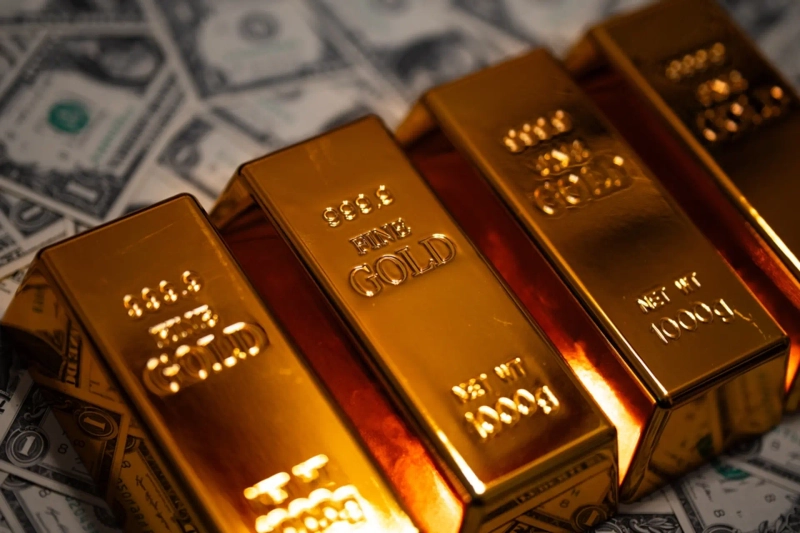
Silver and gold prices fell as the perception spread that market concerns over damage to central-bank independence had eased. The surge in the dollar also helped drive prices lower.
Silver futures tumbled 31.4% to close at $78.53 per troy ounce, the worst day since March 1980. Spot prices also slid 28% to $83.45 per troy ounce, trading near the intraday low.
Gold also fell sharply. Spot gold traded around $4,895 per troy ounce, down about 9%, and gold futures plunged 11.4% to settle at $4,745 per troy ounce.
Market participants said declines began immediately after news of Warsh’s nomination, and losses widened into the U.S. afternoon session as profit-taking accelerated. The sharp rise in the dollar increased the cost burden for foreign investors buying gold and silver, also weighing on prices. The dollar index rose about 0.8% intraday.
Liquidation of short-term funds that had poured into precious metals recently also had an impact. Silver in particular has a high share of leveraged trading, and margin calls were said to have followed during the plunge.
Gold and silver had surged 66% and 135%, respectively, over the course of 2025, posting record-high gains. However, the sharp selloff also drove steep declines in silver-related exchange-traded funds (ETFs) and mining stocks. Markets are watching shifts in uncertainty surrounding Fed appointments and dollar moves as key drivers of precious-metals price direction in the near term.
Bitcoin plunges below $80,000
Bitcoin, the largest cryptocurrency by market capitalization, fell back below $80,000 for the first time in about nine months, reflecting concerns over Warsh’s hawkish tilt. According to U.S. cryptocurrency exchange Coinbase, as of 1:30 p.m. Eastern time, the price of one bitcoin stood at $78,309, down about 5% from 24 hours earlier.
It was the first time bitcoin fell below $80,000 since April 11 last year.
That is about 38% below the all-time high of $126,210.5 recorded on Oct. 6 last year.
After hitting that record, bitcoin slid sharply, falling to the $80,000 level on Nov. 20 last year before rebounding and nearing $98,000 on the 14th. It then failed to reach $100,000 and turned back into a sharp decline.
New York=Correspondent Park Shin-young nyusos@hankyung.com

Korea Economic Daily
hankyung@bloomingbit.ioThe Korea Economic Daily Global is a digital media where latest news on Korean companies, industries, and financial markets.