Kevin Warsh, who met Chang-yong Lee in Korea… What will happen to monetary policy and the exchange rate? [Kang Jin-kyu’s BOK Watch]
Summary
- It said Warsh’s nomination increases the likelihood of more aggressive Fed rate cuts and balance-sheet reduction.
- It said the nomination spurred a stronger dollar and a surge in the won-dollar exchange rate, highlighting expectations for an adjustment in the Korea-U.S. rate gap.
- It said that if the U.S. strengthens an accommodative monetary stance, a narrower Korea-U.S. rate gap could reduce capital outflow pressure and ease the burden of the exchange-rate factor.
Forecast Trend Report by Period


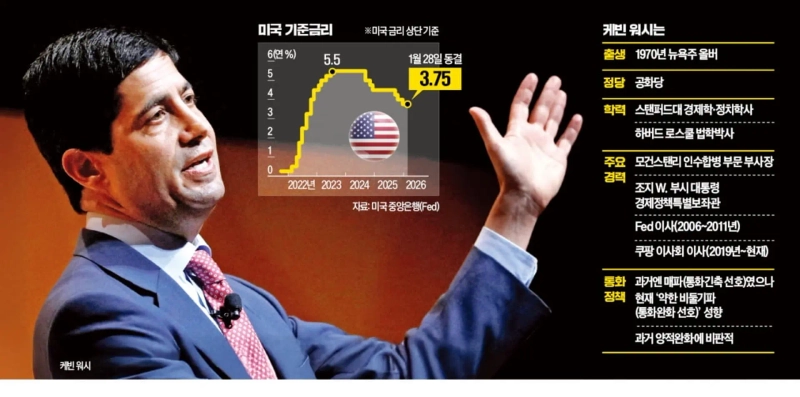
Interest is rising in the impact on South Korea’s monetary policy after Kevin Warsh, a former Federal Reserve (Fed) governor, was nominated to be Fed chair. With expectations growing that rates will be cut at the behest of U.S. President Donald Trump—potentially narrowing the Korea-U.S. rate gap—attention is focused on how Warsh’s reputation as a “soft dove” will translate into policy.
Warsh has ties to Korea, having visited the Bank of Korea (BOK) after Chang-yong Lee took office as governor, and traveling to Seoul, Busan and Songdo in Incheon as a Fed governor during the 2010 G20 summit in Seoul. This has also fueled hopes that monetary-policy coordination between the two countries could proceed smoothly.
How fast will U.S. rate cuts come?
According to local developments shared on the 31st last month by the BOK’s New York office and its staff in Washington regarding Warsh’s nomination, local media assessed that “President Trump’s decision to nominate Warsh is intended to further reinforce FOMC rate cuts.”
While Warsh took a hawkish stance during his time as a Fed governor, he has recently urged the Fed to pursue proactive rate cuts, citing structural changes driven by advances in AI technology and the Trump administration’s deregulation and tax policies.
Paul Krugman, a Nobel laureate in economics and professor at the City University of New York, wrote on the 31st (local time) on the Substack online newsletter platform that “it is wrong to describe Warsh as a hawk,” adding that “when Democrats held the White House, he argued for tight monetary policy and opposed every attempt at stimulus, but since November 2024 he has consistently defended rate cuts.”
The Fed’s balance sheet, however, is expected to shrink. He has also taken a hard line against the Fed’s quantitative easing, and has not withdrawn or revised that stance.
Possibility of ‘minimizing’ communication with markets
Markets also expect Warsh to move to cut rates and shrink the balance sheet. At the same time, they are focused on the prospect that he could “minimize communication with markets,” given his long-held view that “the Fed’s frequent communication constrains its policy options.”
Given Warsh’s leanings, markets see a possibility that the frequency and specificity of forward guidance and economic projections could be scaled back. He is also expected to appear far less often in markets and the media. Data-dependent policymaking could weaken as well, as Warsh believes that “economic data are inherently noisy” and warns against attaching excessive meaning to them.
Warsh has also opposed the Fed offering opinions on a wide range of issues. In particular, he objected to expanding the Fed’s remit to climate change and inclusiveness, calling them “issues outside its core mission.”
What does it mean for Korea?
The foreign-exchange market swung sharply after the nomination. The won-dollar exchange rate surged 17.20 won from the previous session’s close to 1,443.50 won at 2 a.m. on the 31st last month. That was up 4 won from the daytime close of 1,439.50 won. The move was attributed to perceptions that Warsh is the least dovish among the candidates. Expectations that, even if he cuts rates faster than Chair Jerome Powell, he would still cut more slowly than other candidates boosted the dollar.
Over the medium to long term, however, if the U.S. reinforces an accommodative monetary stance, it could give Korea more policy room. Once expectations are recalibrated and Warsh moves to cut rates, the current Korea-U.S. rate gap of 1.25 percentage points would narrow further, easing capital outflow pressure in FX markets. That could put downward pressure on the elevated exchange rate and reduce concerns over the currency as a factor in rate decisions. With growth likely to deteriorate significantly and the need for rate cuts resurfacing, one constraint on considering rate cuts would effectively be removed.
If Warsh’s reluctance to engage with markets materializes, it could also reverse the BOK’s recent push to strengthen data-dependent policy and enhance communication.
Unlike Warsh’s approach, the BOK has been working to increase the frequency of its economic outlook and expand its communication with markets. It has also set a goal of becoming a “think tank” by broadening the scope of its analysis to include various social issues. However, if Warsh, after taking office, stresses that this style of communication and issue-fighting is unnecessary, global standards could shift—potentially prompting the BOK to revert to past practices.
Coordination and communication with Korea’s monetary authorities could still be smooth, given Warsh’s ties to the country. He is said to have known BOK Governor Lee for a long time. A BOK official said, “They interacted frequently in the U.S. dating back to when Governor Lee served as director of the IMF’s Asia and Pacific Department, and they met several times during Lee’s U.S. business trips even after he became BOK governor.” Warsh is also known to have visited the BOK to meet Lee after Lee took office. However, Lee’s term runs through the end of April; if he does not serve a second term, he would not overlap with Warsh, who would take office in May.
During his time as a Fed governor, Warsh also served as the official responsible for Asia and attended various meetings as the Fed representative at the 2010 G20 summit in Seoul. He participated in the deputy finance minister and deputy central bank governor meeting held in Songdo, Incheon, and attended the ministerial meeting in Busan in place of then-Chair Ben Bernanke. He also currently serves as an outside director at Coupang.
By Kang Jin-kyu josep@hankyung.com

Korea Economic Daily
hankyung@bloomingbit.ioThe Korea Economic Daily Global is a digital media where latest news on Korean companies, industries, and financial markets.