Made ₩5 billion selling a stake…half into U.S. index ETFs, 10% into crypto
Summary
- Mr. A said he will invest half of the ₩5 billion secured from selling his stake into U.S. equity ETFs such as the S&P 500 and Nasdaq 100, aiming for long-term upside.
- He said 10% of total assets will be invested in crypto assets such as Bitcoin and Ethereum via staged buying, seeking a hedge against currency depreciation and long-term returns.
- He said the remaining assets will be diversified across AI·semiconductor·robotics ETFs, domestic tax-exempt ETFs, gold and MMFs, while managing volatility through regular rebalancing and tax-saving strategies.
Forecast Trend Report by Period


Young and rich portfolio
Man in his 40s who sold a startup stake
₩1 billion into AI·robotics·semiconductor ETFs
Also adds domestic tax-exempt products
Bets ₩500 million by buying crypto in tranches
₩1 billion in safe assets…securing liquidity
Also uses MMFs to hedge inflation
"Manage volatility rather than chase high returns"
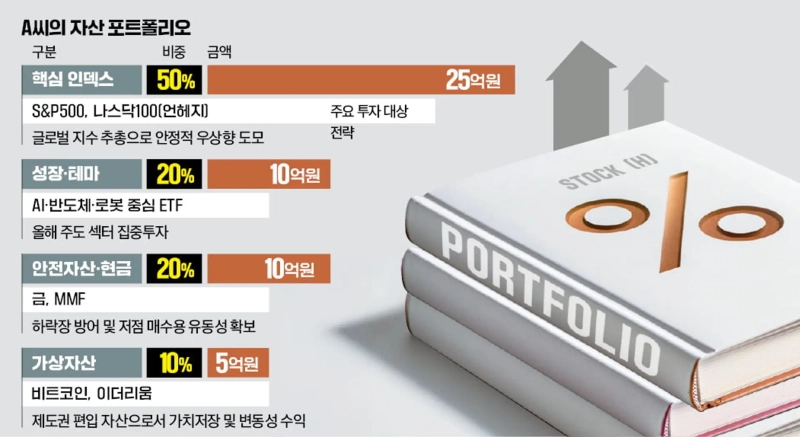
The ₩5 billion that suddenly landed in his hands was both an opportunity and a dilemma. Mr. A, a startup CEO in his early 40s, found himself at a pivotal moment in full-fledged asset management, deciding how to deploy the funds he secured by selling his stake. Having amassed a large amount of liquidity in a short period, he wanted this time to pursue an investment that would clearly outperform the market.
His concerns were clear. Global equities led by artificial intelligence (AI) have posted strong gains since 2024, and crypto assets such as Bitcoin and Ethereum have also been rapidly incorporated into mainstream financial markets. He concluded that relying only on cash-like assets and conservative management would make it difficult for his wealth to keep pace with the market. Still, given the risk that volatility could increase after a sharp short-term rally, he wanted to avoid simply betting blindly on themes.
Mr. A’s portfolio was designed based on market conditions as of January this year. The setup reflected multiple variables, including the KOSPI at around 4,800, entry into a rate-cut cycle, clearer earnings visibility for the AI industry, and heightened won–dollar exchange-rate volatility. The aim was a structure combining downside resilience with upside exposure. There were two core principles: trim risk by adjusting weights when asset prices surge, and also put tax-saving measures in place to reduce the burden of Korea’s comprehensive taxation on financial income.
The allocation was straightforward. Of the total ₩5 billion, half would go to global index assets with long-term upward potential, while the remainder would be diversified across growth themes, crypto assets and safe assets. The core index holdings anchoring the portfolio were U.S. equity ETFs tracking the S&P 500 and the Nasdaq 100. They were seen as a stable choice given their high likelihood of delivering over the long term and their broad exposure to AI beneficiaries. Taking into account FX trends and the cost of hedging, he chose products without separate currency hedges.
For growth and thematic assets aimed at excess returns, he added ETFs focused on AI, semiconductors and robotics. While there are concerns about stretched AI valuations, he judged that this year’s results are again likely to exceed market expectations. He also included domestic tax-exempt ETFs holding leading companies across a range of industries—such as robotics, defense, shipbuilding and energy—to reduce the risk from concentration in a single theme.
Crypto assets were allocated at about 10% of total assets. With fiscal expansion continuing in major economies including the U.S., he factored in the growing role of crypto as a hedge against currency depreciation. Despite high short-term volatility, he approached it from a long-term perspective by buying in tranches, focusing on the largest coins by market capitalization. The mix is 70% Bitcoin and 30% Ethereum. This reflects both Bitcoin’s limited supply and Ethereum’s characteristics as core infrastructure for real-world asset tokenization (RWA) and the stablecoin ecosystem.
Safe assets and cash-like assets were kept at 20% of the total. He used gold and money market funds (MMFs) to brace for geopolitical risks and inflation (rising prices). The goal was to secure liquidity for additional buying during market pullbacks. He also designed a rebalancing structure under which, if the weights of equities and crypto expand sharply, he would take some profits and rotate them back into this bucket.
The portfolio was assessed as enabling aggressive yet controlled management. Noh Tae-seop, gold PB team leader at Hana Bank’s Olympic Village PB Center, said, "The younger and wealthier the client, the more important it is to build a structure that can manage volatility rather than simply chasing returns," adding, "As the market environment changes quickly, only by combining regular reviews and rebalancing with tax-saving strategies can long-term performance be preserved."
By Cho Mi-hyun, mwise@hankyung.com

Korea Economic Daily
hankyung@bloomingbit.ioThe Korea Economic Daily Global is a digital media where latest news on Korean companies, industries, and financial markets.