Korbit Research Center publishes report on the 'rise of stablecoin-specialized Layer 1s'
Summary
- Korbit Research Center said that as the global regulatory environment becomes clearer, conditions have been created for stablecoins to be incorporated into financial infrastructure.
- Korbit Research Center noted that stablecoin-specialized Layer 1s are evolving into infrastructure suitable for institutional and corporate finance by offering fast finality, selective privacy and regulatory compliance.
- Korbit Research Center pointed out that proactive action is needed because if a won-denominated stablecoin becomes dependent on dollar stablecoin-specialized Layer 1s, it could raise issues of financial sovereignty.
Forecast Trend Report by Period


Korbit Research Center, the research arm of South Korean crypto exchange Korbit, said on the 2nd that it has published a report titled "The Rise of Stablecoin-Specialized Layer 1s."
The report focuses on stablecoin-dedicated Layer 1 blockchains, which have recently been emerging as next-generation payment infrastructure. In the report, the Korbit Research Center said, "As the global regulatory environment becomes increasingly clear, conditions have been created for stablecoins to be incorporated into financial infrastructure," adding, "However, existing public blockchains are revealing limitations in terms of privacy, transaction finality, and gas-fee structures."
The Korbit Research Center said there are structural issues in existing Ethereum (ETH)- and Tron (TRX)-based stablecoin frameworks, including institutional privacy infringement, slow transaction finality, and user inconvenience caused by gas fees. As a result, about 94% of stablecoin circulation is used only in on-chain finance, while the share of payments in the real economy remains at about 6%, it explained.
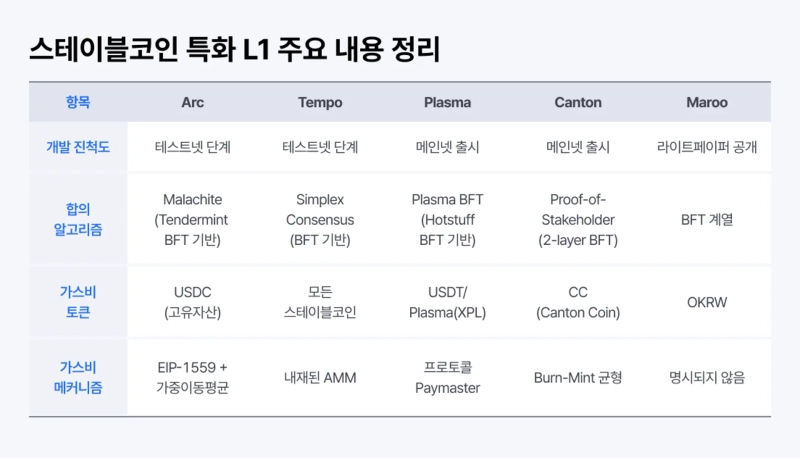
The Korbit Research Center said, "Recently launched stablecoin-specialized Layer 1s such as Arc, Tempo and Plasma are adopting fast finality, selective privacy and regulatory compliance, evolving into infrastructure better suited for institutional and corporate finance."
It cited an "infrastructure gap" as a key challenge for South Korea. The Korbit Research Center pointed out, "If Korea fails to proactively address selective privacy, regulatory compliance, fast payment finality, and gas-fee convenience in the process of introducing a won-denominated stablecoin, the possibility cannot be ruled out that the domestic on-chain financial infrastructure will become dependent on dollar stablecoin-specialized Layer 1s."
Kim Min-seung, head of Korbit Research Center, said, "Before stablecoin-based Layer 1s become established as the standard for global financial infrastructure, proactive responses are needed for won-denominated stablecoins and Korea’s domestic financial system," adding, "If a won-denominated stablecoin becomes dependent on dollar stablecoin-specialized Layer 1s, it could become an issue that must take financial sovereignty into account."

Bloomingbit Newsroom
news@bloomingbit.ioFor news reports, news@bloomingbit.io