Bitcoin breaks below $75,000… even ‘whales’ slip into negative territory
Summary
- Bitcoin fell below the $75,000 level and is down 13.91% year to date, with its underperformance versus other assets standing out, the report said.
- It said that growing odds of delayed rate cuts, a derivatives-centered trading structure, and forced selling made Bitcoin the first asset to be sold, amplifying the decline.
- It reported that the holdings of Strategy, the world’s largest corporate Bitcoin holder, have entered loss territory as the price fell below its average purchase price of $76,037.
Forecast Trend Report by Period


Crypto hit by a ‘Wash shock’
$250bn in market cap wiped out in two days
Growing odds rate cuts will be delayed
Bitcoin becomes the first asset to be sold
Futures trading outweighs spot
Forced selling floods the market, deepening losses
Strategy, the ‘largest holder,’ also takes a hit
No clear ‘upside signal’ either
Volatility likely to persist for now

Bitcoin plunged nearly 5% in a single day, briefly breaking below the $75,000 mark. Global cryptocurrency market capitalization has evaporated by $250 billion (about 360 trillion won) over the past two days. On the surface, the move was driven by the so-called “Wash shock,” after Kevin Warsh, a former U.S. central bank (Fed) governor seen as hawkish (favoring monetary tightening), was named as the next Fed chair. However, as Bitcoin has also shown signs of decoupling from not only gold, a safe haven, but also equities, a risk asset, some interpret this as fueling doubts about Bitcoin’s value as an asset.
◇Bitcoin’s weakness stands out
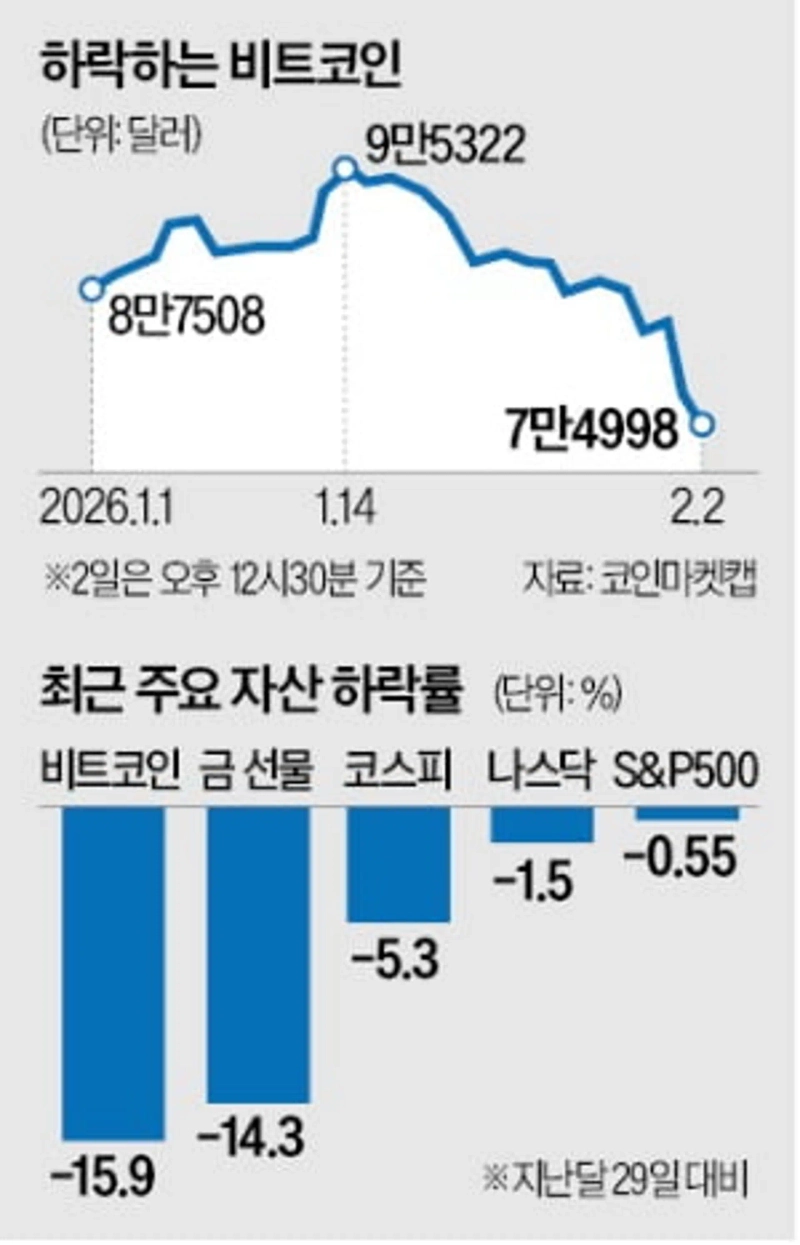
According to CoinMarketCap on the 2nd, Bitcoin was trading at $74,998 at around 12:30 p.m., down 4.67% from 24 hours earlier. This is the first time in about nine months since last April that Bitcoin has fallen below $75,000. In Korea, it posted 110,638,000 won, at one point threatening the 110 million won level.
Bitcoin is down 13.91% year to date. It remained weak even as gold prices (futures basis) hit a record high of $5,600 per troy ounce. Nor did it track equities, another risk asset. U.S. stocks such as the Nasdaq (0.97%) and the S&P 500 (1.17%) have been slightly lower on the year. Compared with the Kospi (15%), Bitcoin’s underperformance stands out even more. When the Wash shock was triggered, Bitcoin posted the steepest decline among major assets except silver.
◇High share of derivatives trading
The market is increasingly viewing Bitcoin as being caught simultaneously in three traps: the interest-rate environment, an asset limitation that stands out only in crisis phases, and a supply-demand structure centered on derivatives markets. On rates, Bitcoin is an asset that generates no interest just by being held. The longer rate cuts are delayed, the more investors shift toward bonds and equities that can provide interest or dividends. That is why, after the Wash shock, as markets began pricing in the possibility of delayed rate cuts, Bitcoin was interpreted as becoming the first asset to be sold.
Its asset limitation is also seen as coming into focus. In the past, during periods when geopolitical risks—such as the Silicon Valley Bank turmoil and the Israel–Hamas conflict—raised fears of broader financial-system instability, Bitcoin drew attention as “digital gold.” But the recent backdrop is less a financial crisis than a process in which markets are gauging direction for rates, FX, and the business cycle. This is why Bitcoin is failing to attract safe-haven demand.
Market structure is also cited as a factor that amplified the decline. In Bitcoin markets, trading in futures and other derivatives outweighs spot trading. Leveraged trading—borrowing to invest—is also prevalent. As a result, when prices fall below certain levels, forced selling to cap losses can hit the market all at once, widening the drop. In fact, once the $75,000 level gave way, short-term supply flooded in and the selloff quickly accelerated.
◇Strategy enters loss territory
As for the outlook, the dominant view is that volatility is likely to persist for the time being. With uncertainty over the timing of rate cuts unresolved, it is difficult to find a clear upside catalyst. In particular, given the derivatives-led trading structure, even if a rebound emerges, it may be limited to a technical bounce.
Meanwhile, Strategy, known as the world’s largest corporate holder of Bitcoin, is seen to have entered loss territory on its holdings following the recent decline. Strategy’s average purchase price is said to be around $76,037. The company has been buying Bitcoin since August 2020 and holds 712,647 coins. This is the first time Bitcoin’s price has fallen below Strategy’s average cost basis.
Reporter Cho Mi-hyun mwise@hankyung.com

Korea Economic Daily
hankyung@bloomingbit.ioThe Korea Economic Daily Global is a digital media where latest news on Korean companies, industries, and financial markets.