Screams erupted as the ‘5,000 KOSPI’ broke down… but an unexpected take: “Not a bad thing” [Analysis+]
Summary
- It reported that former Governor Kevin Warsh’s nomination as a Fed chair candidate fueled concerns over monetary tightening and triggered a sharp drop in the KOSPI and KOSDAQ.
- The brokerage industry said Warsh is not simply a hawkish figure, and noted his past calls for rate cuts, warning against excessive concern.
- Citing a KOSPI PER of 9.4x, upward revisions to semiconductor earnings, and valuation appeal, it said a buy-the-dip strategy remains valid if near-term volatility increases.
Forecast Trend Report by Period


Trump nominates ‘Warsh’ as candidate for next Fed chair
Global asset markets ‘shaken’ by assessments of a ‘hawkish’ pick
“Not simply a ‘hawk’… has also argued for rate cuts”
“Near-term volatility may rise, but the KOSPI remains a stable option”
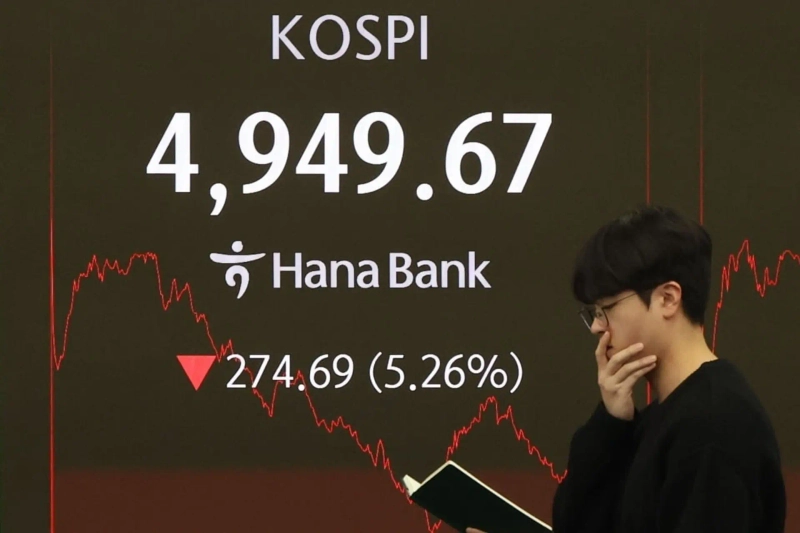
Investors are on edge after a pullback in South Korean equities on the 2nd, as concerns over renewed global monetary tightening were sparked by the nomination of a new U.S. central bank (Fed) chair. With local stocks having surged sharply in the short term versus major global indices, the downside could be steep as well. Both the KOSPI and KOSDAQ plunged intraday by as much as the 5% range.
Brokerages said short-term volatility could increase following the Fed chair nomination, but advised investors to respond with a buy-the-dip strategy given the KOSPI remains inexpensive relative to corporate earnings.
The KOSPI and KOSDAQ closed down 5.26% and 4.44%, respectively, from the previous session. The move is seen as stemming from U.S. President Donald Trump’s nomination on the 30th (local time) of former Fed Governor Kevin Warsh—widely classified as a “hawk” (favoring tighter monetary policy)—as the next Fed chair candidate.
The concern is that if Warsh begins his term in May, expectations for rate cuts may weaken, potentially draining liquidity from asset markets.
Indeed, after Trump nominated Warsh as the Fed chair candidate, global asset markets fell across the board over the weekend. On the 30th, the Nasdaq fell 0.94%, while the Standard & Poor’s (S&P) 500 and the Dow also slipped 0.43% and 0.36%, respectively.
Gold and silver, often seen as relative safe-haven assets, also declined. On the same day at the New York Mercantile Exchange, international gold prices plunged 11.38% in a single day, and silver prices tumbled 31.37%. Bitcoin also fell to the $70,000 level for the first time in nine months.
In contrast, the U.S. dollar surged. The won–dollar exchange rate ended daytime trading at 1,464.30 won, up 24.80 won. A major factor was a wave of selling by foreign investors. Foreign investors posted net sales of 3.2576 trillion won in the KOSPI cash market and 1.7783 trillion won in KOSPI200 futures—more than 5 trillion won in total.
The dollar index, which measures the greenback against six major currencies, also rose 0.75% from the previous day to 96.85, reflecting the risk-off tone.
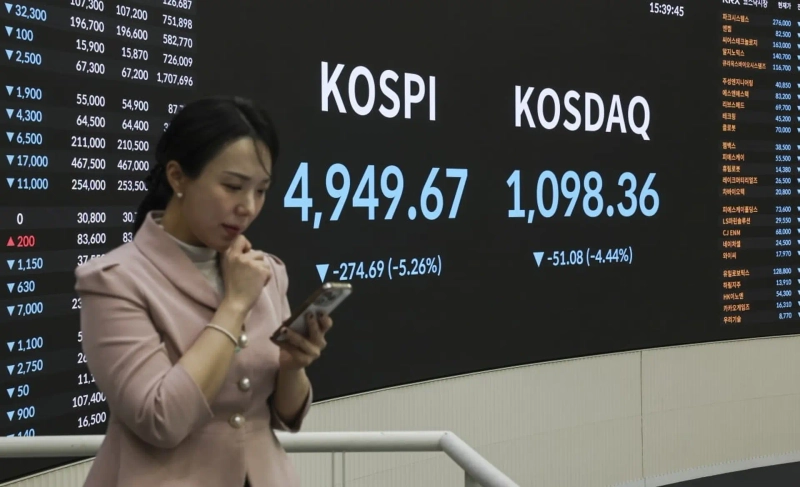
Still, brokerages are cautioning against excessive worries over Fed chair candidate Warsh.
Cho Byung-hyun, an analyst at Daol Investment & Securities, said, “He is clearly conservative on quantitative easing, but looking at the overall profile of the candidate, it’s hard to see him as simply a ‘hawk,’” adding, “He has also argued that productivity gains from artificial intelligence (AI) could drive disinflation across the economy and allow the policy rate to be kept lower.”
He added, “In a contribution last year, he criticized the Fed for always responding late and also argued that ‘30-year mortgage rates need to come down to a level households can afford, and to that end the Fed should carry out rate cuts,’” and said, “He also argued that if easing inflationary pressure through balance-sheet reduction is confirmed, rates can be kept lower.”
Lee Eun-taek, an analyst at KB Securities, also said, “Looking at what he argued in the past, he said, ‘In the end, inflation will be brought under control by technological innovation such as AI, so the Fed should support investment in technological innovation through rate cuts,’” adding, “If that is what Warsh means, the simultaneous emergence of stronger employment and stable prices is the best combination to spur ‘risk appetite,’ and it’s not something to react to as purely negative.”
Some also advised that while external factors could heighten the urge to take profits, investors should pay attention to buying on dips given the KOSPI’s earnings base remains solid.
Lee Jae-won, an analyst at Shinhan Securities, said, “As of the last trading day of last month, the KOSPI’s 12-month forward price-to-earnings ratio (PER) is only 9.4 times,” adding, “After SK hynix’s earnings release, semiconductor profit estimates have also been raised significantly, so the KOSPI still looks inexpensive.”
Jo A-in, an analyst at Samsung Securities, said, “With fatigue from the KOSPI’s rise accumulating, the Warsh nomination became a trigger for profit-taking,” adding, “Volatility may increase in the short term, but in terms of valuation (share-price level relative to earnings), it remains a stable option.”
Noh Jeong-dong, Hankyung.com reporter dong2@hankyung.com

Korea Economic Daily
hankyung@bloomingbit.ioThe Korea Economic Daily Global is a digital media where latest news on Korean companies, industries, and financial markets.