Won-dollar exchange rate also stabilises… closes at 1,445 won after an 18-won plunge
Summary
- The won-dollar exchange rate closed at 1,445.40 won, down 18.90 won from the previous day, indicating that the recent surge had eased.
- It said won volatility has increased recently, with the average daily trading range over the past seven sessions reaching 16.45 won.
- It said bond yields rose across the board and investor sentiment deteriorated sharply following Australia’s policy rate hike.
Forecast Trend Report by Period


Global risk aversion subsides
Bond yields, including government bonds, rise across the board
Risk appetite worsens after Australia’s policy rate hike
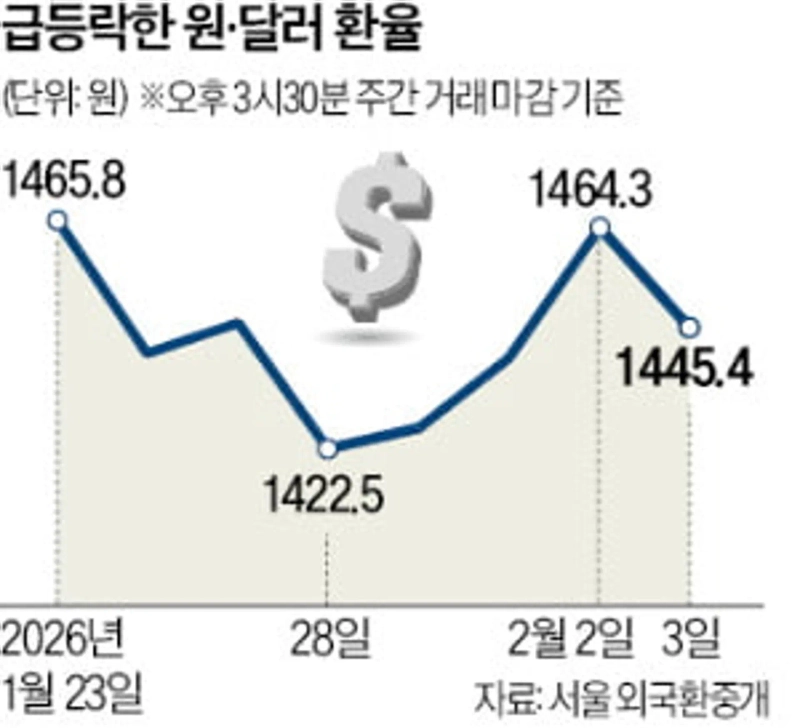
The sharp surge in the won-dollar exchange rate triggered by the nomination of former Fed Governor Kevin Warsh as the next chair of the US Federal Reserve eased after just one day. As global demand for risk-off positions cooled, a clear rebound reversal emerged. Bond yields rose sharply amid concerns over supply and demand and the impact of the Reserve Bank of Australia’s policy rate hike.
On the 3rd in the Seoul FX market, the won-dollar exchange rate (as of 3:30 p.m.) finished at 1,445.40 won, down 18.90 won from the previous day (a stronger won). It gave back most of the prior day’s rise (24.80 won).
As commentary emerged that concerns about nominee Warsh had been excessive, global risk aversion eased somewhat. Foreign investors provided support for the currency’s gains, net buying 716.4 billion won worth of shares on the KOSPI.
Recently, the won has shown large swings depending on global issues. Starting with a one-day drop of 25.20 won on the 26th of last month, when the possibility of coordinated yen intervention by the US and Japan rose, it fell into the 1,420-won range on the 28th after US President Donald Trump’s comments about a “weaker dollar.” However, a rebound began on the 30th as the prospect of Warsh’s nomination came into focus, and the exchange rate surged on the 2nd as the news was first reflected in the market.
Over the past seven sessions, the average daily trading range reached 16.45 won. That is the largest since about 10 months ago, when the average range over seven sessions from April 4 to 14 last year was 20.41 won.
Authorities also judge the recent sharp swings to be linked to global markets. Lee Hyung-il, first vice minister of the Ministry of Economy and Finance, said at a market monitoring meeting that “the won-dollar exchange rate has seen heightened volatility recently in line with flows in global financial markets.”
The Bank of Korea is closely watching the impact of FX volatility on inflation. After the January inflation rate was announced at 2.0%, BOK Deputy Governor Kim Woong said at the annual inflation monitoring meeting, “Volatility in international oil prices and the exchange rate has expanded significantly recently,” adding, “We will closely monitor the situation and plan to release our inflation outlook at the end of this month.”
Bond yields rose across the board (bond prices fell). In the Seoul bond market, the three-year Korea Treasury Bond yield closed at 3.189%, up 0.037% point from the previous day. The 10-year yield rose 0.058% point to 3.661%. The increases were larger at the long end, with the 20-year and 30-year yields up 0.072% point and 0.065% point, respectively.
Amid expectations that Korea and the US will maintain a policy-rate hold for the time being, investor sentiment deteriorated sharply after the Reserve Bank of Australia raised its policy rate for the first time in two years.
Reporter Kang Jin-kyu josep@hankyung.com

Korea Economic Daily
hankyung@bloomingbit.ioThe Korea Economic Daily Global is a digital media where latest news on Korean companies, industries, and financial markets.