PiCK
Did it crash because of Trump?…The 'real reason' Bitcoin collapsed [Hankyung Koala]
Summary
- It said the causes of the sharp drop in assets such as gold, silver, and Bitcoin lie in the structure of leverage and cascading liquidations.
- It said Binance’s 12% USDe interest campaign, the looping strategy, and so-called windmill spinning amplified systemic risk and large-scale liquidations.
- It said that, as in past cases such as Terra-Luna and stETH-ETH depegging, an excessive leverage bubble inevitably collapses, so investors must understand product structure and risk.
Forecast Trend Report by Period


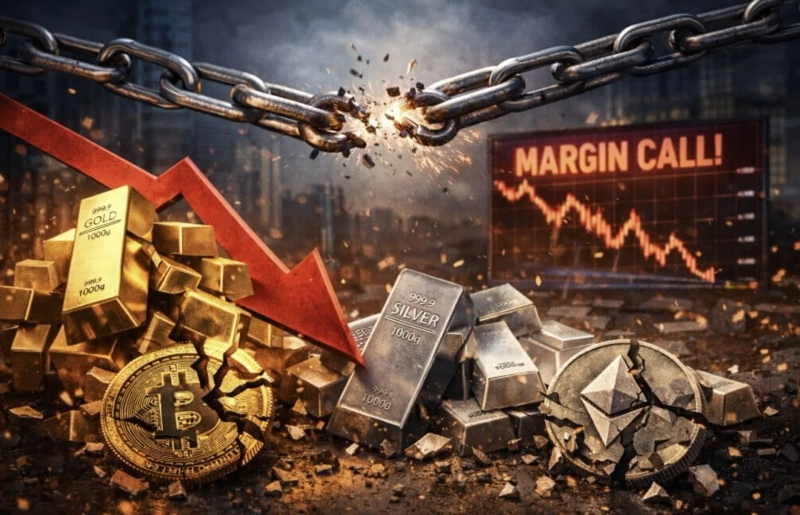
Over the course of 2025, gold prices rose 75% and silver surged as much as 145%. Silver, a key element for semiconductors and solar power generation, and gold, long believed by humanity to be an “immutable asset.” As these two precious metals posted dazzling gains, countless retail investors belatedly jumped into the market.
But in late January, silver plunged 30% in a single day, and gold fell 5%. As stunned investors looked on, a flood of analyses followed. News broke that former President Donald Trump had tapped Kevin Warsh as the next chair of the U.S. central bank (Fed), and the market read him as a “hawk.” Expectations spread that rate cuts would be delayed and a strong-dollar policy would continue. Experts said this was the cause of the sharp drop in precious metals. That analysis is correct. But is that really all.
If Kevin Warsh becomes Fed chair, would silver’s industrial value vanish by 30% in one day. Would demand from the semiconductor industry suddenly fall 30%. No. The problem was not silver’s value, but the layers of leverage piled on top of silver.
As silver prices climbed throughout 2025, investors used strategies that bet on further gains through high-leverage products such as the Chicago Mercantile Exchange (CME)’s Micro Silver Futures. In response, the CME repeatedly raised margin requirements for the product. The higher the margin, the more structurally fragile long positions became.
Then the small event of Trump’s nomination of Kevin Warsh became the trigger. As spot silver prices fell, heavily leveraged positions began to be liquidated in an instant. Margin calls poured in, and humans and algorithms sold silver at the same time. Prices fell further, liquidations continued, and it became a textbook feedback loop.
Similar scenes have already played out many times. On October 10 last year, when Trump declared he would impose 100% tariffs on China, Bitcoin plunged 15% in a single day and Ethereum fell 13%. Over 24 hours, $19.3 billion (about KRW 27 trillion) worth of crypto leverage was liquidated. Trump’s threatening remarks had been reversed multiple times before, and a U.S.-China tariff war has no direct connection to Bitcoin’s technical or social value. Yet the market collapsed.
Did Bitcoin’s intrinsic value drop 15% in one day because of Trump’s “caprice.” No. Then, too, the problem was leverage.
Xu Mingxing, founder of OKX—a rival to the world’s largest exchange, Binance—placed the blame for the plunge on Binance. He argued that Binance’s campaign offering USDe depositors 12% annual interest, and its decision to recognize USDe as collateral on par with USDT and USDC, was the trigger.
Investors swapped USDT and USDC into USDe to deposit it, used it as collateral to borrow USDT again, and repeated the same process—a “looping strategy,” so-called “windmill spinning.” Systemic risk grew rapidly. As Trump’s remarks increased market volatility, USDe slightly depegged, and that small price move triggered massive forced liquidations. Xu Mingxing pointed to Binance’s high-risk campaign as the core cause of the cascading liquidations.
The sharp Bitcoin drop from January 29 to February 4 was no different. There were multiple events—Warsh’s nomination, a plunge in Microsoft shares, a crash in gold and silver—but they are insufficient to explain a decline of nearly 20%. This is especially true because Sunday’s plunge occurred when U.S. equities and commodity markets were closed. In a market where spot liquidity had thinned, excessive leverage was liquidated in a cascade, pushing prices lower.
In retrospect, it was always the case. When U.S. rate hikes began in 2022, the crypto market was engulfed by cascading liquidations and the entire market collapsed. The Terra-Luna fiasco, too, was a tragedy created not only by the structural flaws of an algorithmic stablecoin but also by excessive leverage. The strategy of taking bLUNA using Luna as collateral, then borrowing Terra (UST) against it and repeating the same process—along with the “windmill spinning” centered on Anchor Protocol, which promised 20% annual returns—made the entire system fragile.
The depegging between Ethereum and staked Ether (stETH) was similar. Under the belief that stETH could be exchanged for ETH at any time, it was treated as virtually the same asset. But as a structure spread in which stETH was posted as collateral to borrow stablecoins and buy more ETH, a slight wobble in price caused layered leverage to collapse all at once. As a result, major investment firms such as 3AC and Celsius suffered multi-billion-dollar losses, which ultimately led to FTX’s bankruptcy. The cause was always the same. Leverage.
What is interesting is that gold and silver—said to have “immutable value”—collapsed through the same structure as Terra-Luna, which was “nothing but a bubble.” Even after the crash, silver’s industrial value did not change. The semiconductor and solar industries still need silver, supply is limited while demand is rising. China even controls silver exports at the national level. Yet silver prices fell more than 30% in a single day. Value did not collapse; leverage did.
When asset prices plunge and positions are liquidated in a cascade, people look for someone to blame. When coins crash, they call it a “scam”; when stocks crash, they blame management. Look at the crash in gold and silver through the same lens. What did gold and silver do wrong. These metals, which have existed on Earth longer than humanity, bear no guilt. What went wrong was not the assets, but risky financial products and a market that “jumped on board” while ignoring structural risks.
We live in an era when the value of labor income is falling and even opportunities to work are shrinking. Everyone wants to become a capitalist. Artificial intelligence speaks, and robots dance. Before long, AI agents will execute trades. Uncertainty about the future and volatility in assets can only grow.
Gold, silver, coins, stocks, futures, and options will all dance to uncertainty. The steep rises that surprise everyone may in fact be an illusion created by leverage. The larger a leverage bubble grows, the more surely it bursts. That much is certain. I hope every investor reading this will fully understand a product’s structure and risks before investing.
Kim Min-seung, head of Korbit Research Center, is...
A founding member and head of the Korbit Research Center. He works to explain complex events and concepts in the blockchain and digital-asset ecosystem in an accessible way, helping people with different perspectives understand one another. He has experience in blockchain project strategy planning and software development, among other areas.
▶This article is an externally contributed column introduced to provide diverse perspectives to cryptocurrency investment newsletter subscribers and does not represent the views of The Korea Economic Daily.

Korea Economic Daily
hankyung@bloomingbit.ioThe Korea Economic Daily Global is a digital media where latest news on Korean companies, industries, and financial markets.