Trump wields ‘tariffs’ to secure energy dominance… likely to demand a ‘package deal’ from South Korea
Summary
- The Trump administration is reportedly pressing South Korea to join a No. 1 energy project under the Korea-U.S. investment fund while simultaneously pushing for 25% tariffs on Korean goods and urging participation in the energy supply chain.
- South Korea faces a dilemma in choosing crude supply sources as long-term Middle Eastern crude contracts are financially advantageous, but it is caught between pressure to purchase U.S. energy and the risk of higher tariffs.
- Experts say that to fend off U.S. tariffs, South Korea needs a negotiation strategy that bundles issues into a package deal, including energy-supply-chain security and revisions to the nuclear cooperation agreement.
Forecast Trend Report by Period


Trump’s oil war
(3) Pressuring South Korea with 25% tariffs—does it relate to the oil war?
Tariff leverage expanding to new fronts
U.S. to make it the first project of the Korea-U.S. investment fund
Likely proposed an energy project to South Korea
Tariff pressure paired with demands to join the supply chain
Pressure to buy U.S. crude could intensify
Middle Eastern crude is more attractive financially, but
If U.S. oil is shunned, the tariff rate is hard to gauge
“Energy and security must be negotiated as a package”
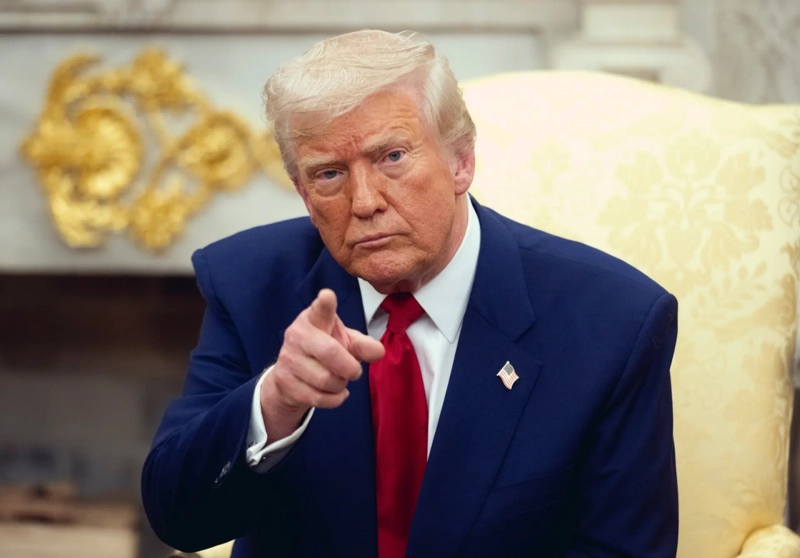
“My energy policy is maximum production, maximum prosperity, and the pursuit of maximum power.”
U.S. President Donald Trump said this in a proclamation last October designating the month as “National Energy Dominance Month.” The United States’ new National Security Strategy (NSS) also defines “energy dominance” as central to security. Amid this shift in Washington’s stance, tariff pressure is being used not merely to reduce the trade deficit but as a tool to strengthen U.S. energy dominance. Analysts say South Korea—now facing Trump’s push to raise tariffs again—may also be pressed to accept an energy-related package deal.
Is the shrouded ‘No. 1 U.S.-bound investment’ about energy?
According to relevant ministries on the 5th, the South Korean government has recently been told that the United States proposed an energy project as the first project under the Korea-U.S. investment fund. The view is that Washington is using delays in passing a special law on U.S.-bound investment as a pretext to threaten raising tariffs on Korean goods from 15% to 25%, while simultaneously demanding Seoul join a U.S.-led energy supply chain.
The government, however, is withholding details on the specific project. One official said, “The U.S. request is specific, but with procedures such as the bill’s passage still pending, it is difficult to definitively say what the ‘No. 1’ project will be.”
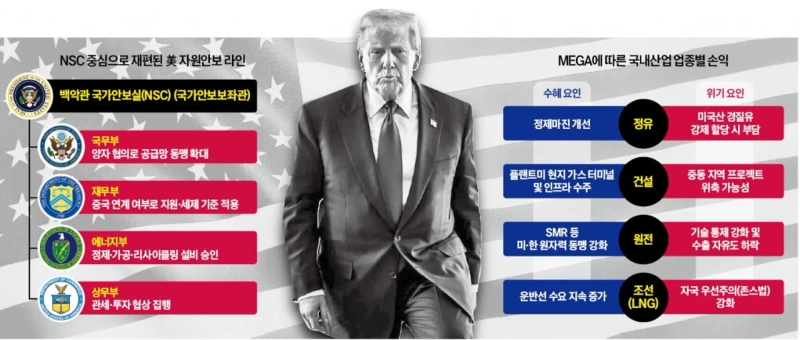
Last year, Trump issued executive orders such as “Unleashing American Energy” and “Declaring a National Energy Emergency,” designating 11 areas—including oil and gas, nuclear power, rare earths, and others—as “national energy sources.” Market participants cite potential candidates for the first project, including investment projects linked to purchases of U.S. energy, nuclear power, rare-earth mining and refining, blue hydrogen, transmission grids, and petrochemical plants (ECC). These are areas where South Korean companies, strong in manufacturing, could contribute.
However, Korea Zinc’s investment in a U.S. smelter is said to have been excluded from the shortlist for the first project because it is structured as a “private-sector investment.”
Heo Jeong, a professor in Sogang University’s Department of Economics, said, “Beyond citing ‘investment delays’ as justification, the United States is using tariffs as leverage to pressure across the full spectrum of investment and security,” adding, “It is highly likely that, on top of energy investment, it will also pressure non-tariff talks—such as agriculture and digital issues—by holding up ‘tariff hikes.’”
Another feature is that the United States’ weaponization of energy through tariffs has a transactional character, unlike the past petrodollar dominance. Jeong Haneul, head of the Institute for International Legal Order, said, “From the U.S. perspective, India serves as a South Asian partner for ‘pressure on China,’ but South Korea’s strategic importance is different.” The implication is that South Korea may be more vulnerable to U.S. energy pressure.
South Korea’s dilemma: ‘diversification or U.S. supply’
Some analysts say that as the United States increases crude output, pressure to buy U.S. energy will only grow. Ahead of tariff negotiations last year, the Ministry of Trade, Industry and Energy replaced 6 million barrels of stockpiled Middle Eastern crude with U.S. light crude to preempt pressure to reduce South Korea’s trade surplus with the United States (USD 55.7 billion as of 2024).
The United States appears poised to go further, presenting a bigger bill by calling for participation in projects such as Alaska. In South Korea, some voices have even emerged arguing that participation in the Alaska project should be expedited for “energy security.”
South Korea faces a dilemma between diversifying crude supply sources and increasing imports from the United States. Financially, “long-term contracts for Middle Eastern crude” are the most advantageous. Kim Yeon-gyu, a professor in Hanyang University’s Division of International Studies, said, “The geopolitical landscape for oil and gas is shifting toward a U.S.-centered structure,” adding, “For South Korea it is advantageous to weigh Canadian, Russian, and Middle Eastern supplies, but doing so would make it hard to gauge how high the tariff rate could rise.”
An analysis also notes that while South Korean companies wanted to bring in at least some cheaper Russian supplies, it has become impossible given the trajectory of U.S.-India ‘tariff-energy deals.’
Experts say South Korea must go beyond negotiations aimed at simply preventing piecemeal tariff hikes and instead craft a strategy linked to energy-supply-chain security. Cho Hong-jong, a professor in Dankook University’s Department of Economics, advised, “Rather than stopping at simply ‘buying’ energy, we should bundle our cards and demands—such as revising the nuclear cooperation agreement—into a package and negotiate.”
Reported by Kim Dae-hoon / Ha Ji-eun / Kim Ri-an daepun@hankyung.com

Korea Economic Daily
hankyung@bloomingbit.ioThe Korea Economic Daily Global is a digital media where latest news on Korean companies, industries, and financial markets.